
ARGENTINA. – Federal Republic of South America.
SUMMARY:
I. Geography
II. History of Christianity –III. History of relations between Church and State
IV. Educational system
V. Art.1. GEOGRAPHY
A., independent since 1816, has been a federal Republic since 1853, comprising 14 autonomous Provincias (with a Governor, a Parliament, and its own elected authorities), 10 Gobernaciones (or Territorios nacionales) administered by officials appointed every three years by the Central Government, and a Distrito federal, comprising the capital. The territory covers 2.8 million sq. km. (nine times the size of Italy), with a population of 16.1 million inhabitants (5.9 per sq. km.). A. is therefore one of the largest States in the world, but its population still only slightly exceeds that of small Czechoslovakia.With a latitudinal extent of 33°, A. displays very different soil and climatic conditions from one zone to another. On the whole, one may distinguish: to the N., the southern Chaco, partly steppe (pastureland), partly scrubland (quebracho), with a semi-arid tropical climate, which toward the E. gives way to increasingly humid areas (Misiones and the Argentine Mesopotamia between the Paraná and Uruguay); the terraced high plateaus (mesetas) of Patagonia S. of the Río Colorado, steppe-covered and desolate, with similarly semi-arid but cold or even subpolar climates (Tierra del Fuego); and—between the two regions—the Pampa, flat and grassy in the E., drier and interspersed with elevations in the W. (western Pampa), with a more temperate climate and less scant rainfall, especially in the E., and therefore better suited to agriculture. Finally, A. includes the E. slope of the Chilean Andes, which in the N. comprises part of the desolate intermontane high plateaus (Puna) and is flanked, like stage wings, by longitudinal sierras enclosing more or less extensive areas of pampa.
Slightly more than one-fourth of the territory (27%) is covered by forests; elsewhere the steppe reigns supreme, with only 10% converted into cultivated land. Cereals (wheat, maize, rice, oats), seed flax (eastern Pampa), vines (Mendoza), sugar cane, and cotton (Tucumán) predominate among these crops. After agriculture, livestock raising constitutes the country’s principal wealth (in millions of head: 34 cattle, 56 sheep and goats, 7.5 horses; 8 pigs).
The most efficient industries are linked to both these activities; besides eliminating A.’s dependence on foreign countries for certain manufactured goods (woollens, cotton goods, footwear), they generate an increasingly substantial export trade (flour, meat, dairy products). Exploitation of mineral resources (lead, tin, manganese, tungsten) is still in its early stages; oil production, obtained chiefly from Chubut (3 million tons), is promising.
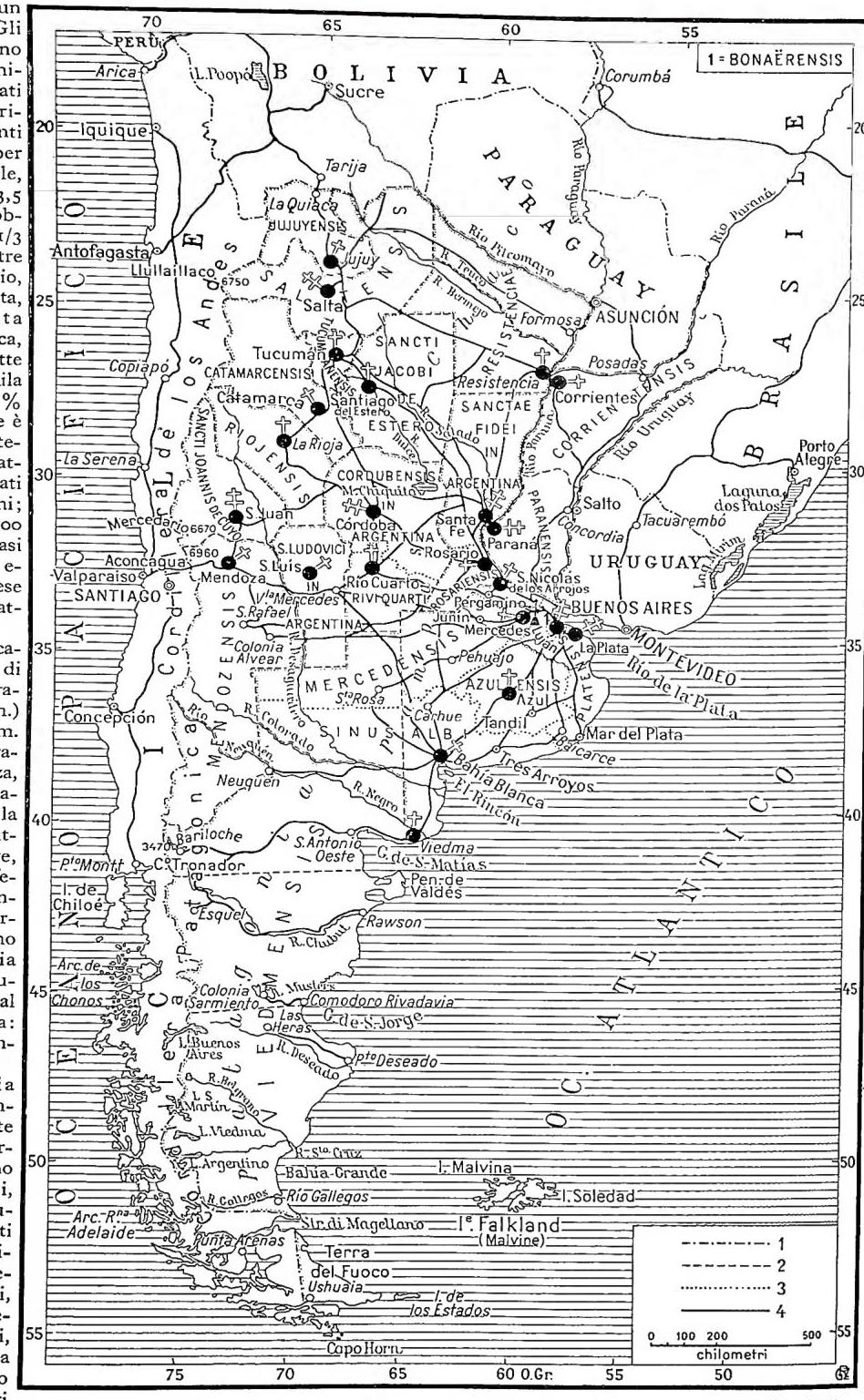
Communications rely on an extensive road network (250,000 km.) and 42,800 km. of railways which, in essence, radiate from the central Atlantic region toward the pampa, but are rather sparse elsewhere and hampered by differences in track gauge. Two intercontinental lines link A. with Bolivia (Buenos Aires–Tucumán–La Paz) and Chile (Trans-Andean: Buenos Aires–Mendoza–Valparaiso).
Argentina’s trade balance is strongly positive. Imports consist chiefly (by value) of textiles, fuels, lubricants, iron goods, machinery, etc.; exports chiefly of cereals, meat, flax (seed), wool, hides, etc. Great Britain and the United States are the principal suppliers and purchasers.
ARGENTINA - 1) State boundary. 2) Provincial boundary. 3) Ecclesiastical circumscriptions. 4) Railways.
| Province | Area in sq. km | Population, 1947 census | Dioceses | Capitals (population in thousands) |
|---|---|---|---|---|
| Buenos Aires | 306.830 | 4.408.373 | 14 | La Plata (260) |
| Distrito Fed. | 186 | 3.000.371 | — | Buenos Aires (3000) |
| Santa Fe | 134.827 | 1.700.026 | 13 | Santa Fé (150) |
| Córdoba | 168.152 | 1.455.222 | 9 | Córdoba (285) |
| San Luis | 76.923 | 167.620 | 2 | San Luis (40) |
| Santiago del Estero | 138.439 | 538.383 | 4 | Santiago d. E. (70) |
| Entre Ríos | 78.330 | 776.280 | 10 | Paraná (75) |
| Corrientes | 88.901 | 570.967 | 6 | Corrientes (68) |
| Jujuy | 43.267 | 166.783 | 4 | Jujuy (20) |
| Salta | 126.577 | 290.063 | 2 | Salta (43) |
| Tucumán | 22.836 | 604.526 | 27 | Tucumán (165) |
| Catamarca | 78.162 | 145.116 | 2 | Catamarca (23) |
| La Rioja | 86.492 | 109.386 | 1 | La Rioja (15) |
| San Juan | 89.179 | 260.714 | 3 | San Juan (36) |
| Mendoza | 148.783 | 590.548 | 4 | Mendoza (110) |
| Governments | ||||
| Chaco | 98.238 | 443.922 | 5 | Resistencia (50) |
| Formosa | 75.480 | 112.056 | 2 | Formosa (19) |
| Misiones | 30.431 | 244.123 | 8 | Posadas (38) |
| Pampa | 144.183 | 167.562 | 1 | S. Rosa (14) |
| Neuquén | 96.464 | 85.601 | 1 | Neuquén (10) |
| Río Negro | 201.010 | 132.419 | 1 | Viedma (9) |
| Chubut | 225.723 | 53.986 | 0,2 | Rawson (3) |
| S. Cruz | 243.336 | 24.651 | 0,1 | Gallegos (7) |
| Tierra del Fuego | 21.610 | 4.902 | 0,2 | Ushuaia (1) |
| Los Andes (abolished) | 72.755 | — | — | — |
| TOTAL | 2.797.114 | 16.053.600 | 6 |
II. HISTORY OF CHRISTIANITY
The history of A. comprises two periods: the first, from colonization in the 16th century until 1816, and the second, from 1816 to the present day, characterized by emancipation and life as an autonomous nation. In the first period, three epochs are to be distinguished, according to the government established by Spain: 1) the epoch of the conquerors (adelantados) from 1536 to 1591, during which the missionaries arrived and undertook the conversion of the indigenous peoples; 2) the epoch of the governors from 1590 to 1776, during which the fruits of the conquest were consolidated and the missionaries undertook the work of Christian culture in the centers and indigenous colonies; 3) the epoch of the viceroyalty (1776-1816), initiated by Carlo III, during which commerce and industry intensified and urban centers multiplied.The republican period (1816-43) likewise falls into two epochs: that of emancipation and autonomous reorganization (1816-1900), and the later period of immigration and commercial development (1900-43), which led to the progressive elimination of party prejudices and removed disintegrating tendencies (federalism), while the people acquired an awareness of Christian cultural unity.
First period (16th century - beginning of the 19th century). — During the period of colonization under the conquerors (1536-1591), the first missionaries arrived. The first expeditions of Giovanni Diaz de Solís (8 October 1515), Hernando de Magallanes (1519-21), and Sebastiano Caboto (1526-30) were the prelude to the conquest and evangelization. With the first «adelantado» appointed by Carlo V, don Pietro de Mendoza, the first contingent of priests and religious arrived in 1536, and on 2 February the great South American metropolis of Porto de Nuestra Señora del Buen Aire was founded. Franciscans, Jesuits, Dominicans, and Mercedarians, in accordance with the aims of their individual institutes, contributed effectively to the rapid evangelization. With the expedition of Alfonso Cabrera, five or six Franciscans arrived in 1538, three of whom became the first bishops of A. New groups of missionaries arrived in 1554, 1572, 1589, and 1592. The true conqueror was the «adelantado» Martínez de Irala, appointed in 1555. Irala did not recognize the governor appointed by Spain, Alvar Nuñez Cabeza de Vaca, and through his soldiers and his energy succeeded in winning the esteem of the government of the Peninsula, which confirmed him in the office of governor. During his government, the cities of Tucumán, Córdoba, and Santa Fe were founded, and in 1580 the city of Buenos Aires was refounded. In his explorations, Irala reached as far as the cordilleras of the Andes and introduced the first specimens of livestock. Meanwhile, the missionaries worked to pacify the Indians.
During the period of the governors (1591-1776), the fruits of the first labors were gathered, and in the cities, which had developed with populations of Creoles and mestizos, the Colegio Máximo, the Colegio de Montserrat of Córdoba, the Colegio Grande and the Colegio de Belén in Buenos Aires, and the colleges of Corrientes, Santa Fe, Rioja, Salta, Tucumán, Santiago del Estero, and Mendoza were opened. Under Gregory XV (1621), the college of Córdoba obtained the right to confer degrees in theology. In 1610 the first indigenous colonies (reducciones) were established; they had a system inspired by Christian equality, liberty, and fraternity, before human rights were proclaimed by the Virginia Statute (1776) and the French Revolution (1789). The colonies found unjust enemies for economic reasons. In 1767 they comprised 88,884 persons. The Jesuits opened the first printing press in 1700. In 1776 Charles III established the viceroyalty of the Río de la Plata, with Buenos Aires as its capital. This viceroyalty comprised, in addition to A., Uruguay, Paraguay, and Bolivia; in 1782 it was divided into eight intendancies.
Setting aside the conflicts of ecclesiastical and civil jurisdiction and the expulsion of the Society of Jesus, A. owes its harmonious cultural and economic development to the generous and Christian action of the Spanish government, to the wise colonial legislation that recognized the dignity of the human person, and to the ethnic element imported from the peninsula.
Second period (1816-1948). - During the first era (1816-1900), emancipation was achieved, in which the national clergy also took an active part; of the 29 members of the Congress of Tucumán (1816) who signed the act of independence, 16 were ecclesiastics. In the organization of the autonomous nation there was a period of internal wars and political disturbances caused by the two parties: the Unitarians (aristocrats) and the Federals (landowners). After the presidency of Rodriguez (1821-24), General Las Heras succeeded him. In 1825 a Constituent Assembly approved the « fundamental law », which established that the provinces were to be governed by their own institutions; but soon afterward Congress abolished the provincial regime, and President Rivadavia initiated a government of Unitarian tendency that irritated the « caudillos », reigniting the civil war. The struggles between Unitarians and Federalists continued until the dictatorship of the Federalist Rosas (1829), who exercised an exclusionary government against the Unitarians until 1852. In 1853 the Constituent Assembly sanctioned the present statute, but full national unification was not achieved until 1861, when Buenos Aires became the capital of the Republic. In 1862 Mitre, who favored Italian immigration and cultural intensification, was elected president. Faustino Sarmiento (1868), Avellaneda (1874), Giulio Roca (1880), and Juárez Celmán (1886) governed amid alternating periods of peace and disturbance. In the latter part of the nineteenth century and at the beginning of the twentieth, a powerful impetus was given to the spread of culture, partly with a liberal and positivist tendency. Numerous pedagogical and economic reforms were implemented; the method of historiography was renewed; universities, schools, and academies were founded; libraries were opened; and journalism thereafter occupied a prominent place, together with cultural journals. After national consolidation (1853), immigration achieved extraordinary success; from 1857 to 1925, 2,659,568 Italians entered A., many of whom contributed to agricultural and commercial development, improving economic conditions through the exploration of mines, the export of wheat, and livestock raising. Scientific development from 1854 onward had several foreign practitioners, many of them Italian. The Church is today excellently represented by the clergy and religious communities, which promote education and charitable works. More than 70 male and 110 female educational institutions are found in Buenos Aires alone under Catholic direction. The Catholic press has more than 50 periodical publications.
There are 7 metropolitan sees (Buenos Aires, Córdoba, La Plata, Paraná, Salta, S. Giovanni di Cuyo, S. Fe) and 16 episcopal sees.
III. HISTORY OF RELATIONS BETWEEN CHURCH AND STATE
From the earliest beginnings of Argentine independence (the Assembly of 1813), the intention of the new government to establish stable relations with the Holy See became manifest. The desire was expressed again at the Congress of Tucumán in 1817 and at the first Constituent Assembly in 1824. But no concrete negotiations ensued.Of capital importance in the history of relations between the Church and the Argentine State is the year 1834, when Pedro J. Agrelo, procurator of the Republic, issued his « Memorial ajustado » (Buenos Aires, 1886): a draft concordat to be proposed to the Holy See, completely imbued with regalism. In this climate (a concordat-oriented tendency and regalism), the constitution of 1853, which is still in force, was enacted.
It explicitly mentioned the concordat and recommended it to Parliament (art. 67, para. 19) and to the executive power (art. 86, para. 14). Consequently, negotiations were begun at once. During the year
1854 an Argentine agent had several contacts with Cardinal Antonelli and even received from him a draft concordat that he had proposed, but the matter led nowhere. The missions of Juan Bautista Alberdi (1857) and Juan del Campillo (1858) likewise failed. The last official attempt was that of 1884, after a long period of near-hostility (the Vicente Quesada mission); like all the preceding attempts, it failed because of the Argentine government’s firm intention to preserve the regalistic content of the constitution.
The Argentine constitution, in fact, although it recognizes the Catholic religion as the religion of the State and, as such, supports it (art. 2), nevertheless reserves to Parliament and the president of the republic the right of patronage (art. 67, para. 19; art. 86, para. 8) and the exequatur for pontifical acts of a general and permanent nature (art. 86, para. 9). By virtue of the exequatur, in 1925 the Supreme Court of Justice denied the juridical validity of the Code of Canon Law, declaring valid within the territory of the State only the laws of the Council of Trent. It is precisely this set of advantageous rights that has thus far prevented the conclusion of a concordat between the A. and the Holy See.
Apart from the concordat question, however, relations between Church and State are rather cordial and are maintained through normal diplomatic relations.
IV. SCHOOL SYSTEM
In 1936, the Council of Public Education of A. established the unity, coordination, and correlation of studies, since freedom of teaching and freedom to choose the subjects to be taught had led to chaos in the education of the young. The school is divided into primary, secondary, and university education. Primary education is private, though partly subsidized by the central government and by the provincial governments; it is secular and compulsory from the ages of 5 to 13. Priority is given to the teaching of reading, writing, and mathematics, which are taught for two hours a day. History, geography, natural history, civics, urbanity, and morals must be divided among the other two hours. Religion is excluded from the school so as not to destroy its secular character and is replaced by moral instruction given by teachers rather than by religious personnel. Children from 5 to 10 years of age are taught morality in narrative form, while boys from 10 to 13 are instructed in their duties toward men, the family, and God. In rural areas, primary education must enable the child to learn how to exploit the land intensively; for this purpose, Honey Days, Tree Day, and Forest Day have been established. To facilitate the task of primary schools, there are 2,286 supporting associations composed of former pupils and military personnel. These associations must look after the material and moral interests of the 1,348 primary schools and of the child, who is given every kind of assistance, including during the holidays through the establishment of summer colonies. Medical examinations are regular and free of charge. Secondary education is provided in 86 normal schools and 47 national colleges. The duration of the normal school is two years when it prepares instructors for rural areas, 4 years when it prepares teachers for ordinary primary schools, and 7 years when it prepares professors for normal schools. The national college lasts 5 years (6 years in Buenos Aires) and prepares pupils for the following universities: Córdoba (1628), Buenos Aires (1821), La Plata (1897), Tucumán (1912), Santa Fe (1889), Litorale (1920). To increase fruit and vegetable production, schools of agriculture have been established at Casilda, Bell-Ville, Córdoba, and Olavarría, as well as the school of fruit growing and ethnology at San Juan. Religious instruction is excluded from all these schools, where Verheyen’s psychology is followed.V. ARTE
When the first nucleus of colonists who were to give rise to the Argentine nation landed in 1512 on the shores of the Rio de la Plata, it came into contact with indigenous peoples whose civilization may be defined as Neolithic and who—with the exception of the Daguiti—had no artistic tradition. Argentine art therefore developed as a projection of European art.The activity of the Jesuit fathers, moreover, brought about a fusion of the artist, whether Indian or European, with the environment in which he lived and created the premise for the development of an original artistic expression. These premises may be regarded as documented by the only work attributed to the legendary figure of José l'Indio, Jesus of Humility and Patience, located in the church of N. S. della Mercede in Buenos Aires and dated 1780; but they may be demonstrated even more clearly by the famous portals of the ruined church of S. Ignazio Miní, on the banks of the Paraná. These developments of an incipient artistic expression were, however, stifled when the Society of Jesus was expelled from the Rio de la Plata, an expulsion ordered by Governor Bucarelli under Charles III.
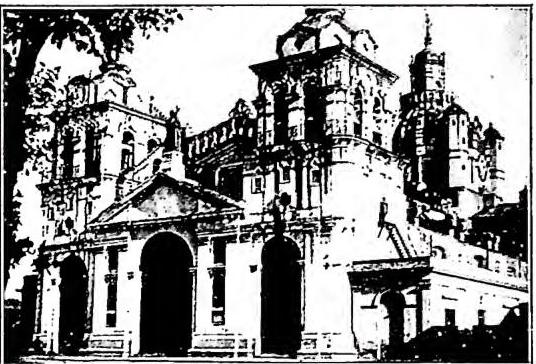
The first important architectural works carried out in the style inspired by the church of the Gesù in Rome are also owed to the Society of Jesus, and especially to the Italians Giambattista Primoli (1673–1747) and Andrea Gianchi (d. 1740), who also constructed civil buildings; the Municipal Palace of Buenos Aires, for example, was built according to plans by Primoli. The Baroque, too, was widely applied; this style is still in use today, especially outside the capital.
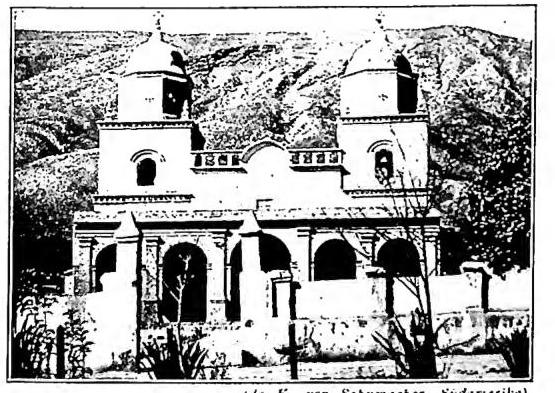
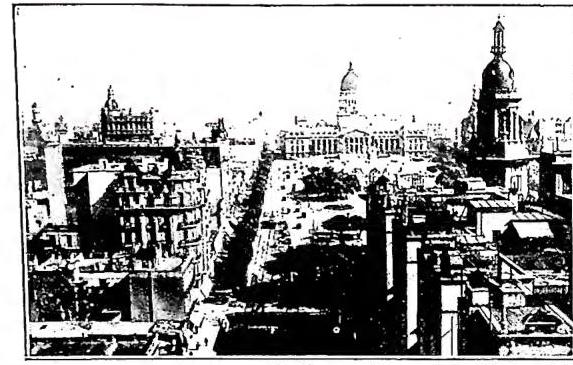
Beginning in the second half of the nineteenth century, the architectural forms then prevailing were overlaid by the influence of the Italian neoclassical movements, which were followed by the French through the personal work of an architect, d. Alessandro Christopherseu, whose principles predominated until the advent of so-called functional architecture, extensively implemented from 1892 onward (A. Virassoro); nevertheless, one cannot overlook the well-known success that the Georgian and Tudor styles enjoyed during this period, particularly in the capital (especially from 1890, through the work of Stanislao Pirovano), nor the constructions in the national styles of the various immigrant groups. Also noteworthy are the developments of the colonial style, still bearing an Andalusian character, due to Martin S. Noël (1888). The leading artists were educated abroad, since it was only in 1901 that a School of Architecture was founded in Buenos Aires.
Sculpture and painting, which were chiefly concerned with portraiture and costume, developed in periods marked by differing characteristics: the first period has been called that of the Precursors and is characterized by the transition from the external observation of facts to a more intimate appreciation of man and his environment. The principal painter was Prilidiano Pueyrredón (b. 24 January 1823, d. 3 November 1870); at the same time, Italian artists worked successfully, among them Carlo Enrico Pellegrini, Lorenzo Fiorini, Ignazio Mausoni, and Baldassarre Verassi. The second period, which saw the foundation of the Association for the Advancement of the Fine Arts, the National Museum, and the Academy, and during which the organization of the annual Exhibition Salon took shape, is known as that of the Organizers.
Rich in artists, ranging from Eduardo Sivori (b. 1847) to Ernesto de la Carcova (b. 1866, d. 1927), this is the period in which the character of Argentine art was formed, assimilating and developing the European currents on an independent plane. This period culminated in the Nexus, which, especially in painting, sought to enhance Argentine art by bringing it into more direct accord than in previous periods with the feeling and modes of the age. This tendency, already initiated by Pio Colliavino (b. 1869 in Buenos Aires of Italian parentage and trained in Italy under Sivori), with the participation of the painters Justo Lynch, Carlos P. Ripamonte, Alberto M. Rossi, Cesareo, Bernardo de Quiros, Fernando Fader, and the sculptor Arturo Dresco, closes the historical account of Argentine art and gives rise to the present period, in which the avant-garde movements common to the nations of Europe and North America are decisively followed.
Giorgio Luigi Bernucci
For the literature of A. vedi: ISPANO-AMERICANA, LETTERATURA.