
CIBORIO. — From the Greek κιβώριον, also called fastigium, tegurium, and in the Middle Ages tiburium. It was an arched covering supported by four columns, which the Romans used to protect statues, altars, fountains, and tombs; in Syria, too, such structures were placed as protection over tombs. G. B. De Rossi holds that, precisely because the altar, according to the concept inspired by the visions of the Apocalypse and in accordance with liturgical prescriptions, is a table arranged above Christ’s tomb, Christian architecture adopted this system, already in use for protecting isolated tombs (G. B. De Rossi, Roma sotterranea, III, Rome 1877, p. 437).
Indeed, the architectural type is found not only on Roman cippi and bas-reliefs but also in Christian underground cemeteries: it is found once in Rome (the cemetery ad duas lauros), several times in Naples and Syracuse, and very often in Malta. In the Lateran Museum, the inscription of Adeodata depicts a c. with the cross at the center (O. Marucchi, I monumenti del Museo Pio Lateranense, Milan 1910). The biography of Silvester in the Lib. Pont. (ed. Duchesne, I, Paris 1886, p. 172) contains a description of the fastigium argenteum of the Lateran basilica; on one side it had the Savior seated in a cathedra among the twelve Apostles, and on the other the Savior enthroned among four angels; it weighed 2025 pounds of silver. Rohault de Fleury attempted a reconstruction of it (La Messe, II, p. 3 and pl. 90). This c. was stolen by Alaric and replaced under Sixtus III by the emperor Valentinian with another, also of silver (Lib. Pont., I, p. 233). Preserved to this day in the basilica of S. Clemente are remains of the ancient marble c. donated by the presbyter Mercurius (later Giovanni II) during the pontificate of Pope Hormisdas (514–23).
A c. is represented in the mosaics of S. Maria Maggiore. On the marble c. of the basilica of the SS. Nereo, Achilleo e Petronilla in the cemetery of Domitilla, the martyrdom of the two Saints was represented on two columns; one of the surviving columns shows the scene of the martyrdom of Achilleo (O. Marucchi, Roma sotterranea, I, II, Rome 1914, p. 174, fig. 40, and reconstruction on p. 149, fig. 49).
In general, however, in the Roman basilicas the columns supporting the c. were of red porphyry; it was generally furnished with vela, which are often mentioned in the Lib. Pont. among the donations made by the popes to individual basilicas, sometimes called tetravela because of the four sides.
G. B. De Rossi has illustrated the remains of two African c.: Arco d'un c. presso Mediana Zabuniorum, in Bull. d'arch. crist., 3rd series, 3 (1878), pp. 115–177; id., Arco marmoreo di tabernacolo rinvenuto nella Mauretania adorno dell'immagine di Daniele fra i leoni e di altri simboli cristiani, ibid., 5th series, 2 (1891), pp. 67–72, 138. Enrico Josi
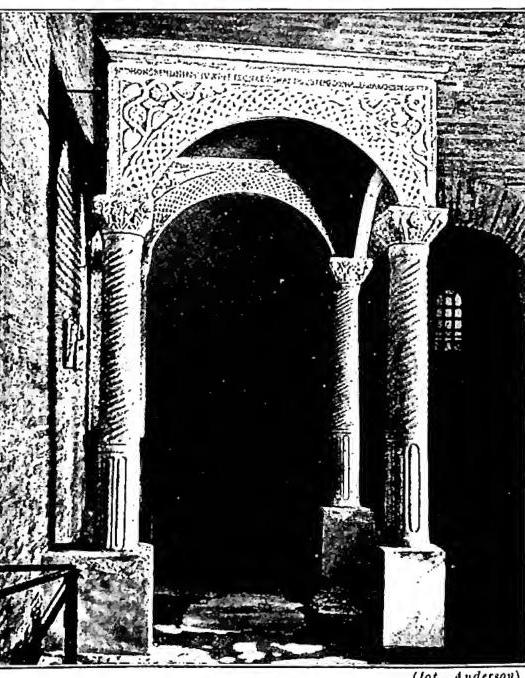
(Anderson photograph)
CIBORIO – Ciborium for the altar of s. Eleucadius, erected by a priest named Pietro at the beginning of the 9th century – Ravenna, church of S. Apollinare in Classe.
of an Ursus Magester cum discipolis suis Iuwintino et Iuwiono. Not dissimilar characteristics are displayed by some remains of ciboria in the Christian Museum of Brescia and in S. Maria in Valle at Cividale, and by the ciborium, still intact with its four columns surmounted by Corinthian capitals, its arches worked in relief, and its pyramidal covering on a polygonal base, which stood in S. Prospero at Perugia and is now in that city’s Archaeological Museum. Similar characteristics are also found in some remains of ciboria from the parish church of Bagnacavallo, in the ciborium of S. Apollinare in Classe at Ravenna, from the time of Bishop Valerio (896–910), and in the other one that still covers the altar of the Miracle in S. Cristina at Bolsena; the latter, however, may, judging from the character of its reliefs, belong to the 10th century.
In the Romanesque period, ciboria acquire greater grandeur and more exact proportions in the organization and general distribution of their architectural elements, also in relation to their surroundings. Worth mentioning is the ciborium of S. Pietro at Tuscania, extremely simple, with masonry arches and surmounted by a square pyramidal covering, adorned on its terminal cornice with a clear inscription referring to the consecration of the altar, which took place in 1093; and the beautiful one in S. Ambrogio at Milan, with magnificent stucco reliefs that some scholars have thought they could attribute to the 9th century. The latter served as the model for the one in S. Pietro al Monte at Civate. The ciborium of S. Marco in Venice, supported by four historiated columns dating from the 6th century, and that of the cathedral of Poreč also belong to the 12th century. They reflect Byzantine forms, especially in their coverings.
Meanwhile, while in Abruzzo a type of ciborium was spreading, almost a distant echo of Eastern influences, with lobed arches (S. Clemente at Casauria), according to a somewhat provincial taste that was also adopted in the upper Lazio (S. Maria Maggiore at Tuscania), in Rome a type of ciborium developed in which the columns, sometimes made of rare marbles, were joined by architraves rather than arches, and upon them the roof or pyramid-shaped covering was set on rows of small columns. Notable examples are found in S. Clemente, S. Giorgio in Velabro, and S. Lorenzo fuori le Mura, as well as in the minor centers of Lazio where the Roman marble workers’ activity extended.
And it was in Rome, toward the end of the 13th century, that Arnolfo di Cambio created at S. Paolo (1285) and S. Cecilia in Trastevere (1293) two ciboria that must be numbered among the masterpieces of Italian art, both for the elegance of their lines, by then Gothic, and for the vigor and beauty of their sculptures, which assume a position of prominence. The Arnolfian models were immediately imitated; Deodato echoed their type in S. Maria in Cosmedin (1294), and they were still considered with interest, though without grasping their sense of exquisite elegance, by that Giovanni di Stefano to whom Urban V entrusted, after the fire of 1361, the cumbersome ciborium of S. Giovanni in Laterano.
When it was being erected in the cathedral of Rome, Andrea Orcagna had already, a few years earlier, completed in Orsanmichele in Florence a ciborium (1349–59) that may be regarded as a masterpiece more of Florentine craftsmanship than of art. Entirely inlaid with polychrome marble, overloaded with ornaments, carvings, and openwork, studded with mosaics and surmounted by a strange ovoid cupola, which appears between two piers beyond a cusp lacking in vertical thrust, it has round arches; and because of a certain deliberate heaviness, it could be understood in Florence as an almost polemical assertion in opposition to the soaring forms of the Gothic style so dear to Sienese and Pisan artists.
With the work of Andrea Orcagna and Giovanni di Stefano, the ciborium had assumed the character of a true architectural work, inserted within the church’s clearly defined and enclosed space. An architecture within another architecture, and therefore difficult to harmonize with the taste and spatial sensibility of Renaissance men. Thus the Michelozzian ciboria of SS. Annunziata and Impruneta and the other similar examples do not possess the proper character of ciboria, since they are not isolated but placed against walls. But in the second half of the 16th century the practice returned of creating ciboria that were genuinely sanctuaries erected within the church; they were conceived and executed with architectural taste, made precious above all by the richness of their materials and their technical refinement. Characteristic examples are the one in the Roman church of S. Alessio, dating from 1382; the beautiful and well-designed one, also in relation to its surroundings, in the basilica of S. Agnese, which has four precious porphyry columns and dates from 1614; and the other in the church of S. Crisogono, supported by four precious alabaster columns, from the period when G. B. Soria, commissioned by Cardinal Scipione Borghese (1623), was remodeling the ancient church in Trastevere.
The other ciboria that between the 16th and 17th centuries established themselves with their commanding structures in the middle of churches must be considered along the same lines; first among them is that of the Florentine church of S. Spirito: an exceedingly rich and monumental work, but disharmonious in relation to the sublime music of the church’s Brunelleschian structures. It was the work of Giovanni Caccini, who here had G. Silvani and A. Ubaldini as collaborators.
The Baroque period, with its unified conception of environmental decoration, offered, through one of its greatest geniuses, G. L. Bernini, a new solution to the problem by creating the famous baldachin in the basilica of St. Peter (1624–33). This baldachin (v.), with its four twisted bronze columns and its likewise bronze crowning, formed by four brackets joined at the top to support the globe surmounted by the cross, together with its draperies and statues, assumes, because of the very character of its material, a sense of provisionality despite its gigantic structure. The great Berninian model, so new as to appear revolutionary, was immediately taken as an example and imitated in Italy and abroad,
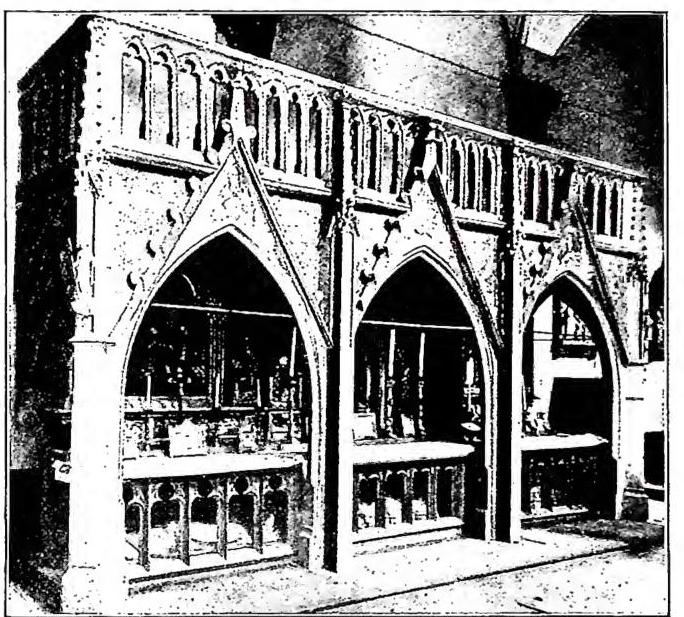
The nineteenth-century ciboria, which generally reflect the eclectic character of the architecture of the period, are often imitations of medieval ones. — Vedi Tavv. XCIX-C.
V. anche BALDACCHINO E TABERNACOLO.