Machine translation of the 1948–1954 Italian original. The original text is authoritative.
AMITERNO. - Ancient diocese of Latium in the country of the Sabines, and a city on the site where the village of S. Vittorino now stands, so named in memory, it appears, of the local martyr Victorin, who fell for the faith during
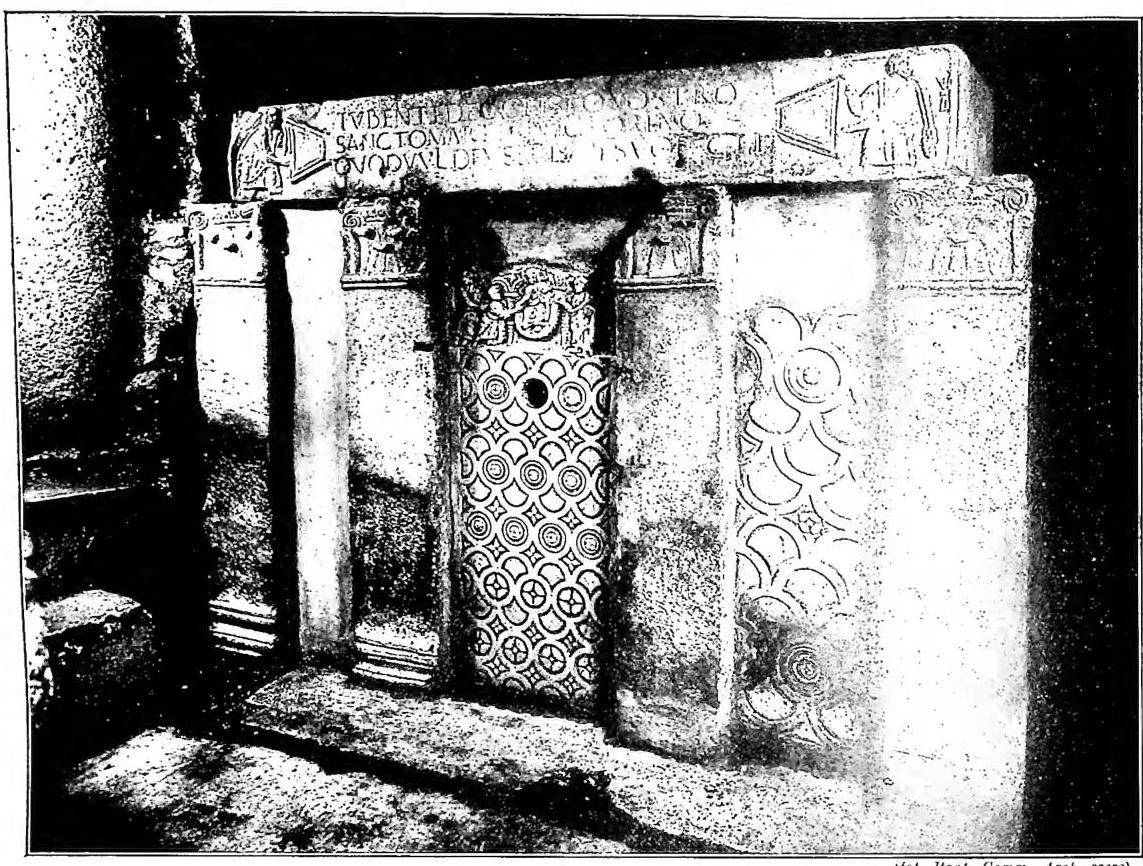
AMITĀBHA - Japanese panel. Rome, Museo Miss. Etnol. Lateranense. (fot. Enc. Catt.)AMITERNO - Reconstruction of the altar dedicated to the martyr St. Victorin with a dedicatory inscription (late 5th cent.).the 3rd and 4th centuries. The Martyrologium Hieronymianum commemorates him on July 24. A late (and untrustworthy) Vita ss. Victorini et Severini (BHL, 7659-60) led some, such as F. Ughelli and P. Gams, to insert St. Victorin into the episcopal list of Amiternum, but wrongly so. The diocese of A. lasted until the Lombard conquest, and the Acta Cethei episcopi amiternini (BHL, 1730-31), regarding the last bishop of this see (6th-7th cent.), narrate that he was massacred by the Lombards under the pretext of collusion with the Byzantines.
BIBL.: L. Duchesne, Les évêchés d'Italie et l'invasion lombarde, in Mélanges d'archéologie et d'histoire, 23 (1903), p. 68; Lanzoni, pp. 359-63. Mario Scaduto
THE CATACOMB OF A. - In a hill outside the ancient city, the early Christians excavated that catacomb in which their martyr St. Victorinus was also buried. It currently extends beneath the church of S. Michele, formerly dedicated to the holy martyr. Few galleries and a few cubicles remain, profoundly altered in their primitive structure by later restoration works. Set into the floor of one of these is a sepulchral slab, upon which is carved a fine scene of a deceased person being introduced to Christ the Judge through the agency of a saintly intercessor. In another cubicle, which must have been the original burial place of the martyr, there is an altar, upon the mensa of which is the votive inscription iubente deo Christo nostro, sancto martyri Victorino Quodvultdeus epis(copus) de suo fecit. The bishop is represented in the corner, prostrate in an act of veneration. Traces of alterations and medieval paintings can be noticed in other crypts. Especially the upper church of S. Michele still bears in the apse a large 12th-century fresco painting representing the Savior between the archangels, St. Victorinus, and other saints. Among the ruins of ancient Amiternum, a leaden reliquary box (capsella plumbea) with very simple ornamentation (cross and palm) from the 4th-5th century has also been found.
BIBL.: G. Marangoni, Acta s. Victorini illustrata, Roma 1740; M. Armellini, Gli antichi cimiteri d'Italia, Roma 1893, pp. 687-91; A. Bevignani, in Nuovo Bull. di archeologia cristiana, 9 (1903), pp. 187-93. Antonio Ferrua
Cite this article
“AMITERNO.” Enciclopedia Cattolica, vol. I (1948), p. 661. Azione Romana digital edition, https://azioneromana.com/article/amiterno.

 Enciclopedia Cattolica