
RAFFAELE, saint. -
I. SACRED SCRIPTURE
Angel who appears under this symbolic name (Hebr. Réphá'el, “God has healed” or “heals”) and definesRADIO COMMUNICATIONS - The Holy Father observes the radio transmitter donated to him by Dutch Catholics (1930).
In the apocryphal writings R. is often mentioned in the Book of Enoch (9:1; 10:4; 20:3; 22:3, 6; 32:6; 40:9; 54:6; 68:2 ff.; 71:8 ff.), which assigns him a notable part in the struggle against the demon Azazel and in the final judgment. He is said to “preside over the spirits of men” (20:3) and “over all the diseases and wounds of the sons of men” (40:9). In the Church, which celebrates his feast on 24 Oct., R. is invoked as an intercessor for the health of soul and body and as a protector in travels.
II. LITURGY
The feast of St. RAPHAEL the Archangel is celebrated on October 24 with a major double rite.(photo Alinari)
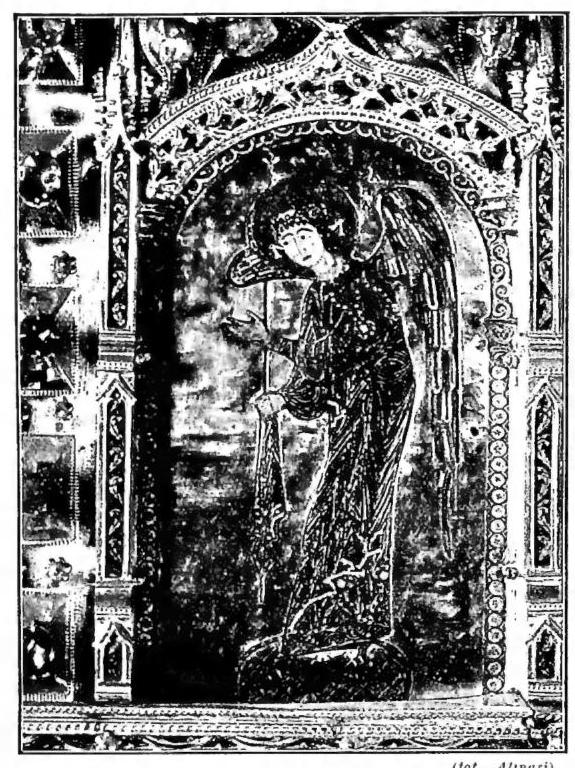
SAINT RAPHAEL — The Archangel RAPHAEL. Enamel from the “Pala d’Oro”
(11th century) — Venice, Basilica of St. Mark
Liturgical celebrations in his honor appear late and rarely. He is completely absent from Sacramentaries and Martyrologies until the 10th–11th centuries; then he is found sporadically and on the most varied dates: in Venice on April 22, in Spain on May 7, in medieval French breviaries on July 9 or 15 or on the Monday of the third week of September. The Mercedarians have his feast on September 18. Peter de Natalibus presents him together with St. Michael on May 8, and finally the popular Martyrologies of Molanus, Canisius, and Ferraris include his name on October 20. In a Sacramentary of Ivrea, written between 1075 and 1090, the feast of St. RAPHAEL appears on January 3, as also in a missal of the Biblioteca Marciana in Venice, dated 1392 (Cod. lat. III, XLVIII), though as a later addition; in a sacramentary of the Biblioteca Capitolare of Verona (IX, fol. 103) from the 12th century, the feast of St. RAPHAEL follows that of St. Michael on September 29. Well known is the church of the Archangel RAPHAEL in Venice, dating from the 7th century but rebuilt in 1618. After the 15th century, the feast of St. RAPHAEL entered many diocesan Proper Offices and even the appendix pro aliquibus locis of the Roman Missal. However, it was only Benedict XV who prescribed it for the entire Church together with that of St. Gabriel on October 26, 1921 (AAS, 13 [1921], 543–44), fixing it on the date that had become established, namely October 24.
It should be noted, however, that apart from the proper feast, the name of St. RAPHAEL already appears in ancient litanies of the saints and in the prayers of the Itinerarium clericorum.
III. ART
St. RAPHAEL is the least represented of the three best-known archangels: MICHAEL (v.), GABRIEL (v.), and RAPHAEL. Rare are the examples of his depictions in early Christian art, where his name is always written beside him; this served also to distinguish him from the other archangels, who, except for Michael, were not marked by particular attributes. Thus he appears in some gold-glass works, in a sarcophagus at Poitiers, and in a fragment of limestone discovered in 1884 near Geminy, evidently a die, as the names written in reverse attest; within roundels were represented the archangels, each with his name beside him, and in the center the Savior.He is also found as a solitary figure in the church of SS. Traso and Saturnino in Rome. The Middle Ages produced few representations of R.; he appears in the church of Münster, at Essen, and, together with the other archangels, in the enamels of the Pala d’Oro in the basilica of St. Mark in Venice (11th century).
From the fifteenth century onward, representations of R. become more numerous, both as the companion of Tobias and, more generally, as a companion and protector of travelers; in this latter role he received many votive images. He is sometimes depicted beside the Virgin and Child together with various saints, as in the panel by Ghirlandaio in the Uffizi and in that of a Florentine painter of the 15th century in the sacristy of S. Maria Novella, or in the fresco lunette by Melanzio in the museum of Montefalco; Andrea della Robbia combines R. and Tobias with St. Francis receiving the stigmata in a glazed terracotta in S. Croce in Florence; and similarly he is joined to other saints by B. Gozzoli (S. Gimignano, S. Agostino) and Raffaellino del Garbo (Florence, S. Ambrogio). Far more frequently, however, artists paint him with Tobias, and only rarely do the other archangels intervene (Botticini, Florence, Uffizi); besides the well-known picture by Pollaiuolo in Turin, one should recall those by Torbido in the Castelvecchio Museum in Verona, by Palmezzano in the Pinacoteca of Faenza, by Savoldo in the Galleria Borghese in Rome, by Rembrandt in the Louvre, and for the eighteenth century the splendid decoration of the organ in the church of S. R. in Venice; even in the 19th century this same iconography is repeated by Amos Cassioli in the cemetery of Antella. There is also a marble group by G. Baratta in S. Spirito in Florence; in the Museum of
(photo Alinari)
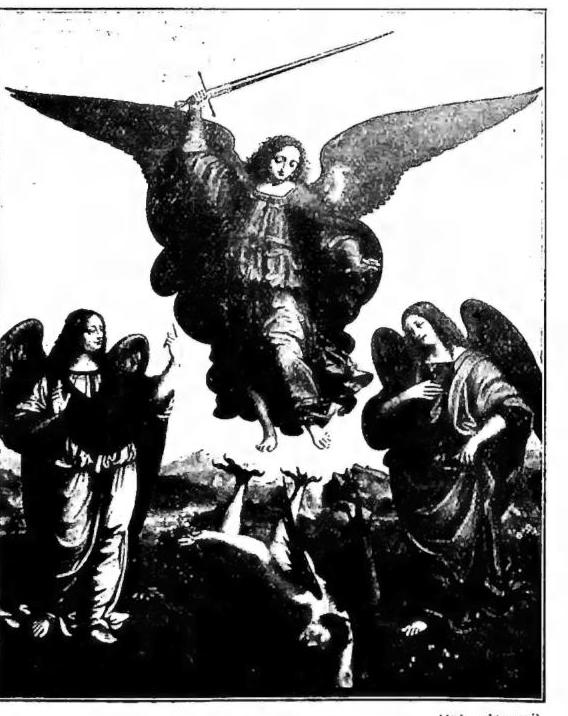
RAPHAEL, saint — The archangels Michael, Gabriel, and Raphael triumphant over Satan. Painting by Marco d’Oggiono (early 16th century). Milan, Pinacoteca di Brera.
[Non-Text]
ceramics in Pesaro there is a plate decorated in 1522 by Maestro Giorgio with R. and Tobias.
A special mention should be made of the painting by Marco d’Oggiono in the Pinacoteca di Brera in Milan for its novel iconography of R. united with Michael and Gabriel as triumphant over Satan — See pl. XV.