
GHIRLANDAIO, FAMIGLIA. – Family of Florentine painters. The foremost was DOMENICO, born in Florence in 1449 and died there on 11 January 1494: his father, the goldsmith Tommaso Bigordi, received the name G., according to Vasari, for having made garlands of rare and precious workmanship as “ornaments for the heads of Florentine maidens.”
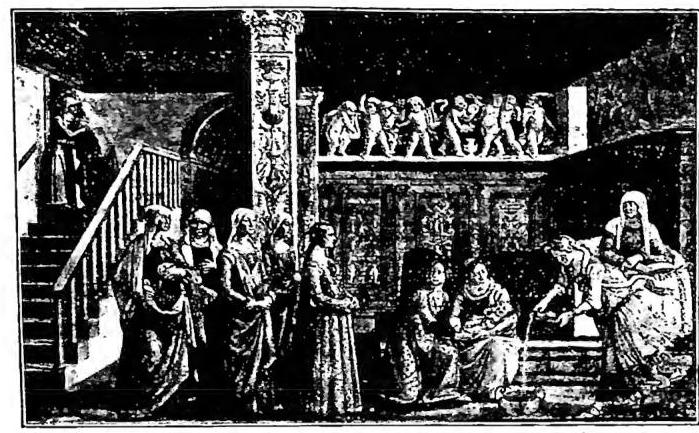
(Anderson photograph)
GHIRLANDAIO, FAMIGLIA - Nativity of the Virgin, by Domenico G. Florence, Church of S. Maria Novella.
His love of detail made him receptive to the influence of Flemish painting, brought to Florence by Hugo van der Goes with the Portinari triptych (cf. the St. Jerome in the church of Ognissanti, 1480; and the two panels—on which he made use of assistants—with the Adoration of the Magi, respectively on the altar of the Sassetti chapel, 1485, and in the Ospedale degli Innocenti, 1488); likewise, his interest in the world around him made him a portraitist. The figures of contemporary personages introduced to animate the narration of sacred episodes—more as protagonists than as a chorus—are vivid portraits, and the gathered figures of the kneeling patrons in the Sassetti chapel may be regarded as the artist’s masterpieces in this field. Yet these images do not impair the balance or the broad compositional sweep, always present when the artist worked without leaving too much to his assistants (Calling of Peter and Andrew in the Sistine Chapel, 1482; Funeral of St. Francis in the Sassetti chapel; Coronation of the Virgin in the choir of S. Maria Novella); and to these qualities is owed Domenico’s importance in relation to the sixteenth-century developments attained by fra' Bartolomeo and Raffaello himself.
The Last Supper in the refectory of Ognissanti (1480) displays a character of serene harmony. Inspired by that of Andrea del Castagno, it differs from it in the tranquil luminosity of its colour; suffused with the clear light entering from the rear, it opens onto a flowering garden, in a manner analogous to the altarpiece with the Madonna Enthroned, St. Zanobi and St. Giusto (now in the Uffizi), which is one of the finest expressions of the painter’s style. His extremely extensive production did not always attain the same quality; this was also due to the extensive participation of his assistants, who worked under the master’s direction and from his cartoons in the fresco cycles and panels. Among them Bartolomeo di Giovanni, Fr. Granacci, J. del Tedesco, Domenico’s brother-in-law Bastiano Mainardi, and especially the brothers David and Benedetto should be remembered.
With DAVID, born in Florence on 14 March 1452 and deceased there on 10 April 1525, Domenico undertook the decoration of the Library of Sixtus IV in Rome (1475), which was subsequently entrusted almost entirely to his brother and of which only negligible remains survive today; he worked on a Last Supper in the cloister of the Camaldolese, later destroyed; he then left to David and Benedetto the execution of the frescoes in the Hall of Lilies in the Palazzo Vecchio (1482–84); again with David he worked on the mosaic of the Annunciation above the Porta della Mandorla (1490–91) and restored the mosaics of the apse of the Cathedral of Pistoia (1493–94). David was in fact known especially as a mosaicist (one of his signed and dated mosaics, from 1496, is in the Musée de Cluny), an activity to which he devoted himself after his brother’s death. His collaboration can also be recognized in the Sistine fresco depicting the Crossing of the Red Sea, executed from a design by Domenico together with his brother Benedetto; in the frescoes of the Sassetti chapel and in the cycle of the choir of S. Maria Novella, where he is distinguished by a more intense naturalism in the representation of the figures and by a more sharply contrasted treatment of light and shadow (Announcement to Zechariah, Visitation). The panel with St. Lucy in S. Maria Novella (1494) and the SS. Sebastian and Roch in the Museo civico of Pisa are attributed to him.
A lesser personality was BENEDETTO, born in Florence in 1458 and deceased there on 17 July 1497. He was trained in miniature painting and later became Domenico’s assistant in almost all his large-scale works. The affinities between the Journey to Calvary in the Louvre and the Coronation of Mary at Narni have led to the attribution to him of the latter work, commissioned from Domenico in 1484. In France, where he stayed between 1485 and 1493, he left several signed works (Adoration of Aigueperse), in which Ghirlandaiesque motifs are fused with Flemish ones. Domenico’s son was RIDOLFO (1483–1561), trained in painting by David and later entering the school of Lorenzo di Credi and Piero di Cosimo; from the latter he derived those concerns with light that distinguished him even amid the eclecticism of his mature production. His first known work is the Coronation in the Louvre (1504); in the Portrait of an Unknown Man in the Pitti, one of his finest works, and in the Marriage of St. Catherine in the Istituto della Quiete in Florence, he turned toward Raffaello; in the well-known Portrait of a Goldsmith in the Pitti, toward Leonardo, while reminiscences of fra' Bartolomeo are present in the Madonna of the Girdle in Prato and in the two paintings of S. Zanobi in the Uffizi. Also attributed to him are the Portrait of a Warrior in the National Gallery of London (with influences from Pontormo) and that of a Lady with a Rabbit in the Yale collection in New Haven, for which Piero di Cosimo’s name has been proposed.
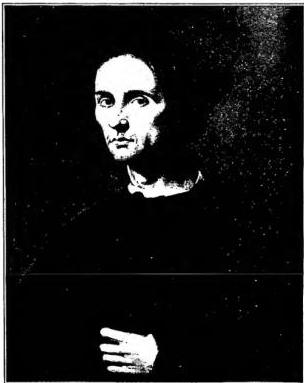
(phot. Allinari)
GHIRLANDAIO, FAMIGLIA - Ritratto d'ignoto, di Ridolfo G.
Firenze, Galleria Corsini.
detto di Ridolfo del G. per la collaborazione con Ridolfo, iniziata nel 1525 (Spasalizio di s. Caterina, nell'Istituto della Quiete di Firenze, a riscontro con l'opera, dello stesso soggetto, di Ridolfo; Madonna della Cintola, Museo di S. Marco a Firenze). Risenti poi delle ricerche monumentali di Andrea del Sarto (Madonna e Santi dell'Accademia fiorentina) e infine, assunto dal Vasari quale aiuto nella decorazione di Palazzo Vecchio, divenne michelangiolesco attraverso la mediazione che di quel maestro e del Parmigianino aveva dato il Salviati; tipico prodotto di tale periodo sono La Venere e La Notte nella Galleria Colonna a Roma, aspre di modellato e di colore. - Vedi tav. XXVII.