
ANDREA del SARTO (ANDREA VANNUCCHI; ANDREA D'AGNOLO). — Painter, born in Florence on 16 July 1486, died there on 22 January 1531. First a pupil of Giovanni or Andrea Barile, then of Piero di Cosimo, he was very strongly influenced by Leonardo da Vinci and later, to a lesser degree, by Michelangelo, whose influence was harmful to him because it was contrary to the gentleness of his temperament. Nor were Bartolomeo della Porta, for the theatricality of his poses, and Raffaello, for the eurhythmy of his compositions, foreign to his art. A.’s activity took place for the most part in Florence; in 1518, invited by Francesco I, he spent a short time in France.
A.’s first work, the Noli me tangere in the Uffizi, reveals, rather than a training under Piero di Cosimo, as Vasari would have it, a formation analogous to that of Franciabigio (v.); very soon, however, in the execution of the frescoes with scenes from the life of s. Filippo Benizzi in the cloister of the Annunziata in Florence,
the manner becomes freer and the composition is balanced according to rhythms akin to those of Fra Bartolomeo. A taste for coloured shadows and atmospheric sfumato appears in the Annunciation in the Pitti and in the Pietà in the Vienna Gallery; the planes are faceted in order to achieve a deeply moving vibration of light. Indeed, in the Procession of the Magi at the Annunziata, the figures attain a perfect fusion with the atmosphere. The splendid Female Portrait in the Prado belongs to this period. Before his journey to France, A. began the frescoes in the small cloister of the Scalzi, in which the first Michelangelesque elements appear. In the monochromes, the harshness of the lighting heightens the sculptural vision of the detail, but in the insistent faceting of the planes and
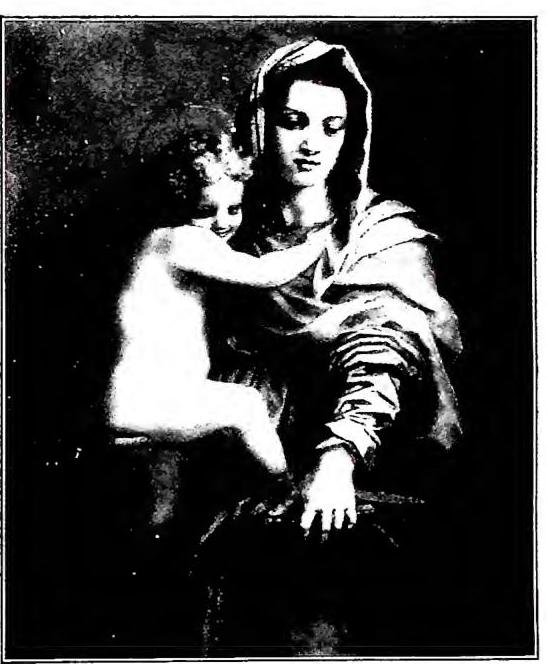
in the overall effect, A.’s pictorialism finds a way to assert itself with originality. The Madonna of the Harpies (1517), composed according to the models of Fra Bartolomeo, but entirely enveloped in a soft, coloured atmosphere, is an authentic masterpiece. Several works with sacred subjects followed, such as the Dispute of the Trinity in the Pitti, the Madonna in the Hermitage in Leningrad, the Deposition, also in the Pitti, and various portraits. Then again, the so-called Madonna del sacco in the cloister of the Annunziata in Florence, through its measured perspectival calculation and subtle chromatic qualities, conveys the measure of the painter’s maturity. In the Assumption in the Pitti Gallery, the composition becomes cumbersome; and in other paintings, the work of the collaborators often diminishes its quality. The Holy Family in the Pitti, the Madonna in Berlin, and the Sacrifice of Abraham in Dresden already belong to a Mannerist conception, and in these works the colour becomes garish, while the softness of the sfumato is attenuated.
While in the Florentine school, wholly devoted to drawing, the formal conception dominates, A.’s painting, deriving from Leonardesque sfumato the subtlety
of chiaroscuro and the gradation of tones, presents itself as essentially colouristic. — Vedi Tav. CV.