
CHANT. —
I. GENERAL CHARACTERISTICS
In the Church, chant originally had the purpose of making public prayer more solemn: it is therefore eminently liturgical, since the liturgy was born together with chant. Just as the liturgies vary, so too do the forms of chant differ, and each has its own special characteristics. Within the group of the chant of the Western liturgies, there are at least four forms of chant, namely: Ambrosian, Gallican, Visigothic, and Gregorian (for Ambrosian, Gallican, and Visigothic, Byzantine, Armenian chant, etc., V. the corresponding entries). Gregorian chant may decidedly be called Roman, both because it is of Roman origin and because, at least from the time of St. Gregory, it acquired a character of its own, distinct in text and style of chant from the other Western liturgies. It must also be called Roman because of its immediate sources, which are evidently Roman. Roman in its Latin text, it presents melodic and rhythmic characteristics that one might call local, and does so to such a degree that these constitute the melodic and rhythmic basis of the chant: namely, the tonicity of the accent, which produces an infinite variety of cadences and even of entire melodies; the indivisibility of the first beat, or rhythmic unit, which gives it a solemn rhythm particularly suited to prayer; rhythmic freedom, that is, an unfixed succession, as in Latin prose or speech, released from the metrical concerns of the classical age; harmonious cadence in the phrases, especially in the recitatives, which correspond to the oratorical cursus of rhythmic prose (v. CURSUS). In addition to these genuinely Roman characteristics, Gregorian chant accepts, as the basis of its modulation, the diatonicism and modal freedom that the West, and Rome in particular, had inherited from the ancients. Gregorian chant must also be called Roman because, in its style or general expression, sobriety and discretion are highly prominent—characteristics that are eminently Roman and that shone forth in the personality of St. Gregory the Great, to whom its paternity is attributed.II. ORIGIN
The work of this Pope (590–604) presupposes an entire period of formation, to which contributed the repeated and varied prayer aloud (and therefore modulated) of the Pontiff; his dialogues and those of the sacred ministers with the people; the people’s participation in the c. of the psalms; the part reserved for soloists in the melodic passages that interspersed the readings and the rest of the prayers; the Supplicationes or Litanies, which gradually became popular and through which prayers are offered for all the needs of the Church; the progressively greater solemnity imparted to the liturgy after the persecutions, through the work of the popes preceding s. Gregorio; and the Stationes, which contributed particularly to defining the feasts and solemnities of the Lord and of the saints. For all these reasons, and because the accent is undoubtedly Latin and Roman, while the various melodic sources are either indigenous—that is, Western—or assimilated by the Latin genius, this c. is truly Roman. To these various sources were added traditions imported from the Church of Jerusalem, or traditions that formed the artistic baggage of the newly converted and of local songs, more or less vernacularized in various churches of the West. Some of these churches, such as that of Milan, present themselves with unquestionable authority; but among them all there prevail notable divergences of style.III. WORK OF S. GREGORIO. — Today criticism no longer disputes the authorship of the Roman chant by this Pontiff. Through his scholarly and artistic formation, his personal qualities, his monastic life, his contact with great Latin and non-Latin geniuses, and his functions as archdeacon, to whom fell the care and direction of the subdeacons, chamberlains, readers, and singers, in addition to his personal service as head of the chant, he was more than sufficiently prepared for the organization of the Roman rite, which he himself directed. This organization of the solemn liturgy, universally attributed to him, necessarily entailed the chant, because at that time, and given the purpose of the former, the one could not be realized without the other. His work, which legend too wishes to adorn with marvelous episodes, was confirmed, scarcely forty years after his death, in the epitaph of Pope Honorius (d. in 638), in which it is proclaimed, as in the divino carmina: « Gregorii tanti vestigia iusti dum sequeris capiens meritumque geris ». S. Gregorio accomplished his
work chiefly through the Schola cantorum, a true school of professionals, which, once it had carried out the « renovavit, compilavit et auxit » (reform, centonization, and new compositions, in which the work directed by S. Gregorio is summed up), performed it, taught it, and disseminated it in Rome and throughout Europe. The twofold fact cannot be explained in any other way: both the homogeneity of style and procedure found throughout the entire ancient Gregorian repertory, and its identical, continual dissemination by means of notations or graphic systems that were also different from one another, in so many different countries, before the eighth century. If the musical manuscripts
(from A. Macgavreau - J. Gujard, La tradition rythmique dans les manuscrits, Paris 1911, para. G.)
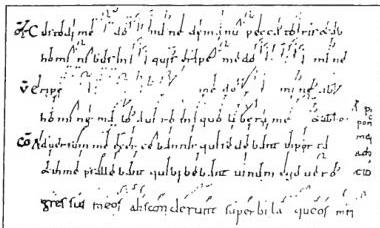
CANTO – Example of Nonantola notation (10th century).
IV. MUSICAL NOTATION
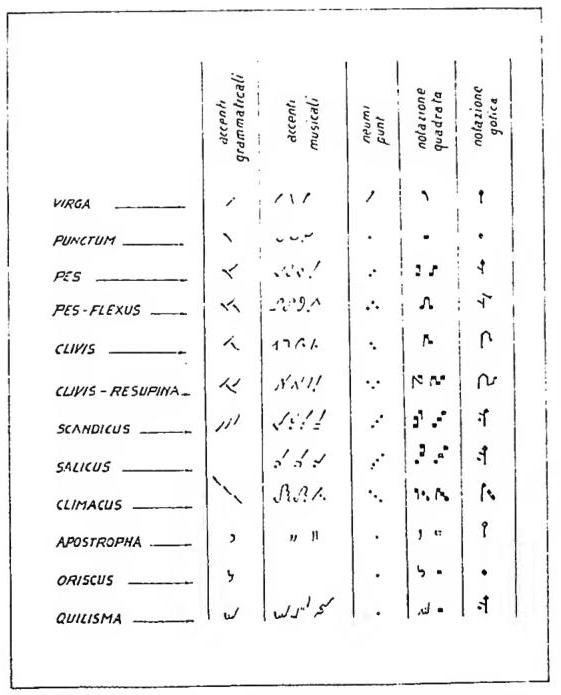
Gregorian manuscripts present a twofold general aspect: a) the natural evolution of the signs in themselves; b) the various scripts adopted in the different countries of Europe. The evolution of musical signs depends on the fact that, at a remote origin, the signs of tonic accent proper to oratory and grammar were adapted, as such, to express sounds of different pitch: high sounds (the acute accent, musically called virga), and low sounds (the grave accent, called punctum). At this period the entire sign, as in grammar, represented the tonic value. This is the notation called oratorical or in campo aperto, because the individual sounds have no fixed position or fixed relative height in the writing; indeed, certain manuscript pages present the phenomenon that, when the page has ended, the neumes rise up along the margins. The tonal value was determined by memory, practice, and, in many manuscripts, melodic signs and letters, such as s (sursum), a (altus), i (iusum), d (deprimatur), sometimes accompanied by v (valde) and m (mediocriter). Around the tenth and eleventh centuries, the neumes began to follow a graduated arrangement, conforming first to an imaginary or ideal line, then to one of those already traced with a dry point on the parchment for the text, and finally to several lines, up to four. But the neume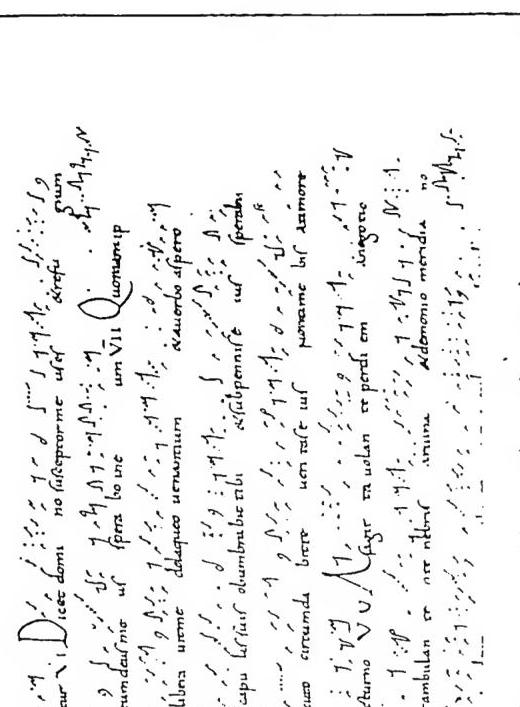
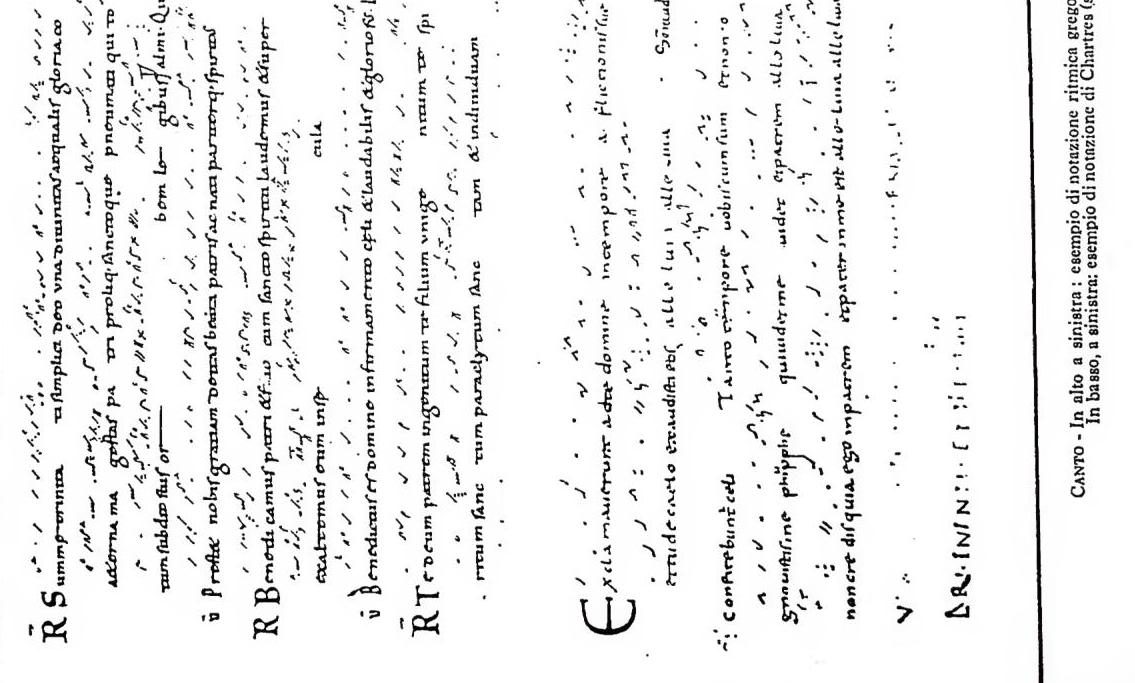
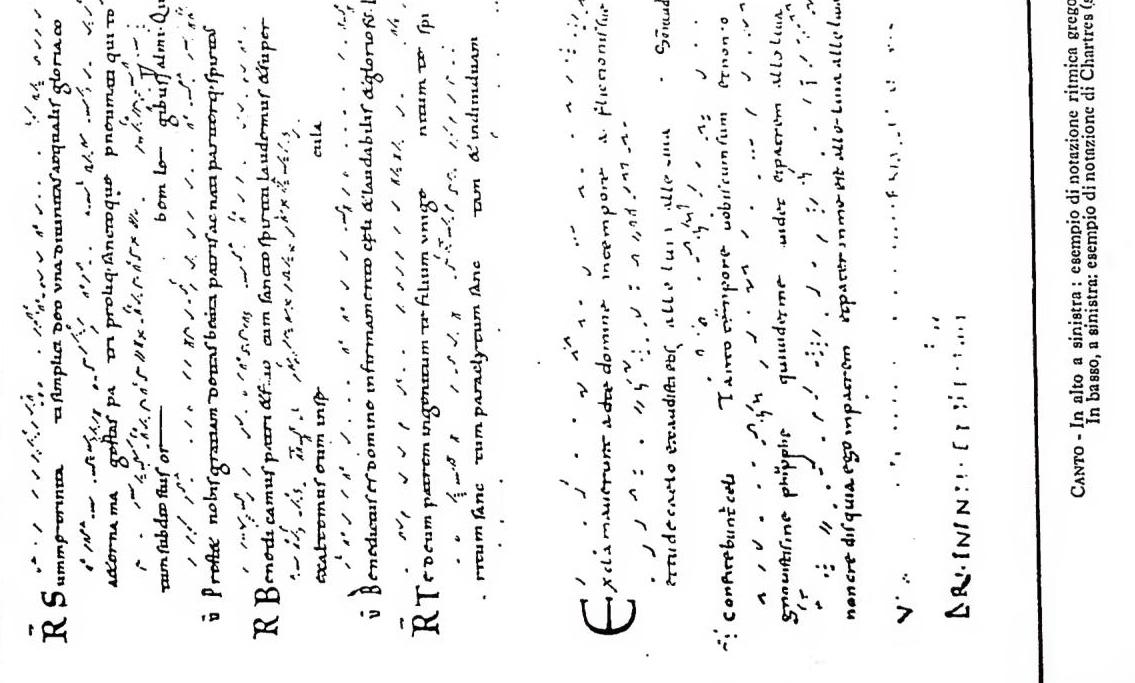
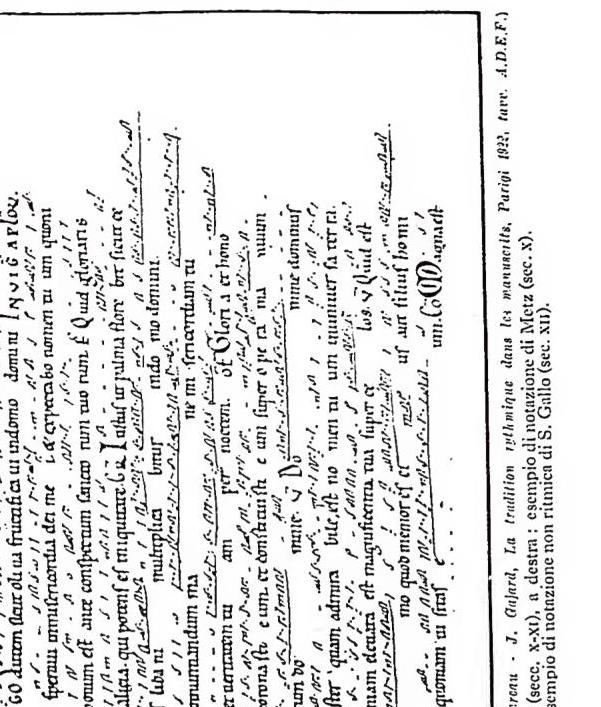
CANTO - At upper left: example of Gregorian rhythmic notation from S. Gallo (10th–12th centuries); at right: example of notation from Meta (10th century).
At lower left: example of notation from Chartres (10th century); at right: example of non-rhythmic notation from S. Gallo (12th century).
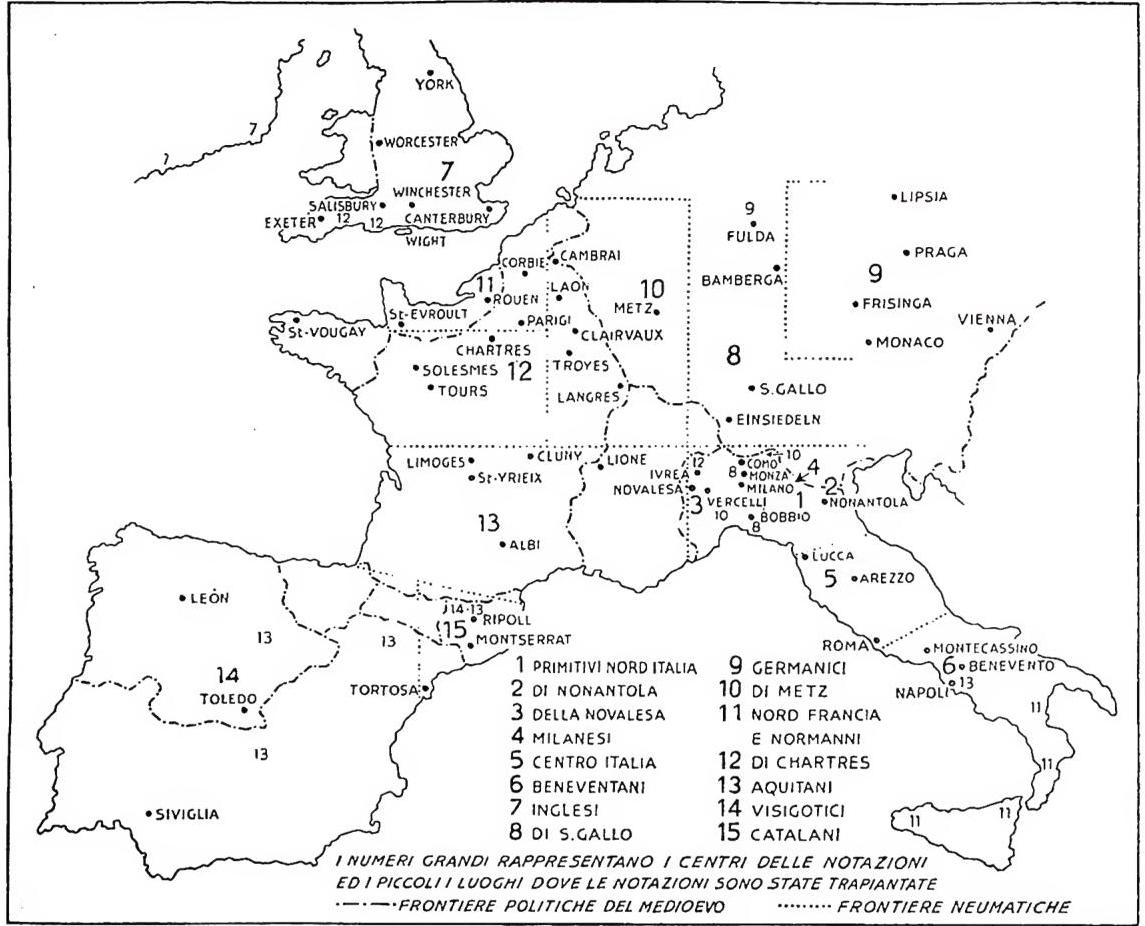
CANTO - Geographic distribution of the Latin neumes.
(courtesy of Fr. Gregorio Sadol)
Almost all these notations, especially S. Gallo, Metz, Chartres, and Nonantola, employ, in order to specify the value of the neumes, signs and letters called rhythmic. The signs are of two classes: modification of the neume (made broader), or the addition of strokes and letters, such as c (celeriter, ordinary tempo), nl (naturaliter), t (tenete), a (augete), increasing the value, or also x (expecta), accompanied, in the case of the letters indicating delay, by v (valde) or m (mediocriter). There are also other letters, such as p (pressionem), pl (pulchre), and f (fortiter), which lead us to think how precise not only the performance but also the expression was, anticipating by so many centuries (in the x) the modern signs of expression. The subtleties of pronunciation were not neglected either, such as the notes called liquescentes or semivocales for diphthongs, liquid letters, doubled letters, and so forth. Many manuscripts of the Beneventan, Aquitanian, and Novalesa notations are also rhythmic; and remains of melodic and rhythmic signs and letters are found in English manuscripts. For pedagogical purposes, various alphabetical notations were devised: such as those of s. Oddone, Ermanno Contratto, Hucbaldo (or dasian), of Montpellier, etc. For the convenience of singers, Gregorian chant can be transcribed into modern notation, while always preserving the grouping of the notes forming the neumes and the appropriate pauses; by convention, the simple note takes the form of the eighth note, which best corresponds to the recitative and rhythmic character and the phrased movement of the Gregorian melody.
V. LA DECADENZA
The negligence of the singers, the carelessness and incompetence of the copyists, the new tastes that in the 13th and 14th centuries produced the Ars nova with the Discantus, the Organum (a combination of several voices), the proportional value assigned to the neumes for the greater concordance of simultaneous voices, the Renaissance with its passion for revising ancient texts, polyphonic art itself, the neglect and ignorance of liturgical piety, which came to give preference to acts of private and subjective devotion, the use of musical instruments, etc.—all favored the progressive ruin of Gregorian chant. Its manuscripts were relegated (if they could be saved from destruction) to libraries, until the revival of the liturgical spirit and the study of the monuments. It was through the work and impetus of Fr. L. P. Guéranger, restorer of the Roman liturgy in France and of monastic life, that many scholars began to concern themselves with reviving those manuscripts and seeking their interpretation. Meanwhile, various practical editions of corrupted chant were being produced in different countries, and one of them, that of the publisher Pustet, prepared by Haberl, had the good fortune to pass as the purported work of the great Palestrina and to acquire an almost official status. By 1901, studies by the monks of Solesmes and other scholars had already progressed to such a point that, once the thirty-year privilege for the Regensburg edition had expired, the Pope proclaimed absolute freedom of investigation.VI. THE RESTORATION
From the election of Pius X (1903), it was immediately expected that, following the change initiated by Leo XIII with the Nos quidem (17 May 1901), the reform ad codicum fidem would be officially imposed. The volumes of the Paléographie musicale, published by the monastery of Solesmes (from 1889 to 1901 there were already seven folio volumes), containing reproductions of a large number of manuscripts and studies, as well as several practical editions (Liber Gradualis, Antiphonarium), which present a substantially authentic version of Gregorian chant; and the edition of the Liber Umalis published by A. Mocquereau, with no small number of critical adjustments and the addition of the rhythmic signs that brought that edition into wider circulation, had prepared the motu proprio of Pius X on sacred music. This document already speaks of restored chant. But, in order not to fall into editorial exclusivism, it was decided, by motu proprio of 25 April(courtesy of Fr. Gregorio Suñal)
CANTO - Outline of Gregorian rhythms:
1. Simple times: individual percussions without relation to one another
2. Elementary rhythms: from non-ictus to ictus
3. Compound times: the relation between the ictus and non-ictus of the elementary rhythm. Only one ictus is expressed on the first beat. -4. Isolated simple rhythms, of two compound beats: arsis and thesis on compound beats
5. Compound rhythm (more than two ictus) through simple juxtaposition.6. Compound rhythm through fusion on the second ictus, which continues the arsic impulse
7. Compound rhythm through repetition of the thetic support.| grammatical accents | musical accents | polyphonic neumes | square relation | Golic relation | |
|---|---|---|---|---|---|
| VINGA | ✓ | ✓ | ✓ | ✓ | ✓ |
| PUNCTUM | ✓ | ✓ | ✓ | ✓ | ✓ |
| PES | ✓ | ✓ | ✓ | ✓ | ✓ |
| PES-FLEXUS | ✓ | ✓ | ✓ | ✓ | ✓ |
| CLIVIS | ✓ | ✓ | ✓ | ✓ | ✓ |
| CLIVIS-RESUPINA | ✓ | ✓ | ✓ | ✓ | ✓ |
| SCANDICUS | ✓ | ✓ | ✓ | ✓ | ✓ |
| SALICUS | ✓ | ✓ | ✓ | ✓ | ✓ |
| CLIMACUS | ✓ | ✓ | ✓ | ✓ | ✓ |
| APOSTROPHA | ✓ | ✓ | ✓ | ✓ | ✓ |
| ORISCUS | ✓ | ✓ | ✓ | ✓ | ✓ |
| QUILISMA | ✓ | ✓ | ✓ | ✓ | ✓ |
(courtesy of Fr. Gregorio Suñal)
1904, that the Holy See should publish a typical edition, for the preparation of which an international commission was established. Practical difficulties prevented its work from leading to a truly critical form; consequently, the editing was entrusted solely to J. Pothier, who published the Kyriale and the Graduale in 1908, and the Antiphonarium in 1912. Later, the Vatican Commission was dissolved, and the Sacred Congregation of Rites undertook directly the publication of the other books: Officium Maioris hebdomadae, In Nativitate Domini, etc., the editing of which was entrusted to the monks of the monastery of Solesmes.
VII. THE “CRITICAL APPARATUS” FOR THE STUDY OF MANUSCRIPTS
These monks, initiated into the work by the sure method and genius of A. Mocquereau, after newly investigating and photographing the musical manuscripts of all nations, which they diligently studied, selected, and compared, have arrived, with the aid of the critical charts, at a demonstrably authentic version, and at the discovery of the treasures—many of them unsuspected—of Gregorian chant. Although it is impossible to publish the complete apparatus, the particular studies published in the Paléographie musicale and the Monographies grégoriennes have in large part recovered Roman chant.VIII. THE RHYTHM OF GREGORIAN C
Nothing could be established on this point before the manuscripts had been interpreted, the entire body of the ancient repertory had been studied, the development of the musical art had been examined, the relationship between text and melody had been established, and the ancient treatises had also been taken into account. This patient work, lasting more than fifty years, with the oversight of a true School and with the observations of scholars carefully given their due consideration, has made it possible—after almost another fifty years of daily practice in the choir—to establish the sound principles of Gregorian rhythm, which are especially indicated in vol. VII of Paléographie musicale and in the two volumes Le nombre musical grégorien by A. Mocquereau. Gregorian rhythm, which also finds its antecedents in the results of studies on Greek rhythmics,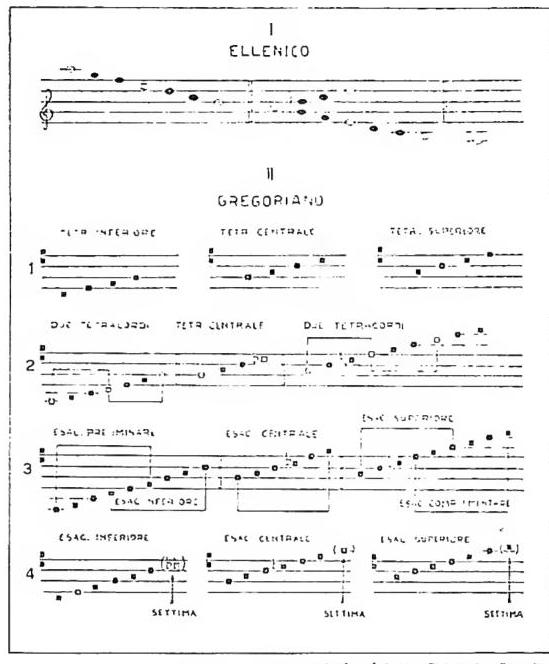
This rhythm is accompanied by a great number of expressive nuances, specified by many very ancient manuscripts from different countries. Today, with its critical version, the Church has also recovered its own manner of praying, singing according to the tradition of the centuries of faith, in a way that satisfies collective piety and gives its liturgical functions a musical interest such as no other c. can provide. Its rhythm unites and gathers together immense multitudes of people and can present to science a testimony to its more than thousand-year-old tradition.
IX. GREGORIAN MODALITY
The theorists of the Middle Ages transmitted to us the theory of the octoechos, which has come down to our own time. Eight modes are distinguished: four authentic and four plagal, grouped in pairs according to the identity of their tonic, each having its own dominant or a different modal center. The ascending scale or gamut, from the lower sol to the upper la, follows the diatonic genus, that is, the succession by natural intervals, unlike the chromatic genus, which divides all whole-tone intervals into two semitones. Gregorian chant does not know the modern leading tone, that is, the semitone below the tonic. Relatively recent studies began to establish that the alleged rigidity of the dominants was rather theoretical, arising from the fact that fixed dominants had been chosen for the c. of the psalms. The observation was made concerning the changing central notes in the various phrases or members, which consequently came to establish different modal relationships in relation to different tonics. This modal freedom already weakened the celebrated immutable theory of the eight modes. Today the studies have been taken much further, to conclusions of the greatest importance, not entirely unsuspected even by A. Mocquereau himself. These new investigations followed his own system: namely, to study impartially, and if possible in the complete repertory as a whole, the modal facts that it presents to us. In this study of modality, no neglect was made of the established fact of the different versions or transpositions offered by certain manuscripts, nor of the discreet observation of how it was possible, when melodies were fixed on the staff, to overlook those modal variations or shifts which, for lack of means in writing, had previously been performed by voice. This investigation was accompanied by a study of the harmonic theory of the Greeks, as well as by an analysis of the Ambrosian repertory (after its critical edition of 1935–39 had been produced); A. Mocquereau had already advocated the importance of these studies, especially of the Ambrosian c., for resolving the Gregorian modal question. In this way we can admire, even more than in the schema of the simple theoretical trope and the hypothetical system of the octoechos, the modal beauty of Gregorian c., and above all understand how the melodies were constructed modally. In light of these results, one may continue, scholastically and for the convenience of singers, especially in the c. of the psalms, to classify melodies as belonging to the first, second, third mode, and so on. But theoretical and practical analysis shows us that the modal foundation, the constructive principle followed by those monks of the school of s. Gregorio, was, as in Greco-Roman music, what is called the first syllable, or the first sonorous nucleus, solid and compact—namely, the tetrachord, the perfect ascending fourth.(courtesy of Fr. Gregorio Sullal)
CANTO – Gregorian modal schemes.
Such was the modal theory contemporary with the first Gregorian composers, who accepted it just as they accepted musical rhythm and the tonicity of the Latin accent, stripped of the classical quantity that was already obsolete. Gregorian chant, modally and rhythmically, is a child of its time.
The diatessaron, no longer descending as in the Hellenic period but ascending as in Greco-Roman music, could, as a constructive process, be completed up to the diapente (fifth) or the hexachord (sixth). This was demonstrated to us by an infinity of melodies that do not go beyond this ambitus and in which the theory of the fifth and fourth, or octave, plays no part whatsoever, as it is presented by the system of the octoechos—an octave that, in the modern sense, with its static notes, was known neither to Hellenic nor to Greco-Roman harmonics. Everything else, both the modal freedom of the dominants and the arrangement of the final notes, which must be one of the two fundamentals of the three perfect tetrachords of the diatonic scale (do–fa; fa–si; sol–do), namely do, re, fa, sol, la, is merely a consequence of the constitution of the tetrachord as the foundation of ancient modality.
Gregorian chant thus contributes to the musical art something of the greatest importance, confirmed by the testimony of the Ambrosian melodies, now critically restored.
X. AESTHETICS
Following the earlier studies on technique, that is, on rhythm and modality, and on the manner in which all the constituent elements are employed in Gregorian chant, it has been possible to establish the aesthetic laws of Gregorian chant, and to do so in both a synthetic and a detailed manner, so as to present a complete account such as it has not been possible to produce for any other chant. These studies have been advanced and their results assembled (already indicated in vols. III and IV of Solesmes’s Paléographie musicale), especially after the preparation of thousands of charts (approximately 40 × 20 in size) which served the monks preparing the edition in establishing the critical text, as well as the many other special charts drawn up directly for these works.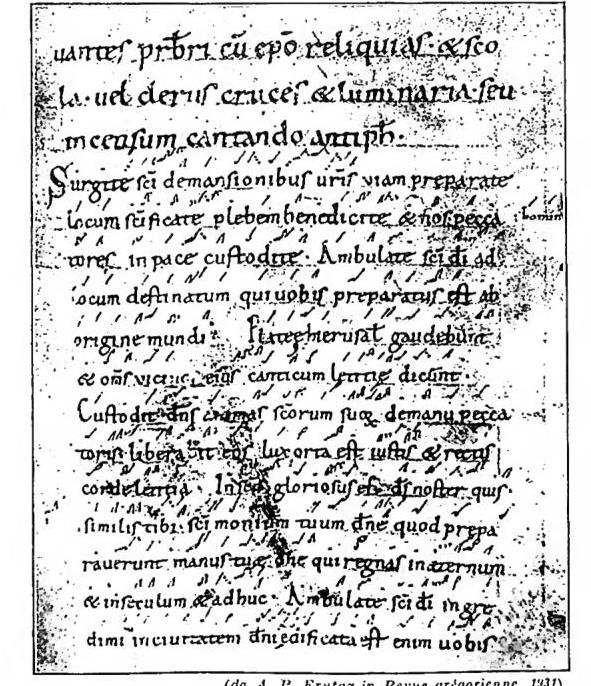
The proper and distinctive expression of Gregorian chant emerges from this entire complex of constituent elements as a genuine tradition which, contrary to what many had believed, unites the Hellenic past with Christian thought. This aesthetic apparatus shows scholars how capricious are the commentaries so often made on Gregorian melodies, and how, according to the genre of the composition—original, typical, or centonized—or the liturgical moment, a proper understanding of the chant is achieved. Moreover, Gregorian aesthetics reveals to us a multiplicity of forms and resources for modern composers—not only with regard to style; there are melodies consisting of isolated phrases which recall, or constitute the development of, a true lied, while others present a certain suite-like form, in which the first part leads toward a new modal form while nevertheless recalling the initial tone, with genuine modulations. Others, instead, play upon the alternation of motifs, like true rondeaux with an equal or similar melodic response, and with variations of motifs, as occurs in many sequences which do not follow the alleluiatic theme note for note. Everyone agrees in admiring an art that was thought to be devoid of every musical spirit, whereas
it is precisely this art that has inspired so many forms of composition. First of all, through the study of its elements, centonizations, formulae, and musical words, it enables us to recognize whether and when the language is truly Gregorian, just as through the grammar and dictionary we can appreciate the authentic literature of a language and judge foreign or scarcely classical words. Secondly, with the aid of this aesthetic study, it has been possible to compose new offices and incorporate them into the Gregorian repertory without their clashing with the ancient melodies. An exquisite art and remarkable skill, which only the initiated have been able to achieve. Through studies of Gregorian aesthetics, composers of modern religious music find a way of viewing Gregorian chant as an inexhaustible source of themes, motifs, and forms, in addition to modal combinations—elements so rich and evocative as to enrich new compositions and artistically rejuvenate religious art, always in harmony with the prescriptions of the Church. This is an exceedingly abundant field which, perhaps through insufficient familiarity, has not been adequately explored, to the detriment of what religious music could and should be, and of its greater spiritual efficacy.
XI. OFFICIAL CHANT
The Vatican edition, containing the Gregorian edition ad codicum fidem of the entire liturgical repertory, has been obligatory since the date of its publication (namely, Graduale and Kyriale, 1907; Antiphonarium, 1919; Officium Defunctorum, 1927; Officium Nativitatis Domini, 1927; Officium Majoris Hebdomedae, 1929). Likewise official are the respective new Offices, such as those of Christ the King, the Sacred Heart, etc. This obligation requires the adoption of this version, and according to the free rhythm in which they were conceived. Reproduction without the permission of the S. Congregation of Rites is forbidden; it grants permission on condition that the reproduction be absolutely conformable, in melody and in the form of the notes, without changing anything, to the typical edition produced by the Vatican press. Under the proper conditions, the rhythmic signs called Solesmes are permitted; inspired by ancient manuscripts, they make the artistic and uniform interpretation of chant easier for choirs. If some local melody rests upon manuscripts of high authority, the S. Congregation of Rites shall judge in each particular case whether it may be performed, even if it differs from the Vatican edition. For sacred ministers, at the altar and in their Office, it is obligatory to employ exclusively Gregorian chant, as also in dialogues with the people. The people as such, men and women, from their places, may always respond and alternate, in the parts authorized for this purpose, such as psalmody, antiphons, hymns, the Ordinary of the Mass, etc. Religious women in their choir, and women alone in the absence of clergy and men, may, likewise from their places, sing also the variable parts, or Proper of the Mass and Office, in Gregorian chant. The Scholae cantorum must be provided with books of Gregorian chant, which greatly serve artistic-religious formation and facilitate the dignified preparation that each singer must bring to the acts of worship.XII. HOMOPHONIC AND ACCOMPANIED C
Gregorian chant, a pure melody, essentially free in rhythm as in modality, in a certain sense resists accompaniment, which is harmonization by simultaneous sounds. Yet the practice of accompanying it exists. The difficulty is evident; but if the accompanist knows how to keep within the proper limits of a discreet harmonization that does not contradict the melodic line or rhythmic flexibility, he can perform a work not only useful to the singers, but also artistic in itself. Chant may therefore be accompanied, except on the Sundays and ferias of Advent and Lent, and in the Mass of the Dead, on the absolute condition that «silet organum dum silet cantus». It may not be accompanied, even to sustain the pitch, in the Office of the Dead and during the triduum of Holy Week.(from A. P. Frutaz in Revue gregoriana, 1931)
CANTO - Accent neumes of the German school.
Pontifical of the 11th century, f. 72 - Aosta, Cathedral Archive.