
MONTPELLIER, DIOCESE of. – City and diocese, seat of the prefecture of the department of Herault, on the River Lez, ancient capital of Languedoc.
The diocese has the same extent as the department of Herault and a population of over 500,000 inhabitants, of whom 450,000 are Catholics; it is divided into 3 archdeaconries, comprising 5 deaneries, which are divided into 283 parishes and 131 annexes. There are 350 diocesan priests and 112 religious; a major and a minor seminary, 19 male and 80 female religious communities.
It is the medieval Mons Pessulanus, at first merely a village which, toward the end of the 10th century, was subject to the counts Guglielmi; after Maguelonne was destroyed by Charles Martel, its inhabitants took refuge in M. It was excommunicated by Innocent II because it had rebelled against Guglielmo VI. In 1141 it obtained a charter of liberties. Having passed to King Pietro of Aragon in 1204, it enjoyed considerable autonomy and began a period of great commercial development. Its merchants formed a « societas et communitas mercatorum in Francia utentium » headed by a « capitaneus et consul »; through their trade they penetrated into Spain and Morocco and reached as far as Syria. A Synod was held at M. in 1215, in the church of S. Maria, presided over by Cardinal Pietro of Benevento, legate of Innocent III, in order
to eradicate the Albigensian heresy (Hefele-Leclercq, V, II, pp. 1298-1302), and another on 25 August 1224, presided over by Arnoldo, archbishop of Narbonne, commissioned by Honorius III to begin negotiations with Count Raimondo of Toulouse (id., ibid., p. 1441). The Hospitaller Order of St-Esprit, which spread in the 13th century throughout France, Italy, Germany, Poland, the Iberian Peninsula, Scandinavia, etc., originated first at M.; its definitive rule was promulgated in 1213 (P. Brune, L'Ordre hospitalier du St-Esprit, Paris 1892, pp. 200-201). In 1349 M. came under the authority of France; but decline then began and continued until 27 March 1536, when Pope Paul III transferred there the see of the diocese, which until then had been situated at Maguelonne.
The church had been founded there by Urban V in 1364, on the site of an ancient chapel of the Benedictine monastery of St-Germain. The central nave dates from the 14th century; the choir, the work of Revoil, dates from the 19th century. The atrium has 4 towers from the 15th century arranged in a square. The abbey building of St-Germain was converted into the episcopal residence in 1536 and now houses the Ecole de médecine. The first bishop of M. was Bishop G. Pellicier (1536-68), then at the see of Maguelonne; the church of the monastery of SS. Germano and Benedetto, dependent on the monastery of S. Vittore, was raised to the dignity of a cathedral. Subsequently there were Bishop P. Fenouillet (1608-52), F. Bosquet (1657-76), Fournier (1806-34), and Cardinal Rovérié de Cabrières (1911-21). The Huguenots destroyed the churches and monuments of M.; a semblance of a republic was established there, which fell in 1622 after the siege by Louis XIII.
The veneration of the Blessed Virgin has been traditional in M. since the 11th century, when pilgrims travelling to S. James of Compostela stopped at a church where merchants and money-changers set up their tables, hence the name Notre-Dame-des-Tables (made a parish church in 1216 by Bishop Guillaume d'Antignac). At the beginning of their term of office, the representatives of the Municipality went to swear that they would work for the preservation of the Catholic faith; at the height of the Albigensian crisis, the image of the Madonna with the Child was placed on the municipal coat of arms, together with the inscription: « Virgo mater Natum ora, ut juvet nos omni hora ». Among the sanctuaries may be mentioned: Notre-Dame-de-l'Ermitage at St-Guillelm du Désert (14th century), Notre-Dame de Grâce at Gignac, Notre-Dame de Grau near Agde, Notre-Dame-de-Mougères at Mougères; Notre-Dame-de-Montaigu at Ceyras, Notre-Dame-de-Roubignac, Notre-Dame-du-Suc at Brissac, Notre-Dame-de-Trédos, and Notre-Dame-des-Tables at M.
As early as the 11th century, a school of medicine flourished in M.; a school of law was added in 1160. In 1220 the University was founded there with a statute approved by Pope Honorius III, and was subsequently reorganized by Nicholas IV in 1289. Today the University has all the Faculties. The Faculty of Medicine is housed in the former episcopal residence, formerly the abbey of St-Germain. The Museum of M. preserves two Christian sarcophagi, one originating from Bagnoles (Wilpert, Sarcofagi, pp. 111, 334-36, pl. 99, 5), while the other is a forgery (id., Restauro di sculture cristiane antiche e antichità moderne, in Riv. di arch. crist., 4 [1927], p. 101, fig. 34). The Fabre Museum (1825), enriched by donations (Fabre, Valedeau, Bruyas), contains paintings from the French, Italian, Flemish, and Spanish schools. The « Académie des sciences et lettres de M. » was founded in 1706. Following its reform in 1847, it began publishing its Mémoires until 1908; from 1909 onward it published a Bulletin mensuel, as did the « Société archéologique », founded in 1833. Notable centres of culture are also the « Société d'histoire naturelle » (1866) and the « Société languedocienne » (1875), all possessing rich libraries. The Archive is located in the Tour des Pins (12th-14th centuries). The city Library preserves precious manuscripts, such as the Liber evangeliorum (ms. no. 3), containing the version of S. Girolamo, formerly belonging to the monastery of Gellona and dating from before the 9th century. The Library of the Ecole de médecine possesses, among others, a Breviarium Alaricianum of the 8th century (ms. no. 84); ms. no. 141, partly a palimpsest, from the 8th-9th century; ms. no. 153 from the 9th century; Evangelia cum canonibus from the 9th century, formerly belonging to the abbey of St-Loup at Troyes; an Antiphonary from the 10th-11th century; and a Latin Psalter from the 8th century (no. 409), formerly at St-Germain d'Auxerre. For the liturgical manuscripts of M., V. Leclercq, s. V. in DACL, XI, II, cols. 2693-2700.
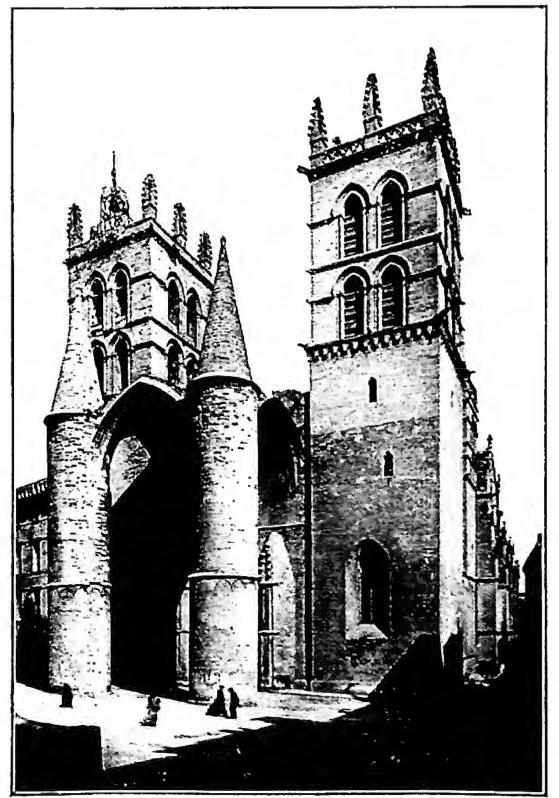
The portal of the Cathedral is surmounted by a block, formerly a Roman milestone, with a decoration and an inscription by Bernardo di Treviers dated 1178; in the tympanum, which is later, Christ in majesty with the symbols of the Evangelists; in the jambs, the apostles Peter and Paul (12th century). The interior has a single nave. A semicircular apse opens in the choir, pentagonal on the exterior. After the see was transferred to M., the cathedral of Maguelonne was damaged by Richelieu and then converted into a warehouse; it was restored and returned to worship only in 1875 by F. Fabrège.
The first known bishop of Agde is Sofronius in 506 (L. Duchesne, Faites épiscopaux de l'ancienne Gaule, I, 2ª ed., Parigi 1907, pp. 317-18); in that year 34 bishops of Visigothic Gaul assembled at Agde. Suppressed by the French Revolution in 1790, its last bishop, mons. Ch. Fr. de Vermandois de Saint-Simon de Rouvroy de Sandricourt (1759-94), was killed under the guillotine in 1794. Lodève is recorded as an episcopal see as early as 421 (L. Duchesne, op. cit., pp. 313-14). In 975 Bishop s. Fulcrano founded and dedicated the cathedral of S. Genesio. Among its bishops are card. Guglielmo di Estouteville (1450-53), and the two brothers G. (1489-1516) and D. Briçonnet (1516-20). The abbey of S. Andrea flourished there, founded in the 5th century by the monk Siro Severo near the ancient cathedral of S. Andrea, as did the abbey of S. Severo, whose church was originally (9th century) dedicated to S. Martino and united in 1158 by Adriano IV to the chapter mensa of S. Stefano.
The city of St-Pons-des-Thomières was founded in 936 by Count Raimondo di Tolosa. The diocese was created by Giovanni XXII and suppressed at the end of the 18th century. The patron of the diocese was s. Pons (Pontius) of Cimiez.
Among the abbeys, besides the Benedictine abbey of Valmagne, founded in 1138 by the viscount of Béziers, Raimondo di Frencavel (Cottineau, II, col. 3288), the following are of particular importance: the abbey of St-Guillemin-le-Désert in the valley of Gellona, founded in 804 by s. Guglielmo, duke of Aquitaine, who died in 812; its abbey church, dedicated to the Redeemer and the Madonna, was built with Roman columns and marbles from Nîmes. Guglielmo was buried simply; the bodies of his two sisters, Albana and Bertrana, were placed in a sarcophagus. In 1138 Guglielmo was canonized by Pope Innocent II, and then Bishop Ugo of Albi, Raimondo, abbot of S. Guglielmo, and Raimondo, abbot of Nantes, placed the remains of s. Guglielmo in a rich 4th-century Christian sarcophagus carved on
all four sides, which was defaced by the Huguenots in 1568 and smashed to pieces during the French Revolution; the sarcophagus was reassembled by G. Wilpert in 1933 (Sarcofago, III, pp. 26-32, fig. 243 e tav. 289). The abbey passed to the Congregation of the Maurists in 1635; it was suppressed at the end of the 18th century. Its library contained precious manuscripts. Among them was a Sacramentario which H. M. Bannister dated to 772-95, that is, to the time of Hadrian I (Journal of Theolog. Studies, 9 [1908], pp. 398-408; A. Wilmart, Le copiste du Sacramentaire de Gellone, in Revue bénédictine, 23 [1906], pp. 210-22; P. de Tuniet, Le Sacramentaire de Gellone, in Ephemerides Liturgicae, 48-52 [1934-38] e volume a parte, Roma 1938; E. Bonnet, L'église abbatiale de St-Gullielmo-Le-Désert, Caen 1908). The abbey of the Most Holy Saviour of Aniane was erected in 785 by Vitiz, called Benedetto, who became its first abbot. The abbey church was consecrated in 796; it passed to the Congregation of the Maurists in 1635 (E. Baumes, Le cartulaire d'Aniane et de Gellone, in Revue historique du diocèse de M., 1912, pp. 69-80, 106-12; A. Wilmart, Un lectionnaire d'Aniane, in Revue Mabillon, 1923, pp. 40-553).