
RICHELIEU, ARMAND-JEAN du PLESSIS de. — Cardinal and first minister of France, b. in Paris on 9 September 1585, d. there on 4 December 1642. Of minor nobility from Poitou, the premature death of his father in 1590 compelled his mother to lead a very restricted life at Richelieu (a castle between Poitiers and Tours), which the boy, whose health was extremely delicate, left in 1594 for the Collège de Navarre in Paris. Having brilliantly completed his studies in grammar and philosophy, at sixteen he entered the Academy, destined for a military career; but a few months later he left it in order to preserve for his family the enjoyment of the bishopric of Luçon, with which King Henri III had rewarded his father’s services, since his second-born brother had become a Carthusian. R. devoted himself ardently to theological studies, aided by a formidable memory, and at the age of twenty-one, designated bishop by the King, went to Rome to seek the appointment and dispensation for his age; there he was also esteemed by Pope Paul V and was ordained on 17 April 1607. After a further stay in Paris, in December 1608 he took up residence in his impoverished bishopric, where, with his customary energy, he visited the diocese, restored the Cathedral, and sought to create an educated and militant clergy for the struggle against the Protestants, to which he himself was devoted.
He did not, however, forget Paris; his episcopal activity was a preparation for the power toward which his ambition drove him, conscious as he was of his own abilities. In 1614 he became the elected representative of the Poitou clergy at the States General and, by designation of the Regent, was its spokesman at the closing session; he owed much to the presence at court of his elder brother Henri. The fruit of so much
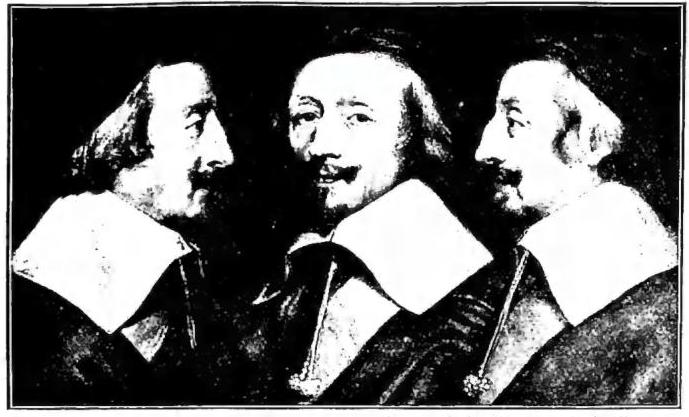
skill and, it must also be said, of so much servility toward the minister Concini, the Queen’s favorite, was obtained on 25 November 1616, with his appointment as minister. But the assassination of Concini at the Louvre, on the orders of King Louis XIII, who, with the help of Luynes, freed himself from his mother’s tutelage and sent her into exile, returned R. to his bishopric and, indeed, for a year, to exile in Avignon. However, in 1619 there was need of him for a reconciliation with the Queen Mother, who had taken refuge among the rebellious nobles; the reward for his skill was the promise of a cardinal’s hat, which he received only on 5 September 1622, after the death of Luynes, jealous of his superior ability. Overcoming, with the help of the Queen Mother, the King’s deep aversion, he entered the Council on 19 April 1624 and in August, as its head, began his grandiose political work.
R.’s primary aim was to repair the errors of foreign policy and “to restore—as he put it—the king’s name among foreign nations to the position it ought to occupy”; he immediately intervened in the Valtellina in order to cut the direct communications between Austria and Spain, but encountered an obstacle in the internal situation. He now did not hesitate to oppose the directives of the Queen Mother, to whom he owed everything, and Maria de’ Medici would eventually become the most bitter enemy of the man whom she had placed beside her son and who no longer wished to serve her. R. dominated the King by satisfying the profound awareness of royal greatness that Louis XIII possessed. The King’s will was weak and wavering, and R. had continually to strengthen it, suggest decisions for the good of the State, and demonstrate their harsh necessity. R.’s foreign-policy program, initially general, gradually developed according to circumstances, needs, and above all the external and internal obstacles, so closely intertwined that only after crushing the Huguenots, court conspiracies, and noble rebellions would he be able to turn freely against the external enemy. R.’s work, with its defects and harshness, must be viewed amid the difficulties and dangers, including personal ones, in which it unfolded.
Not even a month after his accession, R. demanded by ultimatum the withdrawal of the papal troops occupying the Valtellina as a neutral force, and in November 1624 he imposed it by force, creating by this unexpected gesture turmoil throughout Europe. It was not followed, however, by proportionate action, because a Huguenot revolt subsidized by Spain and a conspiracy in which the King’s brother was involved placed R. in difficulty, and he had to accept—amending it only in part—the Treaty concerning the Valtellina with Spain, negotiated at Monzon by the French ambassador according to the directives of the Queen Mother (signed on 2 May 1626). R., however, taking advantage of this relaxation of tensions with Spain, prepared the suppression of the Huguenots as a political party through the siege of La Rochelle (July 1627–30 October 1628), which he conducted with tenacity and skill after repressing a court conspiracy that cost Chalais and Marshal D’Ornano their lives. With a 1,500-metre dam he had closed the harbor and rendered the attacks of the English fleet futile. After the city fell through famine and Catholic worship was restored there, the following year he repressed the last Huguenot revolt in Languedoc and, with the “grace” of Alais (28 June 1629), confirming the religious clauses of the Edict of Nantes, pacified the dissidents and eliminated their threat. R.’s true power may be dated from the victory at La Rochelle. During the siege, the crisis of Mantua had broken out (December 1627), with the succession of Duke Gonzaga-Nevers, opposed by Spain and Austria because he was French. Only in December 1628 did R. persuade Louis XIII to intervene against his mother’s advice; in March 1629, the King forced the passage of Susa and relieved Casale, which was under siege. The struggle at Court, however, remained fierce, but on 14 September 1629, by offering his resignation, R. secured his appointment as principal minister. Thereafter, since Mantua and Casale were besieged by Imperial and Spanish forces, R. and the King occupied
Pinerolo (March 1630) and Saluzzo (July of the same year) and compelled Charles Emmanuel I to make peace. On their return to France, the final battle took place at Court; the King was at death’s door in Lyon, and an order had already been given for R.’s arrest as soon as the King died. But the latter recovered, and on 10 November 1630 in Paris, after a terrible scene between the Queen and R. before the silent King, everything appeared to be over; instead, it was “la journée des dupes”: Louis confirmed his trust in R., while the Queen was confined to Compiègne and then fled. The Netherlands, and would die in exile; following a new revolt, Marshal Louis de Marillac and the Duke of Montmorency were executed (1632).
R. was now stronger at home, but the open and fatal clash with the House of Austria in both its branches was drawing near, because until then he had merely sent financial aid to the Dutch and the Protestants and, not without considerable hesitation, assisted Gustavus Adolphus of Sweden by reconciling him with Poland; now he allied himself with him (13 Jan. 1631), thereby obtaining the evacuation of Italy by the imperial forces and the recognition of the French succession in Mantua: he had, however, imposed upon the Protestant King respect for Catholic worship in the occupied territories. But Gustavus Adolphus’s triumphs and his growing political ambitions soon came to concern R.; later, when the King of Sweden fell on the field at Lützen (6 Nov. 1632), he was seized by the opposite concern, namely the resurgence of imperial power, which impelled him to bring France openly into the German war. A grave decision from the political and religious point of view, but above all a dangerous one militarily, because France had troops barely sufficient for the modest internal struggles, and technically not equal to the armies that twenty years of war had created in Germany and Flanders. The Spanish occupation of Trier, whose Elector had allied himself with France, decided R. and Louis XIII to intervene, with the result that France was invaded from the south and from Flanders, creating a genuine panic in Paris; a prompt reaction drove out the invaders, and from then on the war was fought outside France, with slow but continuous advances in Alsace and Flanders, while Spain was also attacked in Italy and had to face the revolts of Catalonia and Portugal. In 1642 Perpignan was conquered, but victory was still far away when R. died, and he could identify for the King no better successor to his policy than an Italian, Giulio Mazzarino, whose services he had secured by taking him away from papal diplomacy.
Three months earlier he had foiled the Conspiracy of Cinq-Mars, the King’s grand equerry, who, together with other leading figures, had reached an agreement with Spain.
R.’s true achievement was to prepare the power of the monarchy in France and its consequent primary position in Europe, but the difficulties involved in carrying out these aims led him to neglect other important tasks, although he was aware of them. Thus he was only the initiator of French naval power, which had not existed at all
at the time of La Rochelle. He also recognized the need for administrative and fiscal reorganization: under him the first intendants appeared, but when, in 1630, the inevitability of a general war became clear, he deliberately abandoned II. He concerned himself with the colonies and with mercantile companies, but military necessities extinguished all his initiatives. The man who founded the Académie Française (1635) and the Jardin des Plautes, and rebuilt the Sorbonne, where he wished to be buried, would, in peacetime, have shown to a greater degree his love of culture and art. The figure and work of R., especially in domestic policy, through the restoration of the King’s authority over the rebellious nobility, could not be viewed favorably either in his own time or afterward, whatever his merits toward France. The nobility did not forgive the man who had subjected it to the law (among other things, although he had not created the measures against dueling, he finally enforced them with cold severity); nor could Louis XIII glorify so harsh a collaborator. Moreover, certain features of the man lent themselves to dark portrayal: the inexorable harshness of the repression which, although necessary, was often carried out by extraordinary judges; the regal splendor and immense wealth he acquired through the occupation of numerous abbeys; and the grandiose secret intelligence service are realities that cast many shadows around his memory. Yet one must not forget that he served France with ardent and sincere passion, while his opponents were always ready to come to an agreement with foreigners.
In ecclesiastical relations with Rome, too, R. displayed a «lay» spirit: he had been a serious and zealous bishop, but with a spirit of conciliation toward dissenters; highly skilled in theological science, around 1636 he began that Traité de la perfection du chrétien, a refined, though not original, exposition of prayer and contemplation; as a minister, even though a cardinal, he regarded the interests of the State as paramount. He often spoke threateningly and harshly with the nuncios, but always avoided open conflict: he was fortunate to have dealt only with Pope Urban VIII, who was inclined toward France after his nunciature in Paris and convinced that it was a necessary counterweight to Spanish and Austrian claims; for this reason the Pope reacted weakly to the abrupt expulsion of his troops from the Valtellina, but he certainly could not oblige R. to the point of taking the Empire’s side in the German war. In France there was also, in the Parliaments and at the Sorbonne, a lively current of hostility toward the papacy, and R. acted several times as a mediator to prevent its excesses; nor is it right to believe that he himself first incited it, only to act as mediator after achieving his own aims. Even as minister, he could not welcome the excessive agitation of the Parliaments, and often his decisions were merely expedients for overcoming serious difficulties. Supreme abbot of the Benedictines, he would also have wished to possess in France the powers of a legate, and this accords with his desire to bend every resistance to royal and personal absolutism, the sole remedy, in his view, for the disorder of France. In the financial straits that gripped him and drove him to unheard-of harshness in order to raise money, he showed little regard for the property of the clergy. But the gravest reproach that Rome had the right to make against R. was that French intervention in Germany, even though undertaken for political ends, had prevented there the Catholic restoration which at certain moments had appeared possible with the victory of the imperial arms; for R., however, it was a political dogma that French security necessarily excluded the political unity of the two neighboring countries, Germany and Italy.
1907 in Paris; concerning their authenticity V. BERTRAND, LOUIS, in Revue historique, 141 [1922], pp. 40–65, 198–227. For the political testament cf. W. Mommsen, R.5 politisches Testament, Berlin 1926; L. André, Testament politique de R., in Revue historique, 73 (1949), pp. 55–71; his letters, etc., are in G. D'Avenel, Lettres... de R., 8 vols., Paris 1853–74, and E. Griselle, Louis XIII et R. Lettres, there 1911. Among the numerous works on R., cf. (in addition to the general histories of France, especially Lavisse) G. Hanotaux and La Force (duc de), Histoire du card. de R., 6 vols., there 1893–1947 (fundamental). Cf. also G. D'Avenel, R. et la monarchie absolue, 4 vols., there 1880–87. On specific moments: E. de Vaux de Foletier, Le siège de la Rochelle, there 1931, passim; L. Batiffol, R. et Louis XIII, there 1934; B. Baustaedt, R. und Deutschland, Berlin 1936; C. J. Burckhardt, R., der Aufstieg zur Macht, Munich 1937; L. Batiffol, Autour de R., Paris 1937; G. Pagès, Autour du grand Orage. R. et Marillac : deux politiques, in Revue historique, 179 (1937), p. 63 ff.; A. Leman, R. et Olivarès, Lille 1938; W. Andreas, R., Leipzig 1941; J. Canu, Louis XIII et R., Paris 1944. For Italian policy: R. Quazza, La guerra per la successione di Mantova e del Monferrato, 2 vols., Mantua 1926, passim; S. Foà, Vittorio Amedeo I, Turin 1930, passim; R. Bergadani, Carlo Emanuele I, there 1932, passim. For relations with Rome: A. Leman, Urbain VIII et la rivalité de la France et de la maison d'Autriche de 1631 à 1635, Lille 1921; Pastor, XIII, V. indice. For the administrative aspect: G. Pagès, La monarchie d'ancien régime en France, Paris 1928; G. zu Mecklemburg, R. als merkantilistischer Wirtschaftspolitiker und der Begriff des Staatsmerkantilismus, Jena 1929; H. Hauser, La pensée et l'action économique du card. de R., Paris 1944; R. von Albertini, Das politische Denken in Frankreich zur Zeit R.1, Cologne 1951. On spirituality: P. Pourrat, La spiritualité chrétienne, III, Paris 1944, pp. 486–91.