Machine translation of the 1948–1954 Italian original. The original text is authoritative.
RICHER, EDMOND. - Gallican jurist, born in Chaource on Sept. 15, 1560, died in Paris on Nov. 29, 1631.
Syndic of the Sorbonne (1602-18), he was a defender of the "liberties of the Gallican Church" and of the "prerogatives"
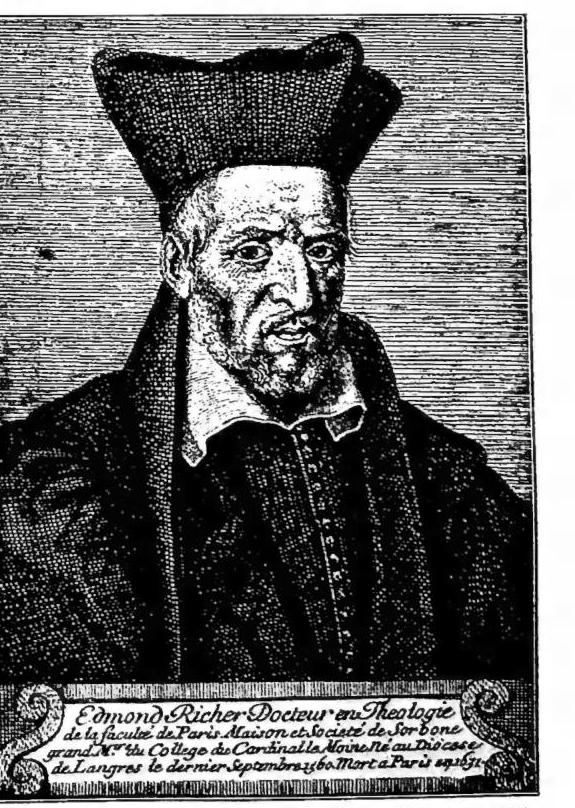
(from E. Richer, Histoire de la Pucelle d'Orléans. Del ms. fr. 1635 della Bibl. naz. di Parigi, a cura di P. R. Dumand, Parigi 1911) RICHER, EDMOND - Portrait. 17th-century engraving.RICHMOND, DIOCESE of - View of the city of R. (photo Uli)of the University, fiercely attacking the religious Orders, especially the Jesuits. Dismissed, he defended his point of view in numerous writings, refusing any retraction. His literary activity was multifaceted, ranging from rhetorical-grammatical pamphlets to the edition of the Works of Gerson (Paris 1606), which he commented on with Gallican intents. His principal work is the De ecclesiastica et politica potestate libellus (ibid. 1611), where he expounded the theses of political Gallicanism concerning the divine power of kings and kingdoms and the absolute independence of civil power. The authority of the Church would be purely spiritual and would depend on the sovereign in mixed and temporal matters, such as the convocation of general councils and the administration of property. The supreme pontiff as the ministerial head of the Church should be subject to the general council, to which alone, as the representative of the universal Church, belongs the fullness of power and infallibility. In bishops, jurisdiction would derive immediately from God. R.'s work was condemned by Paul V (1612) and by the General Assembly of the French clergy.
BIBL.: A. Puyol, E. R., Paris 1876 (fundamental); J. Carreyre, s. V. in DThC, XIII, coll. 2608-2702; V. Martin, Le gallicanisme et la réforme catholique, Paris 1919, p. 361 ff.; id., Le gallicanisme politique et le clergé de France, ibid. 1929, V. index. Piero Sannazzaro
Cite this article
“RICHER, EDMOND.” Enciclopedia Cattolica, vol. X (1953), p. 519. Azione Romana digital edition, https://azioneromana.com/article/richer-edmond.
 Enciclopedia Cattolica