
NEVERS, DIOCESI di. – Capital city of the department of Nièvre, at the confluence of the river of the same name with the Loire. The territory of the diocese coincides with that of the department and extends over 68,165
km², with a population of 248,559 inhabitants (1946), of whom 240,000 are Catholics. It comprises 4 archpriestships and 25 deaneries with 309 parishes, served by 235 diocesan priests and 7 religious priests, and has two seminaries, major and minor; it has 2 male and 34 female religious communities (Ann. Pont., 1951, p. 287). The diocese is suffragan to Sens. The patrons of the diocese are SS. Cyrus and Julitta.
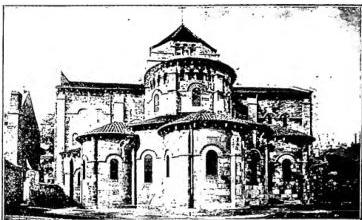
(courtesy of Prof. E. Jovi)
NEVERS, DIOCESI di – Apse of the church of St. Stephen (1063–95).
during the Hundred Years’ War and the religious conflicts. The catalogue of the bishops is transmitted by two liturgical books of N.; by an 11th-century Sacramentary (Paris, National Library, ms. lat. no. 17333, p. 149), commissioned by Bishop Hugh the Great (1013–63), which extends to his predecessor Gerard; and by a 9th-century Evangeliary, to which a list was subsequently added that also includes Bishop Hugh (British Museum, ms. Harleianus 2790, fol. 19'). Robert of St-Marien (Auxerre Codex 132, p. 91) has a catalogue extending to Theobald (1177–89), in which the first ten bishops are indicated as having their see at the church of SS. Gervasius and Protasius, while the others are indicated as being at St. Cyriacus; the change in the cathedral’s name took place under Charlemagne. The first bishop listed is Tauricianus, present at the Council of Epaona in 517; followed by a series of bishops who took part in the various councils of France, namely Rusticus or Rusticius at Orléans in 538 and 541; Aridius there in 549 and at Paris in 552; Eoladius at Lyon in 570; Agricola likewise at Lyon in 581 and at Mâcon in 581 and 585; Rauracus at Paris in 614, at Clichy in 627, and at Chalon-sur-Saône in 650. Jerome obtained from Charlemagne the restitution of his church’s possessions; Jonah attended the Council of Paris in 829; Erimannus was favored by Charles the Bald; Abbo was at Soissons at the Council of 866; Eumenus is mentioned in a diploma of Charles the Fat from 886 and attended the Council of Mehun-sur-Loire in 891; Franco is mentioned in documents of King Odo from 894, 897, and 903. In the later period, mention may be made of Cardinals P. Bertrand (1320–22); P. of Bourbon-Vendôme (1540–46); then E. de Cherry (1635); G. d’Augnes (1740); J. A. Tinzeau (1752); P. de Seguiran (1782).
The diocese was suppressed on 15 July 1801 and annexed to the new diocese of Autun; it was restored precisely by the Concordat of 11 June 1817, but in fact only in 1823.
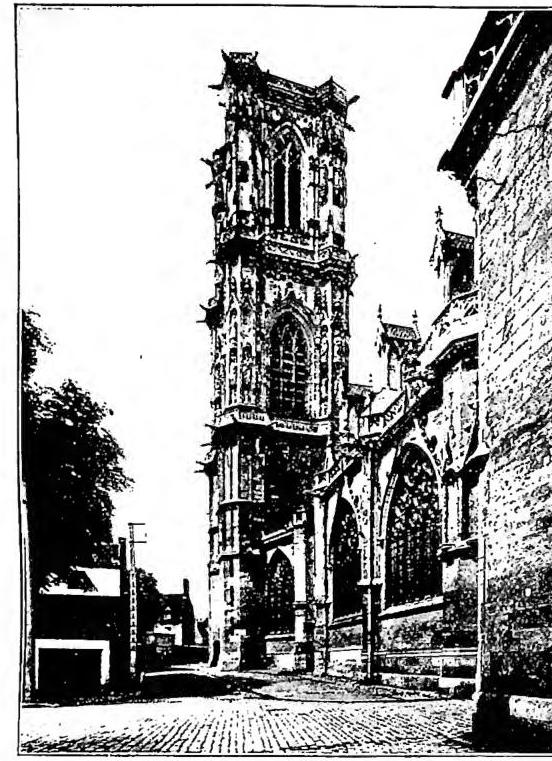
(from the folder of Prof. E. Josi)
NEVERS, DIOCESI di – Cathedral tower (15th century).
Recent excavations (1947 and 1949–50) brought to light the ancient Baptistery, which dates from the 6th century. It is an octagonal hall with eight alternating rectangular and semicircular apsidioles, of the type of the baptistery of St. John ad fontes in Milan, called octachorum (CIL, V, p. 617, no. 2). Eight columns, of which two survive—one in green marble and the other in white marble—supported the dome, whose interior was covered with gold-ground mosaics; there is a drainage channel for the water, but no trace of a supply channel. The building, of the type of the baptisteries of Albenga and Fréjus, shows evidence of restoration between the end of the 8th century and the beginning of the 9th (Bishop Jerome: 795–815), and of alterations after the fires of 993 and 1028 (R. Louis, Le baptistère de la cathédrale de N. du VIe au XIIe siècle, in Bulletin monumental, 108 [1950], pp. 153–80). In the Treasury, an ivory plaque from the 5th century presents on the left the scene of the Child Jesus in the Manger with the ox and the ass, and on the right the Epiphany with the three Magi (Bulletin monumental, 42 [1884], p. 711). In 1724 Lord Harley acquired the Sacramentary of the church of N. (today Harley collection, mss. 2991–92 of the British Museum in London). The 10th-century manuscript appears to be a copy of that of the monastery of St. Columba at Sens, with certain modifications for the church of N. Another Sacramentary is now in the National Library of Paris (ms. 17333), written for Bishop Hugh (1011 or 1013–65) and containing fine miniatures. An Evangeliary donated by Bishop Ermannus (840–60) to the cathedral of N. is also now in the British Museum (Harley collection, ms. 2790). The abbey church of St. Stephen, erected between 1066 and 1097, the year in which it was consecrated, is connected with the Romanesque school of Auvergne, with Burgundian influences; it has three naves with transept, choir, and ambulatory, and an upper gallery with paired windows (H. Du Ranquet, Influences auvergnates dans l'église St Etienne de N., in Revue d'Auvergne, 1909, pp. 102–22). Today it is a parish church. St. Martin, an 8th-century monastery, was restored around 1130 during the episcopate of Bishop Fromond (L. Sery, L'abbaye de St Martin de N., Nevers 1902). St. Savior, a Benedictine monastery from the end of the 9th century, was united with the Seminary in 1709. St. Victor, a Benedictine priory founded in 1053, was later transformed into the monastery of St. Mary of Charity. Spanish and Flemish elements can be found in the façade of the church of St. Mary (first half of the 17th century). The Jesuit College «à la Flèche» was built by the Jesuit E. Martellange. In the former park of the dukes of N. stands the chapel of the monastery of St-Gildard, an ancient priory, now the motherhouse of the Sisters of Charity of N.; it preserves the body of St. Maria Bernarda Soubirous (v. 1860–79), canonized in 1933. Near the Cathedral stood the episcopal residence (18th century), now used as the Frédéric Blandin Municipal Museum, containing a collection of the ceramics of N., a city where this industry was introduced in the 16th century. The Ducal Palace, erected in the 15th and 16th centuries, now serves as the courthouse. The Archaeological Museum preserves notable decorated capitals, such as those from Garchizy with the story of St. Martin, those from St. Savior with monsters and a musical ass, and those from the destroyed St. Peter’s (E. Mâle, L'art religieux en France au XIIe siècle, Paris 1925, passim and fig. 244). It also preserves the Bible of Souvigny.
Nella chiesa di St-Arigle fu trovato un sarcofago merovingico contenente le reliquie del Santo (m. nel 594) e avente all'esterno una decorazione di sette croci, Namur (v.), e ad uno trovato in un gruppo di tombe a St-Parize-le-Châtel nel 1899, e a due dello stesso genere oggi nel Museo di N., provenienti l'uno dagli scavi nella chiesa di St-Genest, l'altro da quelli dell'antica abbazia di St-Martin. Nel 1858 il sarcofago venne estratto e sembra perduto (J. Massillon-Rouvet, Le sarcophage de St-Parize-le-Châtel [Nièvre], in Bull. archéol. du Comité, 1899, pp. 350-55). A 73 km. a nord-est di N. è situata Clamecy, già Panténor, che venne creata diocesi da Innocenzo IV nel 1245, con giurisdizione limitata all'ospedale fondato da Guglielmo IV di N. e alla chiesa di S. Martino e con il titolo di vescovo di Betlemme. Primo vescovo fu Goffredo (1245-51); l'ultimo Fr. Ch. Durant de Lironcourt (1777-1801). Fu soppressa nel 1801 e il titolo è passato all'abbazia nullius di St-Maurice in Svizzera.