
ROMANO-BARBARIAN LAWS. – This is the name given to three legislative compilations produced in the West in the sixth century: the lex Romana Wisigothorum (or Breviarium Alaricianum), the lex Romana Burgundionum, and the Edictum Theodorici.
Compiled at the initiative of three barbarian rulers (Alarico II, Gundobado, Teodorico), and demonstrating the attraction exerted by Roman legal wisdom upon these foreigners settled in the territories of the Empire, they differ from one another essentially in this respect: whereas the first two were intended to regulate the status of Roman citizens living in the territories occupied respectively by the Visigoths and
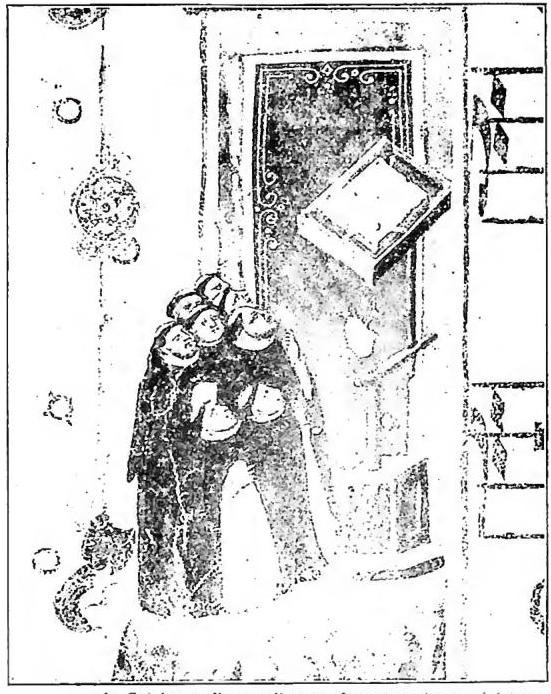
LEGGIO - L. choir - Miniature of a page from a Gradual of Italian origin (15th century). Dominicans in the act of singing the Mass of s. Domenico.
to the Burgundians, the Edictum was imposed for observance both upon the Romans and upon the Ostrogoths subject to Theodoric; and, even in its name, it sought to reaffirm the latter’s ideal dependence upon the Emperor of the East, to whom alone the right to issue leges would have belonged.
The lex Romana Burgundionum was promulgated, in all probability, a few years after the Breviarium Alaricianum (v. ALBERICO DI REIMS) and before the death of King Gundobad (516). Unlike the Visigothic law, the Burgundian law does not consist of a series of extracts from Roman sources, but represents an organic body of norms, divided into 46 titles. The material is drawn from the Gregorianus, Hermogenianus and Theodosianus codes; some Novellae are also included, the most recent of which is by Anthemius, as well as the Sententiae Paulus (v.) Gaius (v.), probably a summary of the Institutiones. In some old editions the lex Romana Burgundionum is designated by the name Papianus; this is due to the fact that in certain manuscripts the Burgundian law follows the lex Romana Wisigothorum, whose final chapter contains a passage by Papinian (v.), and that some copyist regarded this chapter as the first of the lex Romana Burgundionum, so that Papianus (from Papinianus) came to be considered the title of the compilation.
The lex Romana Burgundionum was first edited by Cuiacius in 1566; the most recent Italian edition is in Fontes iuris Romani anteiustiniani (II, Florence 1940, pp. 713–50).
The Edictum Theodorici, promulgated after 503, is divided into 115 chapters, whose material is drawn from the Gregorianus, Hermogenianus and Theodosianus codes, and from the post-Theodosian Novellae. Among the works of jurisprudence, the Sententiae attributed to Paulus were also used here; it is uncertain, however, whether other works were directly consulted, all the more so since the chapters of the Edictum do not indicate their sources and do not even preserve the original text, which is invariably paraphrased.
The compilation was first edited by P. Pithou, on the basis of two manuscripts now lost; the definitive edition is that of F. Bluhme (in MGH, Leges, V, p. 149 ff.), on which the most recent Italian edition is likewise based (in Fontes, cited above, pp. 684–710).