
BENEDETTO
d'ANIANE, saint. — Benedictine, the second father of Western monasticism, born ca. 750, died at Cornelimünster near Aachen
on 11 February 821. Son of Aigulfo, count of Maguelone (Languedoc), of the ancient Visigothic aristocracy, he was originally named Vitiza and was educated at the court of Pipino, in whose service, as well as that of Carlomagno, he remained until the age of 27. Following the danger of death he experienced at Pavia (he had wished to save a brother who was about to drown in the Ticino), he put into effect the resolution he had taken three years earlier to withdraw from the world. On the advice of a holy solitary, he entered the Benedictine monastery of S. Sequano (St-Seine) near Dijon (774), devoting himself to a penitential and extremely austere life. He even thought that the Rule of s. Benedetto was not sufficiently strict, and preferred the Rules of s. Basilio and s. Pacomio.
After five years he returned to his homeland and founded, on the banks of the little river Aniane, a monastery according to his own ideal; but experience having taught him that extreme poverty and austerity were not suitable for everyone, he began to appreciate the moderation of the Rule of s. Benedetto, of which he subsequently became the greatest propagator. Little by little he extended his influence over other monasteries in southern France, and Ludovico il Pio, then king of Aquitaine, appointed him superior of all the monasteries in his kingdom, while Carlomagno granted him privileges to ensure the free election of abbots. In 817 the emperor Ludovico il Pio sent him as abbot to Marmoutier near Saverne (Alsace), but, wishing to have him closer as an adviser, he recalled him to the court at Aachen, appointing him abbot of the monastery then founded on the little river Inde, two leagues from Aachen, today
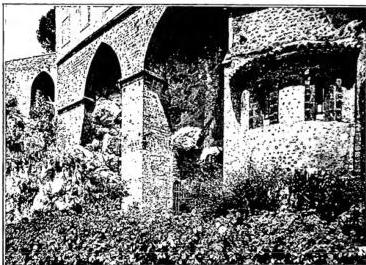
Cornelimünster. In 817 a great assembly of abbots of the empire met at Aachen to deliberate the reform of the monasteries. B. was its guiding spirit, and the prescriptions adopted are attributed to him. His work in this regard has been judged variously by modern scholars. Certainly, he freed many monasteries from secular abbots, who were often a cause of disciplinary and economic ruin. He is also responsible for the idea of what was later called a Congregation, fully implemented at Cluny. On the other hand, with the introduction of new liturgical rites not contemplated by the Rule of s. Benedetto, such as the Office for the Dead and the Hours of the B. V. Maria, the monk spent a large part of the day in choir, and the proper balance between prayer and work was in some way disturbed.
The two principal works written by B. also contributed to consolidating the reform: Codex regularum monasticarum et canonicarum, in which he gathered all the Western and Eastern rules known to him. The work was published in 3 quarto volumes by Luca Ostenio (v. HOLSTE), Rome 1661 and Paris 1663. Olstenio added other texts, which were further increased in the edition by M. Brockie, 6 folio volumes (Augusta 1759), and also in PL 103, 303–702, where, however, many texts are indicated only by references to other volumes in the series. The other work, the Concordia regularum, was intended to show the agreement between the Rule of s. Benedetto and the teaching of the other rules already in use in the Church. Each chapter of the Benedictine Rule was clarified and commented upon with numerous corresponding passages. It was edited by H. Ménard (Paris 1638), and in PL 103, 702–1380. Among his other writings, noteworthy is the theological treatise against the adoptionism of Felice d'Urgel: PL 103, 1381–1413. The Saint’s name is absent from the Roman Martyrology. His feast is celebrated on 11 or 12 February.