
ANTIPHONARY. — antiphon (v.); today, however, when one speaks of an a., one means the liturgical book containing all the chants used for the Divine Office: thus, not only antiphons, but also hymns, versicles, etc. Not infrequently, especially among scholars of Gregorian chant, the term is used to designate the ensemble of liturgical chants traditionally attributed to s. Gregorio Magno, particularly when the adjective Gregorian is added. Both the name and the contents have undergone various changes over the centuries. In the Middle Ages one finds the designations Liber antiphonarius, Antiphonarium, Antiphonale, with varying meanings according to time and place. In the eighth century, for example, a. meant the collection of chants used for the Mass, whereas the ensemble of chants for the Office was called Liber responsal. But from the time of Amalarius, that is, from the ninth century onward, the book of chants for the Mass was called Graduale, as today (or also Antiphonale Missarum), while that of the chants for the Office was called a. This, however, in turn came to be divided into two distinct books: the collection of chants used for the daytime Offices retained the name a., to which the designation diurnal was often added, whereas the collection of chants for the nighttime Offices came to be called Responsoriale. This is also the current terminology. Between the tenth and thirteenth centuries, the a. too underwent a process analogous to that undergone by the Sacramentary, which became the Plenary Missal. The Psalter and the Hymnal were added to the primitive antiphonary-responsorial, and then also Alcuin’s Lectionary and Homiliary, thereby producing the plenary a. Later, when copies of it were made without musical notation, the Breviary arose, so called because, despite its relatively small size, it was greatly reduced and abridged in comparison with its predecessor.
Ancient and modern authors attribute the a. to s. Gregorio Magno. The question has been much debated among
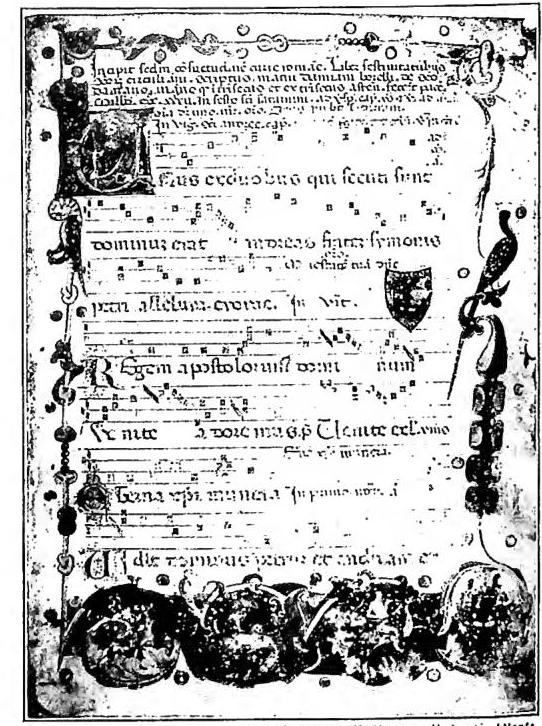
ANTIFONARIO - Liber de l'eteritibus Sanctorum, copied by Damiano Borelli of S. Damiano (Asti), in the year 1332. Asti, Seminary library.
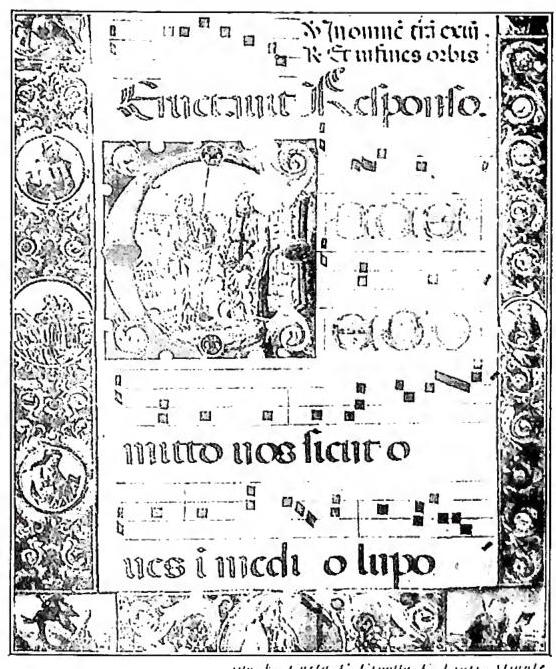
ANTIFONARIO - A. with miniatures from the Ferrarese school (15th century). Ferrara, Cathedral Chapter.
Scholars, especially toward the end of the last century, took a firm stand against the tradition. Although others before him had raised doubts and objections to the common opinion, Augusto Gevaert removed the authorship of the a. from s. Gregorio Magno and attributed it to Pope Gregorio II (715–31). G. Morin replied to Gevaert; in a brief but penetrating analysis, he examined all the arguments for and against and concluded by affirming the claims of tradition. A whole series of scholars sided with Morin, and the traditional opinion soon prevailed. It cannot, however, be asserted that the controversy has been definitively settled in favor of s. Gregorio Magno, and there have also been recent attempts in the anti-Gregorian direction. In any case, the traditional thesis has excellent arguments in its favor, while the difficulties opposed to it are for the most part negative in character. No one, moreover, has ever claimed that s. Gregorio was the author of the a., as he was, for example, of the Regula pastoralis or the Dialoghi: his personal work in this regard must have been analogous to that commonly accepted for the Sacramentary bearing his name. He must have taken the body of chants from the 4th century, together with the additions and modifications of the two following centuries, selected those that seemed most suitable to him, recast them, «imprinting upon them», as Morin aptly says, «the characteristic marks of his genius: naturalness and description, simplicity and harmony», and then distributed them throughout the liturgical year that he had reordered. He probably also added something of his own, in accordance with the needs of the new feasts; but the pieces he composed cannot have been numerous. Even if the great Pontiff’s personal activity is reduced to these proportions, we believe that the a. does not bear his name unjustly. This work of revision and refinement was, at least in part, definitive: no one afterward dared lay hands upon what was believed to have been inspired in the holy Pope by the same divine Spirit. The authentic a. of Gregorio was preserved for many years, according to Giovanni Diacono, who wrote his life, in the Lateran, fastened by a small chain to the high altar of the basilica. The Schola cantorum, founded by the same Pope, regarded it as one of the most cherished and precious relics of its founder.
The popes during the 7th, 8th, and 9th centuries concerned themselves with the chants of the a.; among them Bonifacio IV, a pupil of the schola and Greek by birth, deserves mention. The offices of the Holy Cross, the Annunciation, and the Nativity of Our Lady date from his pontificate, and in part also that of the Purification. It is easy to see that these chants display a style quite different from the Gregorian ones. Some are taken wholesale from the Greek liturgy, both in their text, which was translated into Latin, and in their melody. Other popes who took an active interest in chant were Gregorio II and Adriano I (772–93), who, at the request of the Frankish kings, sent copies of the Roman liturgical books to Gaul, thereby giving them a new diffusion. We also know the names of three abbots of monasteries near S. Pietro in Rome who worked diligentissime on the chant repertory: Cataleno, Mauriano, and Virbono.
The oldest manuscripts of the a. for the office are represented by the codex in the National Library of Paris, Lat. 17. 436, from the second half of the 9th century and originating in the abbey of S. Cornelio at Compiègne, and by cod. 399 of S. Gallo from the 10th century, called the a. of the blessed Hartker, after the name of the monk who wrote II. From the 9th through the 14th century, manuscripts of the a. abound, reproducing the oldest body of material but with all the additions of new offices created from the 11th century onward. The new pieces, however, are easily recognizable, and increasingly differ from the Gregorian style, even though they are not without artistic merit. Particularly noteworthy is the type of a. established between the 11th and 12th centuries in Rome, in the two basilicas of the Lateran and S. Pietro. This was the a. of the Curia, which later passed into the breviary of Pio V and consequently also into the present breviary and a. The most remarkable illuminated a. are those of the 13th century in the Civic Library of Padua, and that of Girolamo da Cremona in the Piccolomini Library of Siena.
From the 13th century onward, musical interest in the nascent polyphony, ignorance of the ancient rules, negligence, and other causes prepared the decline of sacred chant. Nevertheless, until the 16th century, despite the poor taste of its performance, the structure of the chant remained unaltered, and the ancient melodies continued to be reproduced as far as possible. But in 1582 there appeared the famous Direktorium chori of G. GUIDETTO (v.), who had the unfortunate idea of correcting the chant according to the tastes of his time, assigning in particular all groups of notes to the accented syllable. The way was now open to every sort of contamination. In 1614–15, the printing house of Cardinal de’ Medici published the edition of the a. later called Medicea, in which the ancient chant was subjected to a veritable mutilation: melismas were suppressed or shortened, and material was changed, displaced, and even newly composed. Nothing remained but a bare and lifeless skeleton. This affront to art was attributed to Palestrina, but more careful research has dispelled the legend. In 1871, the publisher Pustet of Regensburg reprinted the Medicea, which in 1873 was declared official by the Holy See. Meanwhile, however, the time was ripening for restoration. Liturgical studies, especially through the work of Dom Guéranger, were flourishing anew. Many scholars began to take an interest in the ancient Gregorian melopeia and to consult the old manuscripts that presented it as it had been in its golden age. Among these we recall G. Pottier and A. Mocquereau, both monks of Solesmes, who placed themselves at the head of the restoration movement.
The favor of Leone XIII first, and then the accession of Pio X to the papal throne, marked the triumph of the Gregorian cause. Pio X established a special commission to restore the chant ad fidem codicum. As the fruit of so many studies, the Graduale appeared in 1908, and in 1912 the a. for the daytime offices. It cannot be said that this official Vatican edition meets all the requirements of Gregorian paleographical criticism; but it certainly marks the beginning of the—
ANTIFONARIO - ANTIFONE O.
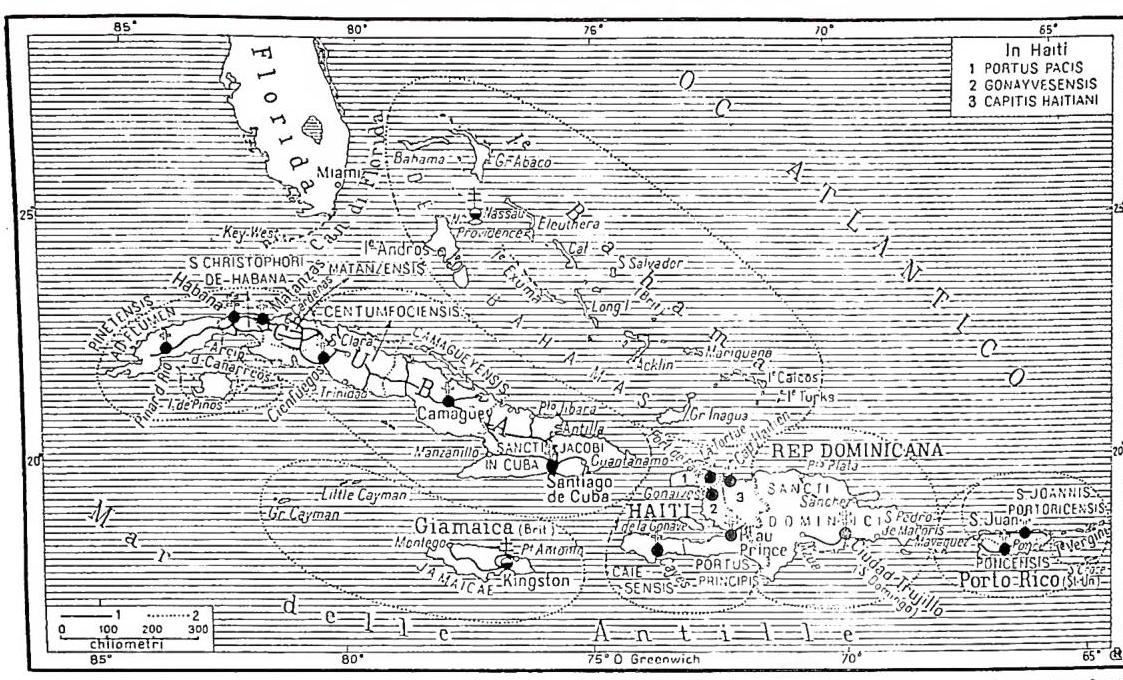
ANTILLES — The Greater A. 1. Railways; 2. Boundaries of ecclesiastical jurisdiction.
ANTIPHONS O. — On 17 December, in the Roman liturgy, a series of special antiphons begins at the Magnificat in preparation for the feast of Christmas. They are called Antiphonae Maiores, because of the particular solemnity with which they are sung, or Antiphonae O, because they all begin with this interjection. Today there are seven, but this number has not always been constant. In the Middle Ages they reached nine in some churches, and elsewhere as many as twelve. One of them, no longer in use, was addressed to the Virgin: O Virgo virginum; another to the archangel Gabriel: O Gabriel; a third to the apostle St Thomas: O Thomas Didyme, whose feast falls precisely during these ferial days. The others, less frequent even in the Middle Ages, were: O Rex pacifice, O Mundi Domina, and, in the form of an apostrophe to the holy city: O Hierusalem! For the most part they were sung at the Magnificat during Vespers, but in some places they were performed at the Benedictus. The primitive group seems to have consisted only of the seven a. in use today, while the others would have been added later.
It is not possible to specify the origin of these a.; certainly they date back to very remote times. The oldest documents that make them known to us are the responsorial (second half of the ninth century), published by the Maurist Fathers among the works of St Gregory the Great (PL 78, 732–33), and several later Roman antiphonaries, edited by Cardinal G. M. Tommasi (Opera omnia, IV, ed. Vezzosi, Rome 1749, pp. 1–360). They are also mentioned by Amalarius, Berno of Reichenau, Honorius of Autun, Durandus, and others. Amalarius of Metz (780–850) explicitly states that they were of Roman origin and that they were introduced into Gaul in the century preceding his own. It may therefore be held that they originated in the seventh or eighth century, perhaps even shortly after the death of St Gregory the Great (604). They open the week of immediate preparation for Christmas, which has particular liturgical importance. These final ferial days, from 17 to 25 December, in fact form the core, as it were, of Advent, and probably also represent the primitive nucleus of this season, since one of the earliest documents we possess concerning Advent, the Council of Saragossa of 380, contains special prescriptions for the period from 17 December to 6 January. It is therefore easy to understand how these ferial days came to be enriched with special liturgical pieces. The author draws inspiration almost always from Sacred Scripture, but selects and combines the texts with great freedom. All seven a. are addressed to the Messiah, who is invoked with the most beautiful epithets and the most expressive symbols. Each ends with veni!, an ardent, almost plaintive cry, followed by a question related to the titles attributed to Christ.
The singing of these a. has always been regarded as solemn and was often accompanied by particular ceremonies and great outward pomp. Customs, however, vary from place to place. It is known, for example, that in the eleventh century the faithful flocked in crowds to hear them. Today they are almost entirely ignored by the people. The rubrics still regard them as solemn, since they prescribe that they always be sung standing, even by the canons, and performed in full, both before and after the Magnificat. For no reason may they be omitted; rather, they must all be sung, each on its appointed day.
ANTIFONE O. - ANTILLE
Characteristic is the melody with which they are clothed, of sound Gregorian workmanship, which also indicates their respectable antiquity. It is in the second mode, the same for all, though with the differences imposed by the diversity of the texts. An intense longing for the Messiah is noticeable in them, harmonizing very well with the meaning of the words.
BIBLI: Amalario di Metz, Liber de ordine Antiphonarii, chap. 13; Durando di Mende, Rationale divinorum officiorum, VI, chaps. 2, 5; P. Guéranger, L'Année liturgique, I, Parigi 1878, pp. 526-50; H. Leclercq, s. V. in DACL, XII, cols. 1817-19; Les Grandes Autismes, in Le Messager des Fidèles, Maredsous 1886, pp. 512-16; L. Bauduin, Notre piété pendant l'Avent, Mont César 1919, pp. 90-97.
Pellegio Visentin
ANTIGO-
NISH, DIOCESIS
of. — In Nova
Scotia, Canada, a
suffragan diocese of
Halifax.
On 21 Sept. 1844
the diocese of
Nova Scotia, that is,
Halifax (erected on
15 Feb. 1842), was
divided to establish
the diocese of Ari-
chat. On 23 Aug. 1886
the latter was
transferred to A.
and currently
includes the counties of
A., Cap Breton,
Guysborough, In-
verness, Pictou,
Richmond and Victo-
ria. Statistics:
102,183 Catholics,
out of a total of
256,000 inhabitants; 119 parishes and 148 diocesan priests.