
GRADUALE. –
I. THE BOOK
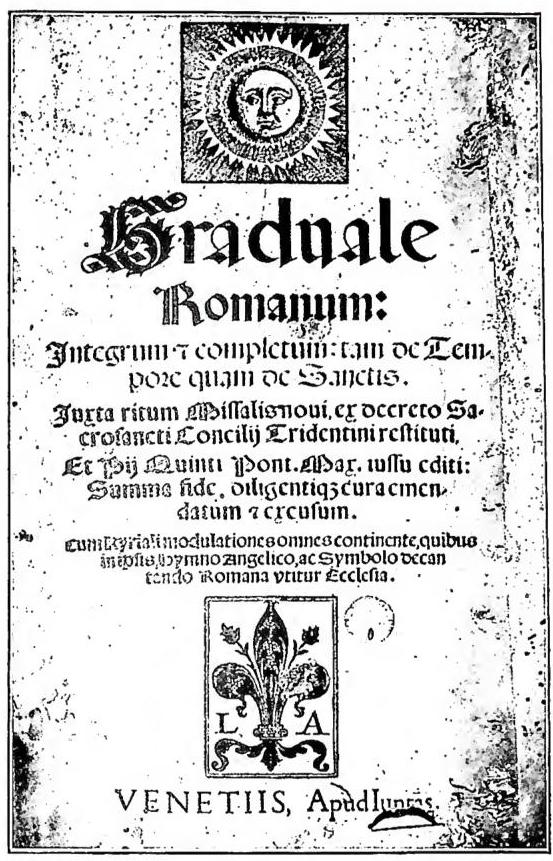
The present Liber gradualis, an excerpt from which, later combined with parts of the Antiphonary, constitutes the very widespread Liber usualis, was approved by the Church as a collection of the chants of the Mass in the 1907 Vatican edition. In addition to the ancient core, it contains all the subsequent additions resulting from the introduction of new feasts into the calendar.The definitive designation of the liturgical books may go back to Amalarius of Metz (9th century). The term Antiphonary was first applied to every collection of liturgical chants. The term was later reserved for the manuscript containing the antiphons both of the Mass and of the Office. Finally, “Antiphonary” came to mean only the book containing the chants of the Office, including the responsories: the “Cantatorium” or “liber Gradalis” or “Gradualis,” which at first incorporated the chants of the Mass intended for the
Ravennate type, tripartite, with a polygonal apse, erected by Patriarch Elia (571–586) on the walls of an earlier basilica, itself built around a small rectangular hall, later provided with an apse, with a baptismal basin (beginning of the 5th century; a funerary mosaic dates from the end of the century). It has its original mosaic pavement, the largest from the 6th century, though with extensive areas of restoration, and contemporary marble plutei; at the sides of the apse are two martyria and on the right the salutatorium, all with fine mosaic pavements. In the cathedral treasury, two silver capsellae (5th and 6th centuries) and a repoussé silver altarpiece (1372) should be noted. Smaller is S. Maria delle Grazie, with an apse incorporated into the rectangular plan (5th and 6th centuries); between the two basilicas stands the octagonal baptistery (5th century). Near the southern end of the enclosure, the basilica of S. Agata has been excavated, arising in the
soloist, later became the collection of all the chants of the Mass. The responsorial chants of the Mass entered the “Liber Responsorius,” intended for the responsories of the Office, the “Liber Sacramentorum,” compiled for the celebrant (from the 10th–11th centuries onward, the “Missale plenarium,” heir to the “Liber Sacramentorum”), which also abridged the chants of the Mass and the readings.
II. THE CHANT
G. is the chant performed during Mass after the reading of the Epistle. The Introit, the Offertory, and the Communio—chants that accompany an action—were introduced into the celebration of Mass after the G., the Tractus, and the Alleluia (which replaced the Tractus). The latter follow a reading, whether the primitive reading from the Prophets that has remained in certain Masses (the four Ember Days), or the second reading, that of the Apostle, the present-day Epistle: they are chants of repose, or rather of contemplation, intended to give the listener time to penetrate its teaching and, with the aid of music, to arouse those affections that form the concluding part of meditations according to modern methods. The chants called action chants, on the other hand, must keep the attention of the faithful alert while the rite is being carried out: procession, oblation, or Communion. The chants following the readings are credited to the Synagogue; the others are an innovation of the Church.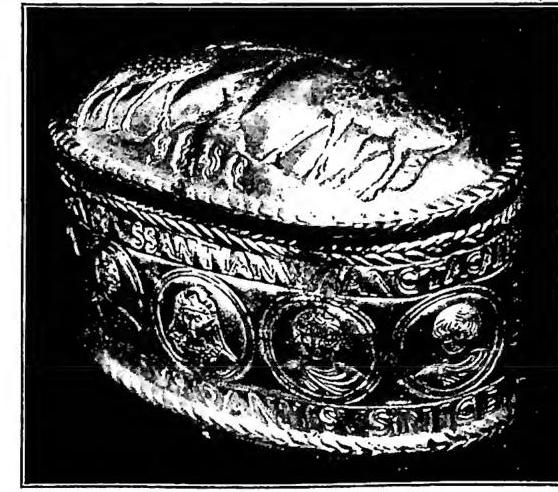
(phot. Soprintendenza, Trieste)
GRADO – Silver capsella of the Cathedral (beginning of the 5th century).
In some places, e.g., in England, the refrain continued to be repeated after the verse until the 13th century. The proper responsorial form of the G. in fact requires that the first part of the chant be intoned and sung in its entirety by the soloist: the choir repeats the refrain. The soloist, rested, then performs an ornate verse, and the choir repeats the refrain; after all the verses, the choir takes up the refrain once more, and then the entire first part of the chant again from the beginning. If this chant had been very ornate, an excessive length and a disproportion in the celebration of Mass would have resulted: s. Augustine excuses himself in one of his sermons because the psalmus responsorius had lasted longer than he wished: the psalm chosen had 24 verses! (Ps. 138). This is one reason for admitting an evolution in the melodic style of the Responsorium graduale. It is probable that at the beginning not only the first part intended for the choir, but also the soloist’s ver-
se was more or less syllabic: evidence for this opinion is found in the fact that in the Responsories of the Office the soloist’s part has remained in this style, indeed with fixed formulas, whereas the part intended for the choir is much more varied and ornate.
The soloist of the Responsorium graduale was a deacon until the time of s. Gregory, as he still is in the Ambrosian liturgy. Excessive zeal for vocal performances led s. Gregory himself, at the Roman Council of 595, to remove this privilege from the deacons. In the 7th century in Spain the number of soloists for the verse of the G. could be two or three (cf. s. Isidore of Seville, De ecclesiasticis officiis, I, cap. 9); at Rome one must wait until the 12th century to record this change: for five centuries, the soloist remained single and was chosen from among the most capable members of the Schola cantorum. The practice of singing from memory required a competence that was not possessed by everyone: at most, the soloist carried in his hand the « Cantatorum », from which he originally read only the words, without neumes. In the beginnings of responsorial psalmody, the choir charged with « responding » was perhaps the assembly of the faithful; when the refrain is in a neumatic and sometimes even melismatic style, its performance is entrusted no longer to persons without musical training but to the schola cantorum.
It may be observed that not all the Gregorian modes are used for the melodies of the G.: the 8th mode is absent; the 1st and 4th modes are poorly represented. It is true that generally the first part of the G. is sung in the plagal form of the mode and the verse in the authentic form, and thus the G.'s in the 5th mode, the most numerous and probably the oldest, are in the 1st part in the 6th mode and in the 2nd in the 5th mode.
The type of melodic composition to which the G.'s belong is for the most part the centonized type: pre-existing formulas are sewn together according to precise artistic rules. This type, derived from the usage of Greek music—and perhaps also of Hebrew music—demonstrates, together with the choice of the psalmic text, the antiquity of the singing of the G.
In the Eastern liturgies, the Mass has a chant equivalent to the Roman G., the « Prokeimenon »; in the Office there is likewise a chant following a reading, also bearing a term recalling the steps on which the Roman soloist stood: it is called the « Katabasia ». In the Ambrosian liturgy, the chant following the reading of the Epistle is called « Psalmellus » and corresponds to the Roman G.