
ETHNOLOGY. - It is the science that studies the cultural manifestations of primitive populations.
CONTENTS:
I. Ethnology and its task
II. Ethnology united with history, geography, and the study of races
III. Ethnology as an independent science
IV. The beginning of the historical approach (Ratzel, Paschel, Schurtz, Weule)
V. The historical-cultural school: the concept of "conigration" and the basic criteria of "quality" and "quantity" (Frobenius, Foy, Ankermann, Gräbner, Schmidt, Koppers, Pinard de la Boullaye, van Bulck)
VI. Clarification of the term "primitive." -VII. The most archaic and accessible cultures to us
VIII. Comparison between the most archaic cultures to establish which is closest to the original
IX. Conclusion.I. ETHNOLOGY AND ITS TASK
Confusion has often arisen between the terms anthropology, ethnography, and ethnology, which in some nations are still used interchangeably, causing harmful confusion for the discipline, which, as an independent science, is still young.Anthropology studies man from the ana-
ological aspects and
addresses the general
problems of the human
family connected with
this study: the ori-
gin, the classifica-
tion, and the mix-
ing of the various
races. Anthropology
belongs to the natural
sciences, with which
it shares its method.
Ethnography is lim-
ited to gathering in-
formation on the mani-
festations of the psy-
chic life of peoples:
economy, sociology,
religion, art, lan-
guage, etc. The sys-
of the formation of various cultures, their development,
and their fusion, that is, their history, constitute the
task of ethnology, as its etymology also indicates: ἔθνος
= people, and λόγος = discourse, reasoning. In recent
decades, ethnology has increasingly refined its object
of study—the cultural manifestations of living primitive
populations—has separated from anthropology, to which
it had been united for a long time, and tends to forge
ever closer ties with prehistory, which studies extinct
primitive populations. Ethnology and prehistory are
historical disciplines because they study the spiritual
manifestations of man; the method of the natural sciences
is not applicable to them, but only the historical method.
II. ETHNOLOGY IN RELATION TO HISTORY, GEOGRAPHY, AND THE
ETHNOLOGY, in conjunction with HISTORY, GEOGRAPHY, and the STUDY OF RACES. - Ethnology as an independent discipline is relatively recent, although accurate and often valuable ethnographic information on the customs and practices of peoples can already be found in ancient Chinese, Egyptian, Greek, and Latin writers.
The Middle Ages ignored Greek classical literature and thus most of the ethnological knowledge acquired by the ancients. However, the missionaries who first evangelized Europe and later ventured into other parts of the world left precious ethnographic records in confession manuals, sermons, and conciliar acts.
The great geographical discoveries greatly expanded the scope of ethnology in breadth but not equally in depth, because travelers, often driven solely by material interests, were primarily concerned with lands and treasures and regarded indigenous peoples as obstacles and burdens, sometimes eliminating them brutally.
The Enlightenment and the 18th-century Encyclopedists, particularly Montesquieu and Rousseau, frequently sought to base their theories on ethnology, but their dilettantism—precisely because it was lively and ingenious—proved particularly harmful.
The suppression and secularization of religious congregations in many nations interrupted missionary activity for nearly a century and limited ethnographic information to the accounts of travelers. During this period (1800–1839), little effort was made to study the spiritual manifestations of peoples. Ethnology turned predominantly to the study and classification of races, but the documentation available was still insufficient and was further processed with little preparation. This led to hasty syntheses: from the correct observation that linguistic commonality is often accompanied by shared customs, practices, and beliefs, the erroneous identification of linguistic commonality with racial commonality was made, and one spoke not only of an Indo-European or Semitic race but even of a Germanic, Celtic, Anglo-Saxon, or Gallic race. During this period, J. A. Gobineau laid the foundations of racism in his work Essai sur l'Ingénierie des races humaines (4 vols., Paris 1853–55).
### III. ETHNOLOGY AS AN INDEPENDENT SCIENCE.
With 1859, a completely new period begins for ethnology: the theory of degeneration definitively collapses, and the application of biological evolutionism to historical and moral disciplines commences (v. EVOLUZIONISMO CULTURALE).
IV. L'INIZIO DELL'INDIRIZZO STORICO (RATZEL, PE-
Toward 1880, materialism—at least in its crudest forms—began to decline, and it became recognized that the methods of anatomy and physiology are not applicable to the study of the manifestations of the spirit. In Germany, the study of human reactions to the external environment (territory, climate, flora, fauna) was initiated—reactions more passive than active—which form the object of anthropic geography, founded by Fr. Ratzel and O. Peschel and continued by H. Schurtz.

(from Zeitschrift für Ethnologie, section, 19 (1898), fasc. 1-3)
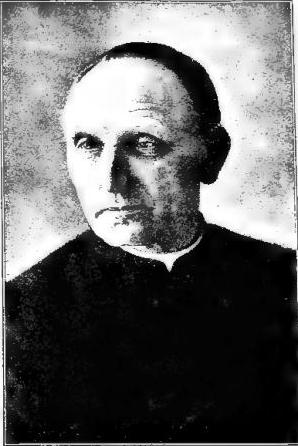
ETHNOLOGY - Bernardo Ankermann (b. 1896), one of the founders of the historical-cultural school.
V. THE HISTORICAL-CULTURAL SCHOOL: THE CONCEPT OF "MIGRATION" AND THE BASIC CRITERIA OF "QUALITY" AND "QUANTITY" (FROBENIUS, FOY, ANKERMANN, GRÄBNER, SCHMIDT, KOPPERS, FINARD DE LA BOULLAVE, VAN BULCK)
Had the evolutionist method definitively prevailed, ethnology would have failed because it would have had to renounce its essential characteristic as a historical discipline. Fortunately, first in Germany and then in other nations, beneficial reactions arose that restored the discipline to its rightful place.Fr. Ratzel, already mentioned for the impetus he gave to anthropogeography, must be considered the founder of the migration theory, an eminently historical concept that is the basis of modern ethnology. From the study of material culture, he arrived at the observation that an object (e.g., a weapon), often widely diffused on earth, sometimes continuously and sometimes not, had a single origin, and that cultural elements, now distant and divided, arose in one place and from there spread in different directions. The same author established the first kinship between a certain form of bows in Melanesia and West Africa, based on the criterion of form, also called the criterion of quality, that is, on characteristic similarities not determined by the nature of the weapon or the material of which it is made. The two forms of bows are characterized by a stave with an oval cross-section wrapped at one end with slender strands of woven vegetable matter; the bowstring is made from a strip of cane called rattan and secured to the end of the stave by a round bulb. The arrows have the same fletching. This first discovery, which became famous, was destined to revolutionize the study of ethnology, because it demonstrated the necessity of first establishing the place of origin of a given object or institution and only afterward investigating the psychological reason for this origin. The psychological method, proper to evolutionism, which saw inventions everywhere, was replaced by the historical method; the theory of convergence was replaced by that of migration, on which modern ethnology is founded.
Ratzel's students successfully applied the new method: H. Schuetz, already mentioned, studied the diffusion of the throwing knife in Africa; K. Weule studied the diffusion of arrows. Leo Frobenius systematically developed the theory of migrations: from the observation that a common cultural relationship is generally not limited to an object or isolated elements (such as the mere concordance in the form of bows and some other weapon or tool) but extends to sociology, mythology, and religion, that is, to an entire organic whole, he introduced the second fundamental canon of the discipline: the criterion of quantity, which is "the set of independent similarities, both among themselves and from the environment, presented by the elements that compose two or more cultures." The more numerous these similarities are, the greater the probability that the compared cultures share the same origin. The same author first formulated the concept of the cultural cycle, which, later reworked by other authors, can be defined as "the cultural complex that includes all the essential and necessary manifestations of human culture: ergology (material culture: housing, tools, weapons, etc.), economy, society, customs, religion" (W. Schmidt). The territory over which this cycle extends is called a cultural area. Cultural cycles generally migrate as a whole. W. Foy, B. Ankermann, Fr. Gräbner, and W. Schmidt applied the new approach with great success to the study of the cultures of Oceania.
(From Festschrift, Publication d'hommage officiel zu p. W. Schmidt, Vienna 1875)
ETHNOLOGY - Father Guglielmo Schmidt (b. in Hörde, Westphalia, on 15 February 1868, living) is the most authoritative representative of the historical-cultural school, whose method he developed and refined, having already been systematically reworked by Gräbner.
of Oceania, Africa, and South America. Above all, W. Schmidt extended his investigations to linguistics, mythology, and later to the entire complex of religion among the most archaic and inaccessible cultures.
The historical method was increasingly perfected. Following Gräbner’s first organic systematization in his classic work Die Methode der Ethnologie, further contributions came from H. Pinard de la Boullaye, G. van Bulck, W. Koppers, and W. Schmidt. The historical approach exerted a beneficial influence in ethnological circles across all nations; in Germany, it is followed—at least as a method of study—by nearly all scholars of the discipline and has been successfully applied to prehistory, particularly by O. Menghin. In America, a historical current has emerged over several decades, encompassing the most renowned ethnologists. Even in England and France, where the tradition of evolutionism was stronger than elsewhere, the new approach was viewed favorably, even by ethnologists trained in the old evolutionist school.
VI. CLARIFICATION OF THE TERM "PRIMITIVE." - So-called primitives are not remnants of decayed civilizations but peoples who have experienced a stagnation in their development (v. PRIMITIVI).
The study of the conditions that have favored such cultural arrest would lead to topics largely extraneous to ethnology. We note only that all geographical, environmental, and psychological conditions that hinder the formation of large populations are obstacles to the development and diffusion of civilization.
Geographical and environmental factors unfavorable to development include small islands, such as those in the Pacific Ocean,
separated by vast expanses of water, narrow valleys enclosed by mountains, poor soil like that of the deserts of Africa and Asia, the tundras of northern Asia and North America, and the humid forests of Central Africa and South America—regions still inhabited, and until recently, by primitive or culturally impoverished populations. Favorable geographical factors include fertile regions with easy communication, especially lands irrigated by great rivers. The oldest civilizations, in fact, developed along the Tigris, Euphrates, Nile, and the great rivers of India and China.
Among the elements hindering progress, wars are particularly noteworthy: they impoverish populations, especially of young people, who are the most suitable for founding and continuing families, and create an imbalance between the number of men and women. In small populations, these losses are felt even more severely than in larger ones and favor the transition from original monogamy to polygamy. Extreme poverty due to infertile soil and famine also undermine the foundations of the family. Polyandry—the institution allowing a woman multiple husbands—often arises from the inability of men to pay the dowry necessary to acquire a bride. Even among primitives, the greatest impulses toward progress come from brilliant, bold, and far-sighted individuals—men and women—who have exerted their influence in economic, religious, political, social, medical, and linguistic fields. The existence of such personalities is now an established fact, and travelers, missionaries, colonial officials, and ethnologists have witnessed the activity of these exceptional figures.
However, great individuals require masses willing to accept, preserve, and transmit the innovations they introduce; without the masses, progress would have little resonance and lack the small, slow, yet countless improvements that refine an invention. Indeed, the very impetus for refinement would be absent. Too often, it is forgotten that among primitives, as among highly civilized peoples, radical inventions and changes are rare; cultural elements are often transmitted conservatively and subject only to slow, continuous variations that perfect them rather than abrupt changes, as the history of cultural elements teaches. And it is well that this is so, for if every generation sought to erase the achievements of its predecessors and begin ab ovo, we would still be at the dawn of civilization. Moreover, the smaller a people, the fewer opportunities it has to produce strong personalities; it may even lack them entirely, and if they arise, they find no resonance. Many primitive populations are small, weak, and isolated, thus in conditions conducive to rigidity. Ethnological research has also highlighted another fact of capital importance: within the same civilization of a people, progress has not been uniform in all directions but has often advanced in one area while regressing in another. Thus, matriarchy discovered and perfected agriculture but, in many cases, destroyed the family; totemism greatly developed hunting techniques and undoubtedly contributed to the progress of science and art, but it also weakened the family and replaced religion with magic; nomadic herders were the first to domesticate and breed animals, yet in some aspects of religious and social life, they represent a regression compared to primitive populations. These uneven developments—a civilization should progress in all aspects, including those that entail duties and burdens, such as family and religion—largely explain the decline of great civilizations that predominantly developed only those elements from which they could derive enjoyment while suppressing or weakening those that required sacrifice. Unbridled egoism is undoubtedly one of the most detrimental factors to progress, as it undermines the family, reduces population size, and hinders relations among peoples.
From what has been outlined, several conclusions emerge—entirely overlooked by the old evolutionist schools—on which one cannot insist enough: 1) there are no absolutely primitive peoples, that is, entirely devoid of civilization or history; 2) so-called primitives have experienced a stagnation in their development; 3) it is impossible to place all primitives on the same level but necessary to distinguish between more and less primitive; 4) the ethical, social, and religious factors of a people do not necessarily progress with greater economic development.
BIBL.:
W. Schmidt, Die Stellung der Pygmäenvölker in der Entwicklungsgeschichte des Menschen, Stuttgart 1910; id., Der Ursprung der Gottesidee, 12 voll., Münster 1912-1955; id., Handbuch der vergleichenden Religionsgeschichte, Münster 1930; W. Koppers, Die ethnologische Wirtschaftsforschung, Anthropos, XXIV-XXV (1929-1930); G. van Bulck, Les recherches comparatives des religions des peuples non civilisés, Anthropos, XXVII (1932); H. Pinard de la Boullaye, L'étude comparée des religions, 3 voll., Paris 1922-1925; O. Menghin, Weltgeschichte der Steinzeit, Wien 1931; Fr. Gräbner, Die Methode der Ethnologie, Heidelberg 1911; B. Ankermann, Kulturkreise und Kulturschichten in Afrika, Zeitschrift für Ethnologie, XXXVII (1905); W. Foy, Die Anfänge der Metallurgie, Globus, LXXXVII (1905).
P. SCHEBESTA
It remains to be determined which peoples constitute the object of ethnology. Some scholars have so expanded the boundaries of the science as to practically include most of the great ancient civilizations. Insisting on this point is an error that generates a justified reaction from Sinologists, Egyptologists, Semitologists, and others. It is true that certain aspects of great civilizations can be understood and explained only by recourse to ethnology, as they have deep roots in older cultural strata that escape the investigation of the archaeologist and the linguist: it is now accepted that Egyptian art received a great impulse from totemism, and W. Koppers, in a series of works published over the last two decades in the journal Anthropos, has explained many hitherto unknown aspects of Indo-European culture and religion through ethnology. Among the people, beliefs, customs, and practices that are survivals of cultures long disappeared in their entirety still persist almost everywhere. Closer collaboration between scholars of great ancient civilizations, of popular ethnography (folklore), and of ethnology would be beneficial to all these sciences. Each of them, however, has its own task and limits that it cannot overstep. Ethnology studies the cultures of those peoples who can still be called primitive, not in an absolute sense (which no longer exists), but in a relative one.
In many parts of the world (Sudan, Indonesia, Polynesia, India, China, Central and South America), there still exist—and abundant traces remain—of populations that had reached a high level of cultural development. Many have had contact with Islam, Lamaism, Confucianism, Brahmanism, and Hinduism, which have superimposed themselves upon the original religions that we no longer know. From these mixtures, new cultures have arisen in which, alongside manifestations proper to great civilizations, many archaic elements often continue to thrive.
It is therefore not easy, indeed impossible, to formulate an absolute criterion by which a population or a culture can be included in the concept of "primitive." However, perhaps no invention has had a more profound influence on human thought and the development of civilization than writing. It indicates the need to fix knowledge previously transmitted orally, eliminates the distances of time, and makes it possible to record the progress of the preceding generation more rapidly, more accurately, and more completely, and to transmit it to the next. By fixing concepts in a more objective manner than is possible through oral tradition alone, it sharpens critical thinking and reflection. Only with writing can a cultural development on a broad scale occur, one that utilizes the work already done by other generations. True progress is possible only when the cultural heritage for which previous generations have labored with effort and tenacity is built upon and expanded in depth and breadth.
Writing was the invention that elevated still-poor cultures to the level of great cultures, and it is the most comprehensive division that can be made of human civilization. The first period includes peoples without writing, whom we shall call primitive, characterized by a still-naïve mode of thought; the second, peoples with writing, characterized by critical and reflective thought. Ethnology studies the entire cultural complex of primitive peoples and those manifestations of great civilizations that can be explained only through knowledge of primitive cultures.
VII. THE MOST ARCHAIC CULTURES ACCESSIBLE TO US
As a historical discipline, ethnology must first address the problem of the age and succession of cultures and cultural cycles. In its inquiry, it does not presuppose the postulates of evolutionism (progress from the crudest to the most refined, uniformity of evolution in all places), nor any specific historical or theological thesis, but proceeds as all historical disciplines do: it first concerns itself with preparing sound monographs dedicated to individual peoples and regions and, where possible, to well-defined cultural periods. From this analytical work, it then moves to synthesis and the study of relations between various cultural cycles, whether near or distant.Relying on data from anthropology and related sciences, some ethnologists of the historical school accept outright as a postulate (the only one they employ) the monogenesis of humanity; others, though equally convinced that the arguments in favor of monogenesis are far stronger and more persuasive than those for polygenesis, yet concerned with remaining free from any thesis, prefer not to grant this premise the status of a postulate but use it only as a provisional hypothesis to guide research and later utilize the convergent conclusions of other sciences such as paleoanthropology, prehistory, linguistics, etc. (These conclusions have been presented by M. Schulien, L'unità del genere umano alla luce delle ultime risultanze antropologiche, linguistiche ed etnologiche, 3rd ed., Milan 1947).
Among primitive cultures still extant or recently extinct, three or four very ancient cultural cycles can already be distinguished (which the current state of knowledge has not yet been able to trace back to a single cycle).
1. The central primitive culture, characterized sociologically by monogamy and local exogamy (v. ESMOLIA), to which belong the Pygmies and Pygmoids of central Africa, southeastern Asia, and Oceania—peoples who inhabit predominantly tropical regions, all south of the equator and thus central.
2. The southern primitive culture, characterized sociologically by exogamy and sexual totemism, to which belong the Tasmanians (now extinct) and the Australians of the southeastern region. It appears that the Bushmen (southern Africa) and the Fuegians of southern America (especially the Yamana) constitute a transition from the central primitive culture to the southern one.
3. The northern or Arctic primitive culture, also exogamous and patriarchal, but with equality of rights for husband and wife. This culture includes some peoples inhabiting the northernmost parts of Asia and America (the Paleosiberians and the Caribou Eskimos, west of Hudson Bay). It seems that the most ancient populations of California, the Algonquins (North America), and the Gè-Tapuya (South America) constitute a transition from the central primitive culture to the northern one.
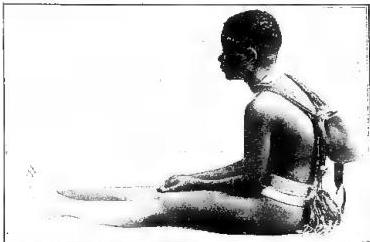
All populations belonging to these cultures occupy, in their respective continents, the most remote and isolated peripheral regions, difficult to access, without traces of older inhabitants and without attractions for populations with more advanced cultures.
The Pygmies and Pygmoids inhabit mountainous territories in the southern or southeastern parts of Asia; the Vedda, forests of the mountains of Ceylon; the Andamanese, the most isolated part of the Indian Archipelago; the Senoi, Semang, and Negritos, the mountainous regions of the Malay Peninsula and the Philippines. The remnants of these populations found in Oceania, still little known, inhabit mountainous regions of New Guinea and the New Hebrides. The Negritos inhabit the virgin forests of central and southern Africa, at whose borders the Bantu and Hamites have settled. The Bushmen have been pushed from better lands into the Kalahari Desert and occupy the southern and southwestern parts of Africa.
Representatives of the southern culture in Australia are some populations pushed to the edges of the continent: in the north (Cepara and others) and in the south (Kulin, Kumai, and Yuin); the Tasmanians inhabited the southernmost part. The Paleosiberians (Samoyeds, Koryaks, Ainu, etc.) have been pushed into the northern and northeastern regions by the great agricultural and pastoral peoples coming from central and eastern Asia. In the northeastern region, the Eskimos reached Greenland and served as a bridge to America; they have been influenced by other cultures. The most primitive populations of North America consist of the oldest stratum of the Algonquins, pushed to the extreme northwest of the continent, to nearby islands, and to the prairies by totemic and matriarchal populations coming from the south and west.
Even the most primitive tribes of California (Hoka, Penuti, and Yuki) have been pushed between the coast and the mountains. The Gè-Tapuya of Brazil were first pushed toward the coast and then again inland by the Guarani-Tupi. And finally, in the southernmost region of the world, Tierra del Fuego, two very primitive populations still live, the Alakaluf and the Yamana. The geographical position of these populations alone would already be a strong argument in favor of their great primitiveness. Their isolation has made them difficult to reach, has constituted, especially in the past, a serious obstacle to their study, and has been the cause for

M. Gusinde, Die Feuerland-Indianer, 3 voll., Mödling 1931-1939; W. Schmidt, Handbuch der vergleichenden Religionsgeschichte, Münster 1930; Id., Der Ursprung der Gottesidee, 12 voll., Münster 1912-1955; A. R. Radcliffe-Brown, The Andaman Islanders, Cambridge 1923; Id., Structure and Function in Primitive Society, London 1952; P. Schebesta, Die Bambuti-Pygmäen vom Ituri, 2 voll., Bruxelles 1938-1950; Id., Die Negrito Asiens, 2 voll., Mödling 1952-1957; M. Schulien, L'unità del genere umano alla luce delle ultime risultanze antropologiche, linguistiche ed etnologiche, 3ª ed., Milano 1947.
P. SCHEBESTA
ETHNOLOGY - The Andamanese preserve and wear around their necks the ribs and other bones of deceased relatives. A girl with the skull of her sister.
This has allowed them to maintain their cultural characteristics and remain untouched by external influences. Other elements also confirm the great primitiveness of these peoples. All are at the first stage of civilization; they live off what hunting, fishing, and gathering provide, and are therefore called gatherer peoples, and their cultures (relatively) original, because they are the closest to the original culture (in an absolute sense) of humanity, which ethnology will never be able to reconstruct. The dwelling, weapons, tools, ornaments, and family structure of these peoples exhibit great simplicity. They lack the elements that characterize the younger cultures surrounding them (totemism, agriculture, matrilineal succession, livestock breeding, pottery, weaving, metalworking, etc.). There is also no evidence to support the assumption that these populations once had a more advanced culture. It can therefore be concluded that each of the original cultural cycles (central, southern, and northern), considered in isolation on the continent where it is found, appears more archaic than all other cultural cycles of the same continent, called primary (totemism, matriarchy, nomadic pastoralism). From this first conclusion follows a second: the set of original cultures is older than the primary cultures.
VIII. COMPARISON BETWEEN THE MOST ARCAIC CULTURES TO ESTABLISH WHICH IS CLOSEST TO THE ORIGINAL
Having examined the geographical and cultural elements that demonstrate the primitiveness of the original cultures, the investigation must still seek to discover which is the oldest culture. In this research, the comparative method and the criteria of quality and quantity are also employed. However, the further one regresses in the study of cultural history, the greater the difficulties become. Indeed, the application of the criteria of quality and quantity, to be probative and allow secure conclusions, must be based on a sufficient number of truly characteristic similarities. An element of material culture (e.g., a particular form of club) found identically in two separate cultures may be a good indication to begin the comparison between them, but it can never, on its own, lead to the conclusion that the two cultures are related and were once united. To reach this conclusion, the cultural similarities must be characteristic and abundant.The possibility of comparison and the certainty of conclusions are always greater the richer the cultures being compared are in elements. This is precisely the case with the younger cultural cycles, composed of elements derived from different cultures. But in the earliest stages of civilization, cultural elements are simple in form and limited in quantity. Furthermore, the most primitive populations, composed of small isolated groups, have undergone more numerous losses of characteristic cultural elements in their evolution than younger populations. Yet the investigation to determine which is the most ancient living culture (that is, the closest to the truly original culture of man) could not be abandoned merely because it was fraught with difficulties. The problem was resolved through the comparative study of (relatively) original cultures.
1. The boomerang cultural cycle
In this cycle, the economy is still based on hunting and gathering; the house has the shape of a round beehive. The characteristic weapons and tools are: a) the boomerang, b) the shield, of a very crude form, called a stick shield or parrying stick, because, rather than a true shield, it is a simple stick used to parry blows from the club, c) in Australia, the hafted axe already appears.The first manifestations of scarification tattooing begin. Monogamy predominates, but there are already cases of polygamy. The populations belonging to
ETNOLOGIA — An Eskimo eating raw meat. Chesterfield (Canada).
The populations belonging to this cultural cycle thus already possess elements of more recent cultures and, moreover, do not occupy the most isolated or least accessible territories but only those bordering them. Therefore, they cannot be considered representatives of the most archaic cultures known to us.
2. The Paleo-Asiatic cultural cycle — that is, the most archaic stratum of northern culture — is already the adaptation of a primitive culture to the Arctic climate, as demonstrated by the economy and the entire complex of the ergology of the populations that compose II. a) The economy is based almost exclusively on hunting and fishing (which is essentially a form of hunting). In the Arctic climate, plants are generally absent, making gathering impossible. Both individual and family hunting — the most archaic form — involving few people, as well as collective hunting, a more recent and evolved form, are widely practiced. In both forms, the dog is already used. With its help and through experience, the hunter locates the breathing holes that seals make in the ice and strikes the animal with a harpoon as soon as it appears. Reindeer hunting is highly developed and conducted in groups. The Eskimos, with the aid of dogs and well-organized drives, herd wild herds into narrow passages and strike them with arrows and spears. The sling and the fish trap also belong to this culture.
b) In relation to the Arctic environment, this culture had to reduce the use of wood and specialized increasingly in bone working. Only later did it come to use stone, worked with a technique similar to that of the Neolithic.
In the preparation of fire, an interesting case of this evolution is found. In the most archaic phase, it was obtained by rubbing a stick with the hands in a specially made hole in an underlying stick or tablet (fire drill). In many places, this method was replaced by the percussion of iron pyrites. Wood is used for the bow, the shafts of arrows and spears, the snow scraper, snowshoes, parts of the sled, goggles and visors to protect the eyes from the sun, some containers, and a few other objects. Bone constitutes at least the essential part of weapons and many tools: arrowheads, spear points, harpoon parts, fish spears, single- or multi-pronged spears (even tridents), hooks, sled parts, and even parts of the bow. It is also used for other objects (pipes, carvings, etc.), which, however, belong to more recent cultures. Stone is used for lamps — absolutely necessary given the brevity of the polar day — and cooking pots, which the Eskimos heat over the lamps. The fire is fueled with moss wicks soaked in seal fat. c) In the polar climate, clothing and housing are of great importance. The Eskimos' attire is essentially the same in both sexes. It consists of a closed jacket, pulled over the head, with sleeves, a hood, and attached gloves, and padded boots. These garments are made almost entirely from the skin of the ringed seal, which is the warmest and lightest of polar furs and also the easiest to keep dry. In winter, they wear double clothing, with the inner layer worn fur-side in. From seal skin, they make padded boots and waterproof outer garments. In the populations belonging to the most archaic cultural stratum, women tan the hides by chewing them, scraping them with a characteristic knife called an ulo — which is crescent-shaped and used only by them — and soaking them in hot water, cold water, or urine. The most archaic dwelling is round and consists of two parts: a lower, underground or semi-underground section, accessed via a corridor, and an upper section that culturally relates to the round beehive hut type. d) Burial practices have also been influenced by the environment. Since digging a grave in frozen ground is difficult, the dead are simply placed on the ground. This form is called platform burial. e) In sociology, influences of more recent institutions such as totemism and especially matriarchy are already evident. f) Finally, the Arctic tribes of America exhibit a more recent cultural aspect compared to the same Paleo-Asiatic cycle because, with the still very simple navigation means available during their migrations, they reached the new land only by passing through Arctic regions. Furthermore, according to the most widely accepted American opinion, no people entered America before the beginning of the Neolithic, which is confirmed by the technique used to work stone.
From all the elements examined so far, it emerges that the Paleo-Asiatic cultural cycle presents itself, as a whole, as a secondary formation. Therefore, it cannot be considered the representative of the most archaic culture known to us. This does not exclude that it may still contain some very archaic cultural elements that have been lost in other original cultures.
It now remains to compare only the central primitive culture and the southern primitive culture in their individual elements.
3. The Tasmanian cultural cycle and the pygmy cultural cycle
If these two cultural cycles were found in contact at any point, a reliable criterion would exist to determine which of them is the oldest: it would suffice to carefully study the mixtures, overlays, and divisions in these areas. However, no point of contact has yet been found because the two cycles are separated by vast distances.The only criterion left is to compare the two cultures and, through an intrinsic examination of the elements that compose them, determine which is the most ancient.
A culture, even the simplest imaginable, must have had, from the beginning, expressions — a certain form of economic life (e.g., gathering) and family organization, a certain language, etc. — that distinguish human life (culture) from that of animals (which have no culture). If, as seems obvious, the first manifestations of material culture arose solely from necessity, they must naturally have been simple, dependent on the limited possibilities available to humans at the time, which were still devoid of any addition responding to a pure criterion of improvement. Foy, for example, has demonstrated that the flat club developed from the round stick, as found in nature. Regarding body care, humans did not immediately begin to practice forms of tattooing, mutilations, and deformations. To the first elements, new ones were subsequently added — due both to the internal progress of individual peoples and to their contact with others — which constituted cultural enrichment.
The criterion discussed above is valid only when dealing with material culture, and even in this case, it must be applied with discernment, as it can easily lead to the preconception of materialistic positivism, according to which the development of humanity would have been, in every field, an ascent from the lowest to the most evolved forms.
From two weapons or tools or any object of material culture, one cannot immediately establish that man first constructed the one requiring less intelligence. Historical investigation has shown that sometimes the opposite has occurred. Among the various examples provided by ethnology, that of the bow is one of the most instructive. This weapon demonstrates an inventive talent and reflection undoubtedly superior to that commonly manifested by other primitive weapons. Based primarily on this fact, some ethnologists have attributed it to more recent cultures, whereas careful investigations have shown that it belongs, from its very origin, to the culture of the Pygmies, where it is still generally found in its simplest form, consisting of a round stick (as found in nature) smoothed and bent, to whose ends a cord of vegetable substance is attached, which serves to propel the arrow. On the other hand, many of its refinements could not have arisen immediately with the bow, as they require tools and means that original cultures did not yet possess. Indeed, these refinements are found only in the bows of more recent cultures. After establishing the limits within which the criterion of intrinsic examination can be used, the aspect presented by the Tasmanian cultural cycle and that of the Pygmies is examined in particular to determine which is the more archaic. These two cycles are the most primitive known and take us back to the most archaic phase of human culture that ethnological investigation can reach. Although the beginnings of this culture are still very obscure, it can be affirmed that the cultural cycle which, in the quality of its elements, most closely approximates the starting point of human culture (that is, the original culture in an absolute sense) is undoubtedly the most archaic. In these investigations, two methodological criteria formulated by Pinard and Schmidt are particularly useful: «Every cultural element that presupposes another is necessarily more recent than the one it presupposes» (criterion of «necessary presupposition» enunciated by Pinard). «Of two cultural elements of the same order, the one that presupposes a change from the original state is more recent than the one that does not presuppose it» (Schmidt).
a) Body scarification. — In original cultures, young men and women reaching puberty must undergo special ceremonies called initiations, which primarily aim to instruct the initiates, now close to marriage, on their future duties toward the family and the State. Candidates must abstain from certain preferred foods but are not subjected to painful practices. Only later—under the influence of more recent cultures, in which initiations are by then practiced only for males—do young men have to allow a tooth to be removed with a wooden chisel, without uttering the slightest complaint. In an even later phase, the circumcision (or incision and subincision) of the initiates is introduced. Circumcision consists in the total excision
(from A. R. Radcliffe-Brown, The Andaman Islanders, Cambridge 1933, p. 51, fig. 1)
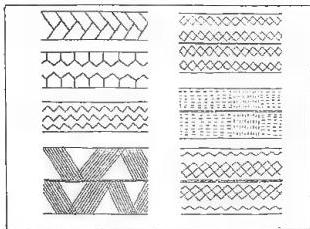
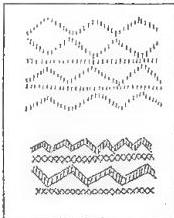
ETHNOLOGY - Examples of geometric or interwoven designs that the Andamanese Pygmies incise or paint on ornamental objects and utensils.
or partial removal of the foreskin or even a simple incision of II. Subincision—which is performed about a year later with a stone knife or a very sharp flint—consists of an incision along the urethra from the urinary meatus to the base of the scrotum. This operation is extremely painful; the English ethnologists who first described it called it the terrible rite, an expression still used in ethnological works.
Both Pygmy populations and those of southeastern Australia belonging to the most archaic cultural stratum do not practice circumcision, which is instead widespread among all other Australian tribes. Tooth avulsion, unknown to all Pygmies, is practiced by populations of southeastern Australia. Among the Pygmies, only the Andamanese practice scarification tattooing, which is instead common among the tribes of southeastern Australia and Tasmania. No Pygmy group pierces the nasal septum or upper lip to insert ornaments, as all Australian populations do (excluding Tasmania). Finally, the various forms of ornamentation, considered as a whole, are far less widespread among the Pygmies than among Australians and Tasmanians.
b) The working of materials: theolithic and Paleolithic phases. - It is highly probable that humans began using objects made of wood, bones, and shells found in nature with almost no processing, as these could serve as weapons, containers, and tools. They could indeed work wood with harder wood, sharp shells, or bones, or stones naturally shaped into points. The true working of stone must have begun only later, as authoritative ethnologists and prehistorians (Gräbner, Schmidt, Menghin, Breuil, Obermaier, and several others) argue with good reason.
With few exceptions, the weapons and tools of the Pygmies are all made of wood, bones, large animal teeth, and shells. All populations of Australia and Tasmania already work stone, particularly in the form of flakes and blades. Therefore, from the perspective of material working, the Pygmies belong to an even more archaicolithic cultural phase than the Paleolithic one, which instead characterizes the populations of the southern culture. It is not possible to explain this cultural characteristic, as some scholars have attempted, by claiming without foundation that the Pygmies lack workable lithic material, since it is a priori excluded that no stones can be found across the vast territories of southern Asia and Africa where Pygmies are scattered. There are even testimonies that decisively contradict this claim and instead prove that groups of Pygmies use stones they find in nature already suitable for working or requiring only minor retouching. Brown, for example, writes that in the Andamanese territory there is quartz and another type of rock with which the natives make blades and flakes for shaving hair and practicing tattooing. To obtain these tools, they hold a quartz pebble or another rock in their left hand and strike it with another pebble of any suitable hard, rounded substance; a flake thus detaches and falls into the palm of the left hand. If needed, it is used immediately; otherwise, it is discarded, and another is made. Flakes and blades are prepared only when necessary and used until they retain their point or edge, then immediately thrown away. A woman shaving someone’s head may use up to twenty blades in succession, for which at least twice as many flakes must be produced. Flakes of harder rock are obtained like those of quartz but are left in the fire for several hours before use and then allowed to cool. The natives themselves confirm that they have never used stone for cutting (except in the cases mentioned) or for making arrowheads. For the latter, they used shells. Brown further presents various arguments against earlier authors who claimed to have found some lithic industry among the Andamanese and concludes that the most sustainable hypothesis is that this people never worked stone but always made all their tools from wood, bone, and shells. From the above, it follows that the limited working of stone is a characteristic of Pygmy culture, attesting to the greater primitiveness of the central cultural cycle compared to the southern one.
c) The production of fire. - The Andamanese Pygmies are the only population in the world that does not know how to produce fire; they therefore keep pieces of wood continuously burning. All other Pygmies and Pygmoids, Australians, and Tasmanians obtain fire by friction between two pieces of wood. However, the methods vary: a) The Tasmanians (now extinct) used "groove friction," i.e., horizontal friction made with the tip of a piece of wood in the longitudinal groove of another piece of wood. Since the Tasmanians preserved many archaic cultural elements that among southeastern Australians have been lost or replaced by more recent ones, it can be assumed that groove friction is a more archaic method of producing fire than those used by southeastern Australians. b) The southeastern Australians spin a stick with their hands in a hole made in a small stick or board below (fire by drill or simple rotation), or they saw one piece of wood with another: "saw friction." There are still two other
ETHNOLOGY - Examples of geometric and interwoven designs that the Andamanese Pygmies incise or paint on ornamental objects and utensils.
Pygmy populations - one in Asia, the Semang, and the other in Africa, the Batua of the Congo - which obtain fire by rubbing in a groove. The presence of this form in each of the two main Pygmy groups - the Asian and the African - and, moreover, in points so distant from one another, attests to the persistence among these peoples of a cultural element more archaic than the corresponding one found among the southeastern Australians.
d) Weapons: the Pygmies' bow. - The club and the spear are the characteristic weapons of the southern culture; the bow is the weapon of the Pygmies. The bow is a weapon consisting essentially of a long, thin, and flexible stick or cane, to whose ends a cord of vegetable substance or a strip of skin or leather is attached, serving to impart movement to the arrow. The arrow is an integral part of the bow. In its most archaic forms, it is equipped with feathers or leaves and small pieces of skin that help maintain its direction once shot. In more evolved cultures, the fletching disappears and is replaced by other improvements to the bow and arrow. Among primitive weapons, the bow is perhaps the one that demonstrates the greatest talent for invention, reflection, and refinement. This has led some authors (Gräber) to argue that the Pygmies did not originally possess this weapon but only the arrow, which they launched by hand at game. However, this hypothesis is not confirmed by the facts, as among the Pygmies the bow and arrow are always associated.
BIBL.:
A. R. Radcliffe-Brown, The Andaman Islanders, Cambridge 1933; Gräber, Die Bogen der Pygmäen, in «Anthropos», 1910.
This bow gains a much greater launching force, but like the round bow already mentioned, it is not very flexible. The string is therefore once again made of rattan. In certain regions (Melanesia, West Africa), it is attached to the bow on supports shaped like cushions, rings, discs, or small balls, carved or woven onto the stave. However, in Further and Hither India—where the culture to which this bow belongs likely originated—the step-like support at the ends of the stave was initially retained, to which the rattan—more prone to breaking than a string—is joined with a strip of more flexible material. This bow is also found outside the Pygmy area; indeed, it is characteristic of the later Mattarcato culture (widespread especially in Melanesia, Indonesia, and Further India, but also represented in West Africa and America).
δ) The Andamanese possess a much more refined bow, similar to that of Melanesia: large, significantly widened at both ends, with the upper limb curved toward the archer and the lower one slightly in the opposite direction. To construct it, they select a stave already bent while still in the ground, facilitating its curvature as it grows. They then craft the bow, which at the center—where it is gripped by the hand—has a circular cross-section, then immediately widens on both sides, though the ends taper to a point again. When the archer draws the bow, they pull the string toward themselves, i.e., in the direction opposite to the upper limb, which, as soon as the string is released, snaps back with doubled force. At rest, it takes the shape of an S; when drawn, it assumes a uniform curvature. It is thus already a "semi-reflex" bow and has the advantage of not subjecting the stave to highly variable tension during its different phases of movement. The northern Andamanese further enhance this bow's potential by keeping the bent side continuously suspended over a low fire, which contracts its fibers. The Andamanese bow retains the step-carved tips. The string, made of plant fibers, is wrapped like a ring around the ends of the stave.
e) The Semang have a true "reflex" bow, which they construct from a stave...
ETHNOLOGY - Pictography on bark depicting hunting scenes. North American Indians, Rome, Luigi Pigorini Prehistoric Ethnographic Museum.
(Int. Enc. Cont.)
already curved in its natural state, upon which they impose another curve opposite to the first. The bow is drawn in the direction contrary to that of the natural curve. The nomadic pastoral peoples of northern and central Asia possess a bow with a semicircular cross-section, which is even more refined. In its resting position, the convex part is on the outside and the flat part on the inside ⊖, but when the bow is drawn, the convex part moves to the inside and the flat part to the outside ⊖. The tension is further increased by highly elastic material intimately bound to the stave. This bow is simultaneously "composite and reflexed." Deep notches are cut at its ends, into which a sturdy cord is fastened. The construction of this bow requires much time and labor. This type is entirely absent among the Pygmies and is instead found in great civilizations (China, India, Persia, the classical world), which derived it from the culture of nomadic pastoralists. Associated with the bow of semicircular cross-section, convex on the inside and flat on the outside ⊖, are more refined forms of fletching in which the feathers, through more or less tight stitching, adhere to the arrow along their entire length. Sometimes fletching is entirely absent, but these evolved forms of the bow and arrow are characteristic of later matriarchy and essentially foreign to Pygmy culture.
From what has been presented, it follows that the forms of the bow and arrows prevailing among the Pygmies (types α, β) are the most primitive known, as they are closest to forms found in nature itself. Therefore, the presence of this weapon among the Pygmies cannot be invoked against their great ethnological antiquity. Its refinements are due both to the nature of these peoples—who are not rigid but capable of improvement, as attested by ethnologists who have studied them in the field—and to external influences. The strongest differences are indeed noted between the African and Asian groups, separated by greater distance. Nor is the hypothesis of some ethnologists tenable, according to which the Pygmies would have acquired the bow and arrow from more evolved cultures, particularly from later matriarchy. On the contrary, there are numerous indications supporting the opposite thesis: that the bow and arrow migrated from Pygmy culture to that of later matriarchy, which subsequently refined this weapon. That forms α, β are the most primitive is confirmed by the fact that, outside Pygmy culture, they are used (alone or alongside more refined forms) only by peoples who still belong to original cultures and have had no contact with either nomadic pastoralists or more recent matriarchy. The cotendo bow (type α) is still used by the Ainu, who represent the most archaic cultural stratum of northern Japan, and by the Gé-Tapuya of eastern Brazil, who, along with neighboring populations, belong to the most archaic cultural horizon of those regions, which bears many similarities to that of the Pygmies. The bow with a semicircular cross-section, convex on the outside and flat on the inside, is still used by the Ainu, by Paleo-Asiatic peoples (Koryaks, Chukchi, Aleuts, and several groups of Eskimos), by Indians along the northwestern coast of America down to California, and by very archaic populations of South America (Chaco and south of the Amazon).
The Paleo-Asiatics apply wood and elastic substances to the inside and outside of the stave to increase its tension, thus constructing a composite bow; other populations predominantly, and some exclusively, have the simple bow. The string, always made of plant fibers, is generally attached to the bow by means of the usual notch and step, a characteristic of the bow in primitive cultures that later disappears. Alongside this form, others exist (limited, however, to isolated populations or individual groups) in which a small hole, a groove, or a rest is used. The arrow always has tangential fletching.
From what has been presented, it follows that:
the bow and arrow, always associated, constitute the characteristic weapon and often the only one of most Pygmy tribes;
since no cultural horizon more archaic than or contemporary with that of the Pygmies is known to use the arrow alone as a throwing spear, it must be concluded that the Pygmies invented the bow in its technical entirety and from the outset associated it with the arrow (N. Schmidt).
c) Art. - It would be pure apriorism to assert that man did not possess, from the very dawn of civilization, a certain aesthetic sense that could be expressed through bodily movements. Equally unfounded, however, would be the claim that he immediately knew how to construct musical instruments, paint, sculpt, etc. a) Music. The few string and wind instruments occasionally used by some Pygmy tribes betray their character as imports from neighboring populations, so it can be affirmed that Pygmy culture has no musical instruments. The same can be said of the Tasmanians; the Australians, however, already know how to produce sounds by striking sticks. The Pygmies have no form of drum to mark rhythm, whereas in Australia this instrument already appears, albeit in a very crude form: women stretch a hide over their thigh and beat II. In their ceremonies, Australians produce a certain noise by whirling a wooden board called, due to its shape, a "bullroarer." This instrument, widespread among all Australians, is entirely absent among the Pygmies. It follows, therefore, that with regard to musical instruments, the Pygmies are at a more archaic cultural stage than the Australians. β) Figurative art. No Pygmy population knows relief sculpture, even in its simplest expressions. Only the Andamanese scratch or paint geometric figures on tools and containers. The Andamanese and Semang paint themselves according to ornamental patterns. The Semang engrave geometric figures on combs and spoons, sometimes associating them with magical significance. However, both the figures and their meaning have been imported from their neighbors, the Ple, a population with cultural elements of a matriarchal character. Even less can be said of the figurative art of African Pygmies. Only the Bushmen—who, it seems, constitute a transition from the central primitive culture to the southern one—have produced a great rock art of realistic character, which has close relations with that of the European Upper Paleolithic (caves of Cogul, Alpera, Tortosilla in Spain) and is the result of the blending of a primitive culture with a totemic one, thus more recent. Art is not the only point in which the Bushmen differ from the Pygmies. The Australians already have some manifestations of carving and relief sculpture. Therefore, even in terms of figurative art, the Pygmies are more primitive than the Australians.
f) Totemism. - The basis of totemism is the belief in a magical relationship between a social group (clan) or an individual or a sex and a particular animal species (more rarely a plant, and even more rarely a natural element: sun, moon, water), a relationship generally founded on the belief in a common ancestor. There are three different aspects of totemism: social, individual, and sexual. The southeastern Australians already possess elements of social totemism, derived from
g) Funerary customs. - The funerary customs of the Paleo-Australians exhibit certain complex elements that are absent among the Pygmies, such as: α) the consumption of some part of the deceased's flesh and the anointing of relatives' bodies with the fluids secreted by the corpse; β) the extraction of intestines and other manipulations of the corpse; γ) magical practices performed with the intent of discovering who caused the death—practices characteristic of more recent cultures that attribute death solely to magical influences—in order to exact vengeance. Thus, even in this cultural aspect, the Pygmies are more archaic than the Paleo-Australians.
From the comparison of the two cultural cycles, it has been observed that: α) in both cycles, there are elements belonging to the same ethnological age; β) there are then several other characteristic cultural elements which, among the Pygmies, exhibit a more archaic character than among the Paleo-Australians, while no contrary case occurs. From the whole,
(de M. Gusinde, Die Yamana, Mödling bei Wien 1927, 8p. 59, p. 1129)
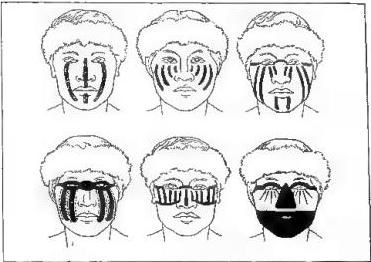
ETHNOLOGY – Burial and Funerary Rites. Signs of Mourning among the Yamana (Tierra del Fuego).
From these facts, it may be concluded that the cultural cycle of the Pygmies is more archaic than that of the Paleo-Australians.
IX. CONCLUSION
The origin and formation of the earliest cultures may be summarized as follows:1. From the truly primordial ancient culture, which appears to have been located in eastern Asia, there branched off—even before the beginning of the Stone Age—the peoples belonging to the central culture (Pygmies), who soon subdivided into two main branches: the Asian and the African. Despite notable differences, these two groups still constitute, as a whole, a true cultural cycle, the most archaic known in ethnology. From an anthropological perspective, the Pygmies seem to belong to the oldest race, not in the sense that they should be considered the progenitors of all or even many races, but rather as a branch that split very early from the main trunk, a branch that did not undergo the great subsequent evolutions of other races and did not give rise to any, not even among the Negroids. (W. Schmidt).
2. Subsequently, the peoples composing the northern or Arctic culture—whose most archaic stratum is still alithic—and those of the southern culture, who were already Paleolithic, branched off.
These cultures, having remained almost completely isolated for millennia, slowly adapted to their new environments and thus underwent different specializations: enriching themselves, particularly in material culture (though not exclusively), with new elements while also losing others they had previously possessed, as these were no longer suited. Therefore, none of these cultures can be called primordial in an absolute sense. The reconstruction of the original phase of humanity has perhaps been the most arduous task undertaken—and, insofar as possible, resolved—by the ethnologists of the historical-cultural school.
(fot. Eur. Catt.)
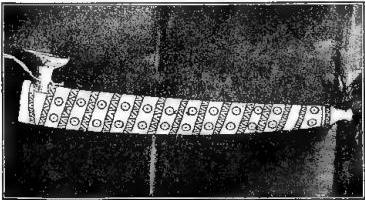
ETHNOLOGY - Ivory pipe with spiral geometric decoration. Eskimos Selawig'mat, Selawik River, Alaska - Rome, Luigi Pigorini Prehistoric Ethnographic Museum.
It is obvious that this reconstruction cannot consist merely in the sum of the elements composing the most archaic cultures still accessible to ethnology; on the contrary, proceeding backward, all elements due to specialization and external contacts must be discarded one by one, as they are more recent. In this comparative work, it is absolutely necessary to consider all the most archaic cultures still accessible to ethnology and prehistory, because the fact that one culture is more recent than another does not mean that all elements of the former are more recent than the corresponding elements of the latter. Ethnological investigation has indeed demonstrated that some elements—undoubtedly very archaic—probably already belonging to the truly original culture—currently missing in the Pignoni—have been preserved in the ancient Arctic culture or in the Tasmanian one. However, even after eliminating all the more recent elements, ethnology could not presume to have recomposed the truly original culture of humanity in all its complexity, because certain manifestations, in the long and almost complete isolation of central, northern, and southern cultures, have inevitably become rigid, causing impoverishment in the culture. This has always occurred in all isolated and closed cultures, whether large or small. And there is no reason to believe that there was an exception for the most primitive ones.
This loss occurred especially in spiritual manifestations.
Therefore, ethnology is highly skeptical of being able to reconstruct the truly original culture of humanity in all its fullness.
Similar observations could be made for anthropology, linguistics, and prehistory when they directly address the problem of origins. This finding, though very bitter in itself, should not diminish interest in these sciences, which have proven capable of reconstructing, if not all, at least much of the history of humanity that seemed definitively lost.
In particular, ethnology has shed light on the earliest manifestations of human economic, social, and religious life. - Vedi tavv. XLV-XLVII.
Evolutionist authors: J. J. Bachofen, Das Mutterrecht, Stuttgart 1861; J. Lubbock, Prehistoric times, London 1865; Italian trans. Turin 1875; A. Giraud-Taulon, Les origines de la famille, Geneva-Paris 1874; H. L. Morgan, Systems of consanguinity and affinity of the human family, Washington 1871; id., Ancient society, London 1877; J. Ferguson-McLennan, Studies in ancient history, London 1876; E. B. Tylor, Primitive culture, 2 vols., 3rd ed. Turin 1891; id., Sopra un metodo per investigare lo sviluppo delle istituzioni sociali applicato alle leggi del matrimonio e della discendenza, in Archivio per l'antropologia e la e., 19 (1880); H. Spencer, Principi di sociologia, trans. by A. Salandra, I, Turin 1881; Ch. Latourneau, L'évolution de la morale, Paris 1887; id., L'évolution du mariage et de la famille, ibid. 1888; J. H. King, The supernatural, its origin, nature and evolution, London-Edinburgh-New York 1892; R. R. Marrett, Pre-animistic religion, in Palli-fore, 11 (1900); A. E. Post, Giurisprudenza etnologica, trans. Bonfante and Longo, Milan 1906; H. Hubert and M. Mauss, Mélanges d'histoire des religions, Paris 1909; J. G. Frazer, Totemism and exogamy, 4 vols., London 1910; id., The golden bough, 12 vols., London 1911-15, trans. by L. Da Bozia, Il ramo d'oro, 3 vols., Rome 1925; R. Pettazzoni, Difformazione e sviluppo del monoteismo nella storia delle religioni, I: L'essere supremo nelle credenze dei popoli primitivi, Rome 1922; id., Saggi di storia delle religioni e di mitologia, ibid. 1946; id., Miti e leggende, I, Turin 1948; E. Durkheim, Les formes élémentaires de la vie religieuse, 2nd ed., Paris 1925; W. Wundt, Elemente der Völkerpsychologie, trans. E. Aschieri, Elementi di psicologia dei popoli, Turin 1920; M. Mauss, Manuel d'ethnographie, Paris 1947.
Historical-cultural authors: Fr. Graebner, Methode der Ethnologie, Heidelberg 1911; id., Ethnologie, in Paul Hinneberg, Die Kultur der Gegenwart, part 3, sect. 5, Leipzig and Berlin 1923; H. Pinard de la Boulaye, L'étude comparée des religions, 3rd ed., 4 vols., Paris 1925; G. van Bulck, Beiträge zur Methodik der Völkerkunde, in Wiener Beiträge zur Kulturgeschichte und Linguistik, 2 (1931); id., Philosophie, la religion et cycles culturels en Afrique, in Congo, 1936; id., Où en est l'application des cycles culturels dans l'ethnologie africaine, in Zaire (Brussels 1949); W. Koppers, Le principe historique et la science comparée des religions, in Annuaire de l'Institut de philologie et d'histoire orientale et slave, 4 (1936); W. Schmidt, Handbuch der Methode der kulturhistorischen Ethnologie, Münster in Westfalen 1937, trans. L. Vannicelli, Manuale di metodologia etnologica, Milan 1949; M. Schulien, Nuovi orizzonti in campo di e. e di storia delle religioni, in Acta Pontificia Academiae Romanae S. Thomas, 4th ser., 7 (1941); B. Bernardi, Religione e religioni, in N. Turchi, Le religioni del mondo, Rome 1946; R. Boccassino, Gli studi di A. C. Blanc ed i risultati moderni dell'e., in Bollettino di paleontologia italiana, new ser., 8 (1946), part 2; id., La religion des primitives (with an extensive bibliographical introduction), in P. Tacchi Venturi, Storia delle religioni, I, 3rd ed., Turin 1949, pp. 35-105.
Monographs, manuals, treatises, encyclopedias: F. Ratzel, Le razze umane, 2 vols., Turin 1891-96; id., Geografia dell'uomo, ibid. 1914; W. Schmidt, Die Stiftung der Psychoanwaltschaft in der Entwicklungsgeschichte des Menschen, Stuttgart 1910; E. Westermarck, The history of human marriage, 2nd ed., 3 vols., London 1911 (Italian trans. by De Rossi, Storia del matrimonio umano, Pistoia 1864, based on a now outdated earlier edition); F. Gräbner, Die melanesische Bogenkultur und ihre Verwandten, in Anthropos, 4 (1910), pp. 726-780, 809-1032; Th. Mainage, Les religions de la philosophie, l'âge paléolithique, Paris 1921; R. H. Lowie, Primitive society, London 1921; A. A. Goldenweiser, Early civilization, London 1922; G. Buschan, Illustrierte Völkerkunde, 2nd ed., 4 vols., Stuttgart 1922; W. Schmidt and W. Koppers, Völker und Kulturen, Regensburg 1924; W. Schmidt, Familie, in Handwörterbuch der Staatswissenschaften III, 4th ed., Jena 1926; E. Flor, Haustiere und Hirtenkultur, in Wiener Beiträge zur Kulturgeschichte und Linguistik, 1 (1930); O. Menghin, Weltgeschichte der Steinzeit, Vienna 1931; F. Trilles, Les Pygmées de la forêt équatoriale, Paris-Münster 1932; A. R. Radcliffe-Brown, The Andaman Islanders, Cambridge 1933; G. Montandon, Traité d'ethnologie cyclo-culturelle, Paris 1934; R. Thurnwald, Die menschliche Gesellschaft, 5 vols., Berlin-Leipzig 1931-34; various authors, Die Indogermanen und Germanen Frage, in Wiener Beiträge zur Kulturgeschichte und Linguistik, 4 (1936); W. Koppers, Der Totemismus als menschengeschichtliches Problem, in Anthropos, 35 (1936); K. Th. Preuss, Lehrbuch der Völkerkunde, Stuttgart 1937 (v. the extensive review of this work by R. Boccassino, in Annali Lateranensi, 2 (1938), pp. 364-68 and in Il pensiero missionario, 10 (1938), pp. 250-57); J. Haekel, Über Wesen und Ursprung des Totemismus, in Mitteilungen der Anthropologischen Gesellschaft in Wien, 69 (1939); H. A. Bernatzik, Die große Völkerkunde, 3 vols., Leipzig 1939; id., Afrika, 2 vols., Innsbruck 1947; E. Volhard, Kannibalismus, Stuttgart 1939, trans. by G. Cogni, Il cannibalismo, Turin 1949; E. Bächler, Der alpine Paläolithikum der Schweiz, Basel 1940; W. Schmidt, Das Eigentum auf den ältesten Stufen der Menschheit, 2 vols., Münster in Westfalen 1937-40; H. Baumann, R. Thurnwald, D. Westermann, Völkerkunde von Afrika, Essen 1940; R. Biasutti, Le razze e i popoli della terra, 5 vols., Turin 1941; O. Falsirol, Il totemismo e l'animalismo dell'anima, Naples 1941; F. Cavazza, Intorno alla origine dell'umano sociabilico, in Annali Lateranensi, 5 (1941), pp. 9-119; W. Schmidt, Der Ursprung der Gottesidee, 5 vols., Münster in Westfalen 1936-49; id., Manuale di storia comparata delle religioni, 4th ed., Brescia 1944; M. Ebert, Reallexikon der Vorgeschichte, 14 vols. plus one index volume, Berlin 1924-32.
Journals: Africa, London; The American Anthropologist, New Haven; Annali Lateranensi, Vatican City; Annual Report of the Bureau of American Ethnology, Smithsonian Institution, Washington; L'Anthropologie, Paris; Anthropos, Fribourg (Switzerland); Archiv für Anthropologie, Braunschweig; Archivio per l'antropologia e la e., Florence; Boessler-Archiv, Berlin; Bulletin of the bureau of American ethnology, Smithsonian Institution, Washington; Ethnos, Stockholm; Folk-lore, London; Internationales Archiv für Ethnographie, Leiden; Journal of the Royal Anthropological Institute of Great Britain and Ireland, London; Man, London; Mitteilungen der Anthropologischen Gesellschaft in Wien (from 1947 Mitteilungen der Österreichischen Gesellschaft für Anthropologie, Ethnologie und Prähistorie), Vienna; Primitive man, Washington; Rivista di antropologia, Rome; Studia ethnographica Upsaliensia (so far 2 fascicles, almost entirely in English), Stockholm; Zeitschrift für Ethnologie, Berlin; Zeitschrift für Missionskunde und Religionswissenschaft, Münster in Westfalen; Wiener Beiträge zur Kulturgeschichte und Linguistik, Vienna; Semaines internationales d'ethnologie religieuse, 5 vols., 1st session, Louvain 1912; 2nd, ibid. 1913; 3rd, Tilburg 1922; 4th, Milan 1925; 5th, Luxembourg 1929. Renata Boccassino