
ANTHROPOLOGY (from Gr. ἄνθρωπος = man and λόγος = discourse). — It is the science of man. The term is used both in philosophy and in the natural sciences. At present, the naturalistic meaning is more common, though it has not yet received a uniformly accepted definition from all anthropologists. The broadest current is that which gives to a. the meaning of the study of the whole man, but as a naturalist might do II. De Quatrefages (1869) defines a.: “the history of man as a naturalist would understand it when studying an animal.” And Martin (1914), in his classic treatise on a., gives a substantially identical definition: “Anthropology is the natural history of hominids in their expansion through time and space.” Thus conceived, a. includes the study of all human manifestations, both physical and cultural; and it is divided into two main branches: physical a., which has as its object the physiomorphological characteristics of man in their individual, racial, and sexual variations, and ethnology, which studies human groups in their cultural, social, religious, etc., manifestations. Physical a., in so far as it deals with the physical characteristics of extinct men, is called paleoanthropology; while ethnology, in so far as it studies the cultural manifestations of the same, is called paleoethnology.
Commonly, however, the term a., without any further specification, refers to physical a., which is identified with somatology. This, although it has many points in common with anatomy and physiology, differs from them because these disciplines have as their object, respectively, the anatomical and physiological characteristics of man in general, one might almost say, in the abstract, without taking into account individual, sexual (at least for some characteristics), and racial differences; whereas a. deals precisely with such differences. Moreover, anatomy and physiology do not address the problems of origins, transformations, and the diffusion of man; whereas a. also has these problems as its aim.
It is clear that in its research a. should take into account the greatest possible number of characteristics; instead, for a variety of reasons, one may say that until recently it was limited, almost exclusively or at least predominantly, to the study of the characteristics of the skeleton. Influences on this direction were, in the first place, the fact that skeletal characteristics are often more constant than others and therefore more suitable for systematic classification and discrimination; secondly, because the soft parts of individuals belonging to different races, often distant and difficult of access, are less easy to obtain; and finally, because an important part of a., paleoanthropology, can necessarily be carried out only with bones, the only parts of the human organism that are preserved in privileged conditions over the millennia.
It goes without saying, however, that a study of man so one-sided and incomplete, which is practically limited to the investigation of some physical characteristics, might be accused of presumption or even temerity if it claimed to solve the major problems of the origins of man. And this is indeed the case, at least for some materialist anthropologists, who delude themselves into thinking that they can solve the problem of the appearance of man (body and soul) from the examination of a few bones. In reality, the problems of origins are incomparably more complex. They presuppose the solution of other fundamental questions, such as: the question of the nature of man, of the place he occupies in nature, etc. Questions which physical a. alone cannot resolve without the cooperation and assistance of the other anthropological disciplines, as well as of psychology and philosophy—in short, of all those sciences that have man as their object, seen from every side, not only naturalistically but also philosophically and metaphysically. Only from this intimate collaboration can one hope to receive greater light on the problems of origins, which constitute, in certain respects, one of the most important aims of a.
1. HISTORICAL NOTES
The study of the natural history of man goes back to ancient Greece, although, as has already been said, this study was not separated from the philosophical. Hippocrates makes some observations on the influence of the environment on the physical nature of man. Aristotle is interested in phenomena of heredity, in crossings, observes the proportions of the body, the distribution of hair, the sutures of the skull, etc. But after these, the study of the natural history of man declined, as did, in general, all the natural sciences: and throughout the Middle Ages the same notions about the nature of man were repeated, often mingled with fantastic and extravagant tales.It was in the 18th century that anthropological studies revived and flourished again. Linnaeus attempted a classification of man. Buffon seems to have been the first to introduce the term “race” to designate the various human groups. He also expounded the causes which, in his opinion, determined the formation of these groups. J. F. Blumenbach (1752–1840) laid the foundations of anthropological technique in general. In a work entitled De generis humani varietate nativa (1775) he set forth a new classification of the principal living varieties or human races, based on observations of skulls. He also adduced anatomical, physiological, and psychological arguments in favor of monogenism. Camper (1691) measured the facial angle (Camper’s angle). Daubenton determined the position of the occipital foramen. Various methods (Saumarez, 1798; Virey, 1817; Tiedemann, 1836) were devised around this time for measuring cranial capacity, attaching much more importance to this characteristic than it actually warrants. Some materialist authors, indeed, claimed that from such measurements they could determine intelligence. What had been shown to be absurd by rational psychology was soon demonstrated by the facts to be contrary to reality.
Around the middle of the 19th century, anthropological measurement methods were devised which, with some modifications, are still in use today. They were conceived by the Swedish anthropologist Anders Retzius. Along with Retzius, the use of indices, i.e., ratios between measurements, was introduced; these proved to be incomparably more suitable for anthropological studies than the use of absolute measurements.
While in the first half of the 19th century the study of skulls developed greatly, societies of a. for the promotion of this discipline also arose. In the second half of the same century two names occupy a large part of the history of a.: de Quatrefages and Broca. The teaching of a. was raised by de Quatrefages to a height that is still difficult to attain today. In the work Unité de l'espèce humaine he declared himself clearly in favor of monogenism.
Broca, a positivist physician, impressed upon a. an essentially morphological and materialist direction, placing as the foundation of all progress in the science of man the knowledge of form, not only for anthropology in the strict sense, but also for physiological, psychological, and sociological sciences. In 1859 he founded in Paris the “Société d'Anthropologie,” on the model of which similar societies were founded in the principal countries of Europe: in London in 1863, in Madrid in 1865, in Moscow in 1866, in Florence by Mantegazza in 1868, in Berlin in 1869. Broca’s direction brought advantages to a., but also damage, above all by having exaggerated the importance of the metric method and by his materialist prejudices.
Alongside de Quatrefages and Broca in the 19th century, the Belgian Quételet should be remembered for the impulse he gave to anthropometry. Among the principal representatives, in recent times, of the school of Broca, was the Frenchman Manouvrier, who concerned himself, besides anthropometric technique, with the interpretation of brain weight.
While abroad there was a tendency to exaggerate the importance of measurements and indices in the study of anthropology, in Italy an attempt was made, through the work of Giuseppe Sergi, to reduce it almost exclusively to morphological bases. Sergi distinguished various forms of skulls, observing them from different points of view, on the basis of which he established a complex and not infrequently subjective classification that drew criticism from many. Frassetto (1929) attempted to simplify it, suggesting new methods. Among those who contributed most to placing the use of indices and measurements in their proper perspective, neither exaggerating nor diminishing their value, was Biasutti.
Without going into greater detail on the history of anthropology in recent times, it will suffice for our purposes to recall some scholars who have most influenced its progress. These include Virchow, Kollmann, Ranke, Klaatsch, Schwalbe, von Luschan, Martin, Mollison, Weinert, Fischer, Poëch, and others.
In Italy, in addition to the names already mentioned, the following should be noted: P. Mantegazza, founder of the “Società di antropologia e di etnologia” in Florence and author of noteworthy popular scientific publications unfortunately tainted by materialistic content; Tedeschi, director of the Institute of Anthropology in Padua; and Ruggeri, who taught in Naples and opposed the polygenism of G. Sergi.
At present, the following are actively engaged in the field of anthropology in Italy: Sergio Sergi, son of Giuseppe and his successor in directing the Roman Institute; Frassetto, of the Bolognese school; Sera of the University of Naples; Battaglia of Padua; Genna of Florence; and Sacchetti of Rome.
The development of anthropology was significantly advanced, beyond the rise and spread of evolutionary ideas—especially after the publication of Darwin’s On the Origin of Species (1860)—by the discovery of lithic tools of fossil man, long contested but eventually accepted, and by the recognition of skeletal remains of fossil man. The first discoveries, of lithic tools in 1858 by Boucher de Perthes in the Somme Valley deposits and of fossil man in 1856 in the Neander Valley near Düsseldorf, were followed by numerous findings that gave rise to two notable branches of anthropological studies: paleoanthropology and paleoethnology.
Another impetus to these disciplines and to anthropology in general came from the discovery of Pithecanthropus in Java in 1891 by the Dutch physician Dubois.
The study of the morphology of the various races, initially focused especially on bones and the skull, expanded to include the external forms of the human body (somatology). Among the many contributions, mention may be made of the work of Beddoe for the English, Livi for the Italians, Czekanowski for certain groups of Negroes, Sarasin for the Vedda and the Neocaledonians, and Martin for some tribes of the Malay Peninsula. For the study of the anatomy of the various races, the following should be noted: Murie, Turner, Testut, Giacomini, Adachi, and others.
At present, anthropology has turned its attention particularly to the study of the heredity of traits (v. RENDITA), racial eugenics (v. EUGENICA), the doctrine of constitution (v. BIOTIPOLOGIA), and the distribution of blood groups (v. SANGUE).
This shift in focus has been influenced—though not always happily—by factors extraneous to scientific research, such as nationalist movements and political directives.
Unfortunately, for a long time and to a large extent, anthropological studies were contaminated by the materialistic outlook that dominated anthropology until recently. This harmful influence was felt especially in the grave and highly delicate problems concerning origins, which have such an intimate connection with religion and moral life. At present, however, there are anthropologists—especially among the younger generation—who, free from the prejudices of the past, approach these questions with a more serene and open mind, even embracing finalistic and spiritualistic conceptions of nature and man. Their research, in addition to the merit of greater depth, acquires that of a higher scientific value, since it does not limit itself, as do those of some empiricists and positivists, to the mere description of phenomena but investigates their deeper causes, not hesitating to ask not only the causal why but also the final why of the various and wonderful phenomena of which the anthropologist is a privileged witness.
Limiting ourselves here to a brief exposition of anthropological method and the principal results obtained in the specific field of classical anthropology—that is, osteological anthropology and human morphology—we refer the reader to the individual entries for the treatment of the other branches of this discipline (v. PALEONTOLOGIA; BRAZZA; RAZZISMO).
2. OSTEOLOGICAL ANTHROPOLOGY
The morphological and metric study of bones has always constituted, for the reasons mentioned above, a most important part of anthropology. It acquires an almost exclusive value when dealing with the study of fossil races, for which, as is obvious, only the skeletal system remains. From such study, however, if conducted with prudence and scientific accuracy, it is possible to infer the morphology and development of missing parts through the impressions and modifications they have left on the skeletal system. For example, it is possible to determine the volume of the brain from cranial capacity, the development of muscles from the bony crests of muscular insertions, and the approximate shape of the cerebral surface from the cerebral impressions on the endocranium, and so on. From this, it is clear how experienced anthropologists can learn much about the development and form of the soft parts of the organism, in direct contact with the bones, of completely extinct races known to us only through some skeletal remains. There have never been lacking, nor are there today, enthusiastic scholars who, giving free rein to the easy constructions of their imagination rather than to the facts, have made and continue to make bones reveal things they can in no way disclose.Since it is not possible to present here a complete account of the methods used in osteology and anthropology and the results obtained, we limit ourselves to mentioning the principal notions concerning the skull, which is the most important skeletal part and the one of greatest interest,
both for racial classifications and, above all, for the study of human fossils.
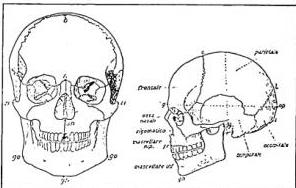
Ida Marucci, La vita e l'uomo, p. 38, having Bissutti
ANTHROPOLOGY — Human craniometric points; b bregma; c zygion; n nasion; su anterior nasal spine; go gonion; gu gnathion; pr prosthion; g glabella; l lambda; op opisthocranion; i inion.
These points have the same value and significance, and allow for comparison of measurements taken by various anthropologists on different materials.
For example, the glabella is the point on the median plane of maximum projection of the lower margin of the frontal bone; the opisthocranion is the point on the median line of the occiput corresponding to the maximum distance from the glabella; the bregma is the point where the two limbs of the coronal suture meet the sagittal suture; the basion is the point where the anterior margin of the foramen magnum is intersected by the sagittal plane. The same applies to other well-defined points on the skull.
From these points, it is possible to measure distances that have homologous or corresponding values in different skulls. Thus, we have the glabella-opisthocranion distance, which measures the maximum length of the skull; the basion-bregma distance, which gives the height of the skull; the distance between the most lateral external parts of the skull, which measures the width of the skull, and so on for other measurements.
Absolute measurements, however, are of less importance for comparisons. What is more important is not so much knowing the height, width, or length of an individual or a skull, but rather the ratio or proportions between these measurements, since it is understood that the difference is smaller between two individuals who are one larger than the other but whose respective measurements are in equal ratio, than between two individuals whose measurements are in different ratios. Therefore, ratios between these measurements, called indices, are determined by the aforementioned measurements. These are calculated by taking the smaller measurement as the numerator, multiplied by 100, and the larger measurement as the denominator. The ratio or index thus obtained has been divided into classes or categories according to their value, whether below, within, or above certain conveniently chosen values. Thus, for example, skulls have been classified, in terms of the length-width or cephalic index, as dolichocephalic (long skulls), mesocephalic (medium skulls), and brachycephalic (short skulls).
We indicate the main indices of the skull with their respective craniometric categories.
1. Transverse-longitudinal index (width-length):
(width × 100) / length
| Dolichocephalic (long skulls) | up to 74.9 |
|---|---|
| Mesocephalic (medium skulls) | from 75.0 to 79.9 |
| Brachycephalic (short skulls) | from 80.0 upwards |
2. Total facial index: total facial height × 100 / bizygomatic width
| Euriprosopic (low face) | up to 84.9 |
|---|---|
| Mesoprosopic (medium face) | from 85.0 to 89.9 |
| Leptoprosopic (high face) | from 90.0 upwards |
3. Upper facial index:
(upper facial height × 100) / bizygomatic width
| Eurynic (low upper face) | up to 49.9 |
|---|---|
| Mesenic (medium upper face) | from 50.0 to 54.9 |
| Leptenic (high upper face) | from 55.0 upwards |
4. Nasal index: nasal width × 100 / height
| Leptorrhine (high-narrow nose) | up to 46.9 |
|---|---|
| Mesorrhine (medium nose) | from 47.0 to 50.9 |
| Platyrrhine (low-wide nose) | from 51.0 upwards |
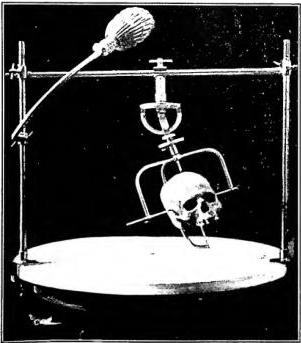
A skull is said to be oriented on the German plane when both lines (one on each side) from orbitale to porion lie on the same horizontal plane.
(via Ricerca di Antropologia, 1568-69)
ANTROPOLOGY — A skull suspended on the assidiatètero of S. Sergi, according to the bregma-basion axis.
A skull is said to be oriented on the German plane when both orbital-porion lines (one on each side) lie on the same horizontal plane. A skull is said to be oriented on the French plane when the two condyles and the prosthion rest on the horizontal plane.
The determination of such planes becomes indispensable when comparisons are to be made, since the shape and often the measurements change according to the way in which the skull is oriented.
One of the most perfect instruments for such orientations and for taking projections is the assidiatètero of Sergio Sergi.
In addition to the determination of measurements and indices, reference is made to the shape of the skulls, observed according to certain standards. Thus skulls are distinguished as ellipsoid, pentagonoid, rhomboid, sphaeroid, etc.
Cranial capacity is also important in anthropological study. Hence various methods for measuring it directly (filling the skull with shot, millet, etc.) and indirect systems, by means of mathematical calculations based on measurements and indices.
We report some racial averages of cranial capacity:
Eskimos . . . . . . . . . . . . . . . . . . . . . . . . . . . . . . . . . . . . . . . . cmc. 1583
Europeans . . . . . . . . . . . . . . . . . . . . . . . . . . . . . . . . . . . . . . . . . . . . . . . . . . . . . . . . . . . . . . . . . . . . . . . . . . . . . . . . . . . . . . . . . . . . . . . . . . . .
Mongols . . . . . . . . . . . . . . . . . . . . . . . . . . . . . . . . . . . . . . . . . . . . . . . . . . . . . . . . . . . . . . . . . . . . . . . . . . . . . . . . . . . . . . . . . . . . . . . . . . . .
African Negroes . . . . . . . . . . . . . . . . . . . . . . . . . . . . . . . . . . . . . . . . . . . . . . . . . . . . . . . . . . . . . . . . . . . . . . . . . . . . . . . . . . . . . . . . . . . .
Australians . . . . . . . . . . . . . . . . . . . . . . . . . . . . . . . . . . . . . . . . . . . . . . . . . . . . . . . . . . . . . . . . . . . . . . . . . . . . . . . . . . . . . . . . . . . .
Hottentots . . . . . . . . . . . . . . . . . . . . . . . . . . . . . . . . . . . . . . . . . . . . . . . . . . . . . . . . . . . . . . . . . . . . . . . . . . . . . . . . . . . . . . . . . . . .
Andamanese . . . . . . . . . . . . . . . . . . . . . . . . . . . . . . . . . . . . . . . . . . . . . . . . . . . . . . . . . . . . . . . . . . . . . . . . . . . . . . . . . . . . . . . . . . . .
It should be borne in mind that these averages concern very different numbers of individuals and that stature varies greatly. There is no doubt, however, that even taking stature into account, cranial capacities prove to be different. In fact, the Eskimos are of small stature, yet they have, on average, a higher cranial capacity than Europeans; the Australians have an average stature (1.67 m) and a low cranial capacity (cmc. 1349).
Even within cranial capacity, differences are noted among the various classes of the same group, and individual differences are very great.
With the aid of the above-mentioned means, anthropology has succeeded in determining various cranial types corresponding to different races, ages and sexes. Consequently, it is not impossible for an expert anthropologist to determine, at least approximately, the race, age and sex of a prehistoric skull about which no other information is available besides its presence.
3. ANTHROPOLOGICAL MORPHOLOGY
The principal morphological and anthropometric characteristics of the living subject studied by anthropology are: skin colour, eye and hair colour, hair form, stature, the shape and indices of the face, the shape of the eye and of the palpebral aperture, the shape of the nose and the nasal index, the shape of the head and the cephalic indices, the development and shape of the brain, the dermal ridges, etc.Skin colour. — Skin colour depends on the presence or absence of certain pigments.
On the basis of colour, men are classified, very generally, into Whites or Leucoderms, Yellows or Xanthoderms, Blacks or Melanoderms.
The colour of Leucoderms (Europeans, Western Asiatics, North Africans, etc.) can vary from milky white to pinkish white, to brownish; that of Xanthoderms (Mongoloids, Bushmen, etc.) from the pale yellow (wheat) of the Chinese to brownish yellow; that of Melanoderms (Pygmies, African Negroes, Australians, Malays, etc.) from smoky black, rare, to chocolate colour more or less dark.
Pigmentation is not uniform over the whole skin. The ventral side is generally lighter than the dorsal; the flexor surfaces of the limbs are lighter than the extensor surfaces.
Pigmentation also varies with age. Negro infants are livid red, those of Whites are bright pink, those of Yellows are much less yellow.
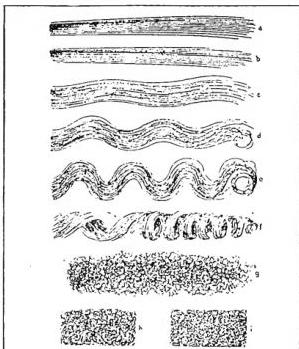
(from Marrazzi, La vita e l'uomo, plate XXII, drawing by Cipriani)
ANTHROPOLOGY — Various forms of hair: a-b, leiotrichous or straight; c-d-e, cymotrichous; f-i, ulotrichous.
The dependence of skin colour on climatic factors is generally admitted; however, it still presents many doubtful and obscure aspects. It is believed that climate affects colour because the skin, under the prolonged action of solar radiation, becomes dark, and because in the Europe-Asia area there is a certain correspondence between the intensity of pigmentation and luminous radiation. The minimum pigmentation is found in the area surrounding the Baltic and the North Sea; the maximum in the open savannahs of the Sudan. To these observations that would support a causal link between climate and pigmentation, others are opposed, namely that the darkening of the skin due to light is limited and temporary, whereas melanodermic populations are extremely dark and this character is constant and hereditary; moreover, on other continents, particularly among the indigenous populations of America, the correspondence between pigmentation and climate is not observed. Therefore, the problem of the origins of pigmentation is still unresolved.
With skin colour, the Mongolian spot or congenital pigmentary spot should be recalled; it is present in newborns for up to a few years of life with a highly variable percentage in different races. In the Chinese it is almost 100%, in Whites from 2% to 0.5%. It is found in the sacral region and is formed by pigmented cells (chromatophores) present in the dermis. The colour varies with race: pale blue in Europeans, clay-coloured in the Chinese, greenish in Native Americans, blackish in Blacks and the Chinese.
According to some, it would be a character of a primitive race that migrated from southern Asia towards the East and the Mediterranean; according to others, it would be an atavistic character of common ancestors.
Form and colour of hair. — The form of hair varies from the curly, short and fine to the straight, long and coarse, passing through all intermediate gradations.
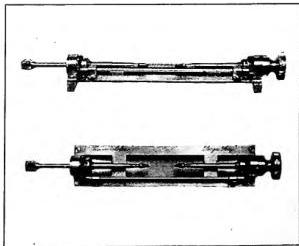
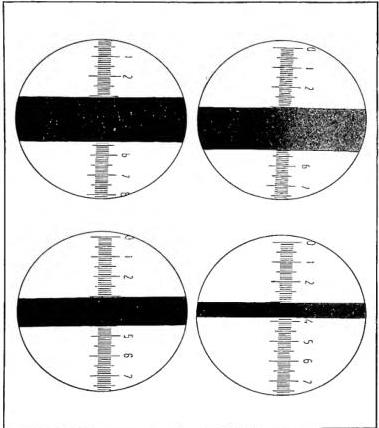
Of great importance is the shape of the hair’s cross-section. S. Sergi’s trichocylindrofer allows for a precise evaluation of diameters.
All these varieties are usually grouped into three categories:
helicotrichous hair: ‘spiral-shaped’. The implantation in the skin is curved; the cross-section has an irregular, generally flattened shape. The spiral of the hair can be very short in the less curly forms (Pygmies, Bushmen) and also notably wide (Abyssinians, Melanesians). Most African Blacks exhibit this form of hair;
cymotrichous hair: wavy. The implantation is straight; the cross-section is oval. The length of the hair increases the closer it approaches smooth forms. Europeans have this form of hair;
leiotrichous hair: straight, coarse, similar to horsehair. The implantation is straight; the cross-section is rounded. The length can exceed that of cymotrichous hair. Mongoloids exhibit this form of hair.
It is noteworthy that helicotrichous individuals are cymotrichous at birth, i.e. they have wavy hair and only become curly after a few weeks (African Blacks) and even after several months (Oceanic Blacks).
This fact suggests that curly hair is a character acquired later, and that initially the hair was smooth or wavy.
The colour of hair depends on a twofold pigment: one diffuse, yellowish-reddish, and another, in granules, ranging from yellowish-brown to black.
In Europe and a large contiguous area, all gradations of colour are found, both in eyes and hair; outside this area the colours range from brown to black.
Blondism (with blue eyes) is found mainly in Europe and contiguous zones. Within this area it does not seem necessarily linked to a given somatic or racial type, because it can be found among Scandinavians as well as among Poles, Lapps, Finns, Ostyaks and Alpine populations.
Blond or light-haired individuals have also been found among non-European populations, such as Pygmies, Western Australians, Cuna of Central America, and others.
(from Archivio di antropologia criminale, psichiatria e medicina legale, 1910)
ANTHROPOLOGY — Tricociolofero by S. Sergi, an apparatus for measuring the diameter of hair and fur. Seen from the side and from above.
Stature. — The average stature in adult males ranges from 142 to 180 cm. The average stature of women is about 12 cm lower; but in human groups with very low stature, such as the Pygmies of the Ituri, the difference drops to 9 cm.
In general, on the various continents, there is a peripheral distribution of lower statures. This distribution suggests that lower statures represent older forms that have gradually given way to the spread of taller statures, retreating to marginal zones or less favorable areas such as the Arctic tundra, northern forests, deserts, etc.
Body proportions. — The proportions of the body, i.e., the relative dimensions of the head, trunk, and limbs, also show individual and average variations that must be considered.
Various measurements are calculated and related to stature. Particular attention is given to the ratio between the height of the seated subject and that of the standing subject. This gives the relative length of the leg and has therefore been named the schelic index; likewise, the ratio between the arm span and stature should be noted.
The schelic index varies between 45.7 (a group of very tall Nilotics) and 55.4 (Eskimos of southern Alaska). In this index, low values indicate long legs, while high values indicate short legs.
The ratio of arm span to stature averages between 99 (Japanese) and 108 (Negroes). In the former, the arm span is less than the stature; in the latter, it is greater.
Generally, the development of the limbs in various human groups is correlated: long legs are found with long arms, and short legs with short arms. Other characters (transverse diameters of the trunk) are also correlated, while stature itself shows no correlation, as both stocky and slender individuals can be found in every stature class. Within the same group, however, there is a tendency for slender proportions to associate with taller statures, and stocky proportions with shorter statures.
As for the schelic index, the following categories can be established:
macroschelic . . . . . from 49.0 to 50.9
mesatischelic . . . . . from 51.0 to 52.9
brachischelic . . . . . from 53.0 and above
Macroschelic forms are found mainly in the southern regions of the ancient world, especially Sudan, Ceylon, Australia, and the New Hebrides. Brachischelic forms are found especially in northern regions: parts of the Lapps, Kalmyks, North American natives, and nearly all peoples of the yellow race, etc. A certain correspondence has been noted between brachischelia and lissotrichous hair. There seems to be a relationship between environment and the schelic index. Brachischelic forms (short legs) are found especially in mountainous and forested regions, while macroschelic forms (long legs) are found in open spaces such as deserts and steppes. Similar correspondences are observed in animals, e.g., the Tibetan antelope is stocky, while the North African steppe antelope is slender.
Steatopygia. — This is a particular trait of some populations (Bushmen and Hottentots) consisting of hypertrophic development of the gluteal and thigh regions.
Facial shape. Facial index. — Many facial features are difficult to measure and can only be described, e.g., the shape of the facial contour, the shape of the eye, mouth, nasal region, the shape and position of the zygomatic and molar bones, etc. Others can only be observed in the skull (shape of the piriform aperture of the nose, orbits, and palate). Still others can be measured in the living subject, such as the absolute or relative dimensions of various parts. However, due to practical difficulties, these measurements must be taken with great discernment, especially when making comparisons. The morphological facial index is particularly useful; it gives the ratio— as seen— between the nasion-menton height and the width of the face.
Based on the facial index, the following categories are distinguished:
lepto- or dolichoprosopic (long faces) . . . from 90.0 upwards
mesoprosopic (medium faces) . . . . . from 85.0 to 89.9
brachy- or euryprosopic (broad faces) . . . up to 84.9
The lowest average values have been found in the Akka women of the Ituri (Congo) at 73.4, while the highest are found in western Swedes at 93.7. Brachyprosopic forms are found in the tropical and southern regions of the ancient world and in Oceania as far as Tasmania. Dolichoprosopic forms are less widespread. They are found especially in certain districts of Europe, Asia Minor, northern Africa, and in Oceania among the Jaluit and Tonga peoples.
Prognathism. — A facial profile is called "prognathous" when the mouth is more or less prominent, and "orthognathous" for the opposite profile. There are notable variations, from the very prominent face of an Australian to the ultra-orthognathous profile of the classical aesthetic type.
Prognathism of the face may involve the entire upper jaw (Australians), or only the alveolar region ("profatnia"), as in many Negroes.
Prognathism is generally associated with a wide mouth and thick lips. Thick lips are found in southern (equatorial) types, while thin lips are found in northern types.
The chin may be more or less receding, or prominent, low, or high.
A receding chin is found in many fossil men and, among living peoples, especially in the New Caledonians. A high chin is characteristic of some Mongoloid (Eskimos) and Europoid (Nordic) groups.
Shape of the eye and palpebral aperture. — The shape of the orbit and soft parts can be distinguished. The shape of the orbit can vary from narrow and horizontally elongated types to vertically developed ones. The former are found in low faces. They are common in fossil forms and in some present-day types (Australians, New Caledonians, Lapps). The latter are found in vertically developed faces.
Regarding the soft parts, the palpebral aperture also varies considerably from race to race and among individuals of the same race, passing through all intermediate forms, from narrow and half-closed to wide and open.
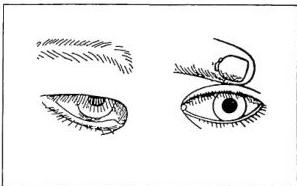
In Mongols, the palpebral aperture is narrow and oblique; in Europeans, Pygmies, and Negroes, it is open and horizontal. In Mongols, the Mongolian fold is also observed. In some human groups, the inner part of the eyelid is folded and covers the inner corner of the eye. This fold is known as the Mongolian fold because it is frequent in Mongolian populations. It is also observed in other groups, e.g., among the Hottentots, though in these it slopes toward the lateral side rather than the medial side. The Indian fold of Amerindians is represented by a medial extension of the upper eyelid margin that covers both the caruncle and the medial end of the lower eyelid margin.
These conformations, however, are observed— though rarely— in all racial types.
The Mongolian fold is not rare in Europoid infants; it later disappears with development. The Hottentot fold is not rare even in adult Europoids.
The three characters of the Mongolian eye— narrow slit, obliquity, and Mongolian fold— show notable group and individual variations and may occur separately.
The color of the eyes depends on several factors but primarily on the structure and pigmentation of the iris.
The iris consists of various superimposed layers which, from the anterior to the posterior surface, are: the endothelium, the stroma, and the epithelium. The endothelium covers the anterior surface of the iris. It presents on the anterior surface depressions or crypts which are absent at the base. It is formed of very flattened endothelial cells, with an almost circular outline and not infrequently pigmented. The stroma forms the fundamental layer of the iris. It consists of a fibrillar connective tissue, traversed by vessels and nerves, and contains the sphincter muscle of the pupil. In the stroma are found cells containing pigment in varying quantity (stromal cells).
Rarely is the iris of uniform tint. It usually presents three concentric zones, a pupillary one, a central one, and a third peripheral one. The latter is usually the darkest, then comes the pupillary, and then the intermediate. Moreover, the chromatophores are often arranged in
ANTROPOLOGIA - Mongolian fold of the eye.
radiating outward, giving the iris a striped and crinkled appearance.
Eye color is classified using chromatic tables. Those most commonly used are Martin’s and Martin–Schultz’s.
Shape of the nose and nasal index. — The root, bridge, and wings of the nose are considered.
The shape and proportions of this part vary greatly among individuals and races, from the classic form of the Greek nose to that of the African nose.
The root of the nose may be more or less sunken, even appearing straight.
The bridge of the nose, viewed in profile, may be depressed, straight, arched, or angular. Combinations of these forms are also possible, such as depressed-undulating or arched-undulating. The profile of the nose is determined not only by the shape of the root and bridge but also by the shape of the tip and the lower border.
The tip may be pointed or rounded. Characteristically thickened tips are also found; those of Armenian noses are typical.
The lower border of the nasal septum and alae is sometimes perpendicular to the upper lip, sometimes slanting upward or downward.
The shape of the root varies from the high and narrow types of the Nordic race to the low and broad types of African races.
The degree of nostril dilation is expressed by a ratio between the width of the nose at the level of the nostrils and the height of the nose from the nasion to the nasal septum. This ratio is called the nasal index and is calculated by dividing the width of the nose × 100 by the height:
Nasal index: frac{width of nose × 100}{length}
Based on this index, noses are classified as:
leptorrhine . . . up to 70
mesorrhine . . . from 70 to 85
platyrrhine . . . over 85
Platyrrhine and hyperplatyrrhine noses are found throughout Africa up to the northern trunk, in Melanesia, Oceania up to the equator, in southern Asia, and in Insulindia. Leptorrhine noses are found especially in Europe, northern Africa, and the Near East. Mesorrhine noses occur, in addition to the marginal zones of platyrrhine areas, in tropical and subtropical America, Micronesia and Polynesia, and northern Asia.
Based on shape and nasal index, various racial types of noses can be distinguished.
Shape of the head and cephalic indices. — As regards the shape of the head and cephalic indices, much of what has been said about the skull applies. It may be added that brachycephalic forms are found in the Eurasian continent, Polynesia, and America; dolichocephalic forms occur in terminal or peripheral zones, such as the northwestern and southern margins of Europe, southern Asia, the peripheral islands of Polynesia, and the extreme Arctic and subarctic margins of America; or in central areas coinciding with the intertropical mountain environment (Indochina, Insulindia, Central and South America).
Even in the anatomical conformation of various systems and organs, racial differences are noted, though these have been observed less than external morphological differences because they are harder to observe. These differences, needless to say, appear in statistics or averages, as do the other racial differences.
4. MAIN MORPHOLOGICAL DIFFERENCES BETWEEN HUMANS AND ANTHROPOIDS
The principal differences between humans and anthropoids are those connected more or less closely with the greater development of the brain, with the upright stance, and with the absence of a hairy covering in humans.Absence of a hairy covering. — All primates, including anthropoids, have the body covered with a thick fur. In humans, however, the pilary system is so reduced—taking racial and individual differences into account—that one may speak of naked skin. Long and thick hair forms only in certain parts of the body (head, chin, etc.), while the rest of the body has only sparse downy hair that cannot be compared with the fleece of anthropoids.
Development and shape of the brain. — The brain—and consequently the cerebral cranium—of humans is much more developed than that of anthropoids, so much so that even on this basis alone there is a clear division between anthropoids and modern humans. The table below gives the maximum, minimum, and average cranial capacities of present-day humans, anthropoids, and some fossil primates. For the latter, only male values are given, as they are higher.
Excluding the values found in Pithecanthropus—whose nature is still debated—and not considering the value of 850 cm³ as the minimum capacity of Sinanthropus—since, given the fragmentary condition of the skullcap, its capacity could not even be approximately measured—
(da Marrazzi, La vita e l'uomo, p. 212, secondo Unifusa)
ANTROPOLOGIA
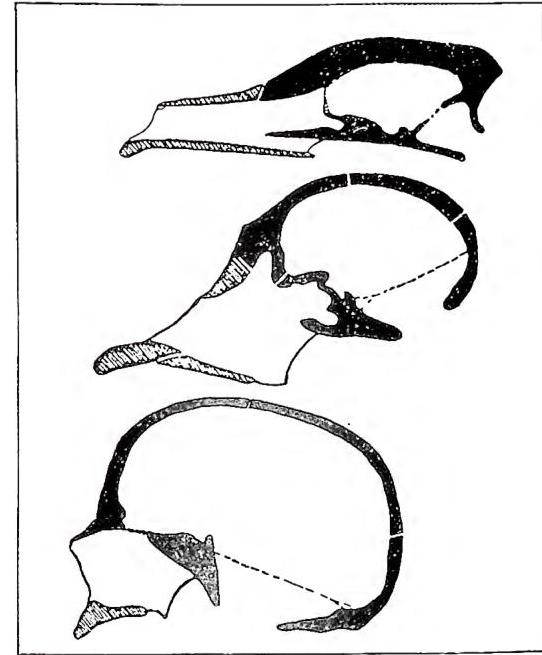
Cross-section of the skull — From top to bottom: of a dog, an orangutan, and a modern human.
In black: neural cranium; in hatching: visceral cranium.
The cranial capacity of the great apes reaches a maximum of about 655 cc, while the minimum for humans is about 900 cc, a difference of roughly 250 cc. It should be noted, however, that human cranial capacities of 900 cc are extremely rare; the average for Europeans is about 1500 cc, and for races with more limited capacity, such as the Australian Aboriginals, around 1250 cc.
The development of the brain is closely related to the shape of the skull. In humans, as the cerebral cranium increases in size, the visceral cranium — the part housing the respiratory and digestive systems — decreases proportionally. Moreover, in humans the visceral cranium lies beneath the cerebral cranium, whereas in the great apes it projects noticeably forward. Additionally, in the human skull the anterior portion, i.e., the forehead, is more developed and elevated, and the frontal lobes extend to the outer margins of the orbits. In contrast, in chimpanzees and gorillas, the frontal lobes of the brain do not reach halfway up the orbit.
Young great apes, however, resemble humans more closely in this respect than adult apes do. Other differences between the brains of great apes and humans, besides size, are found in the structure of individual parts.
The parietal region is much more developed in humans than in great apes, as is the frontal region, as noted above. The convolutions of the human brain are also far more numerous.
Differences arising from the upright posture. — Only humans possess true upright posture, standing fully erect on vertical legs, with the trunk and head also vertical. Among birds, the penguin, and among mammals, the jerboa, do not have true upright posture; their trunks are only partially straightened through changes in the proportions of the segments of the lower limb and the angles formed between them.
Great apes have a semi-upright posture.
Human upright posture is made possible by a complete restructuring of the skeleton, muscles, and external form.
The skeleton features a series of spinal curves whose relative proportions, measurements, and functional reasons are unique to humans, particularly the forward curve of the lumbar region. The chest is flattened from front to back. The scapula is applied against the posterior surface of the chest rather than laterally, as is generally the case in mammals and great apes. The scapular spine is nearly transverse and horizontal, not strongly oblique as in the latter. The articular cavity that receives the humerus faces outward in humans, whereas in great apes it faces downward. In humans, the head of the humerus is positioned internally on the medial border of the bone, extending equally over its anterior and posterior surfaces; in great apes, it is situated more on the posterior surface, supporting the scapula (whose articular cavity faces downward) and, consequently, the trunk, as in quadrupeds.
In humans, the arm and forearm form a straight line; in great apes, the forearm is always slightly bent relative to the arm. When the human arm hangs at the side, the thumb points forward; in the great apes, it points backward.
In great apes, the metacarpals are arched, and there is one fewer carpal bone.
Differences also exist in the pelvis. In humans, the iliac bones develop to form a true pelvis. The curve formed by the iliac crest and the sacrum is divided by a vertical line passing through the hip into two equal halves, one in front and one behind the femur. In great apes, however, the iliac crest and sacrum lie anterior to the vertical line passing through the femur. In humans, the lower limbs are relatively longer than in great apes, perfectly vertical, and the muscles originating from the pelvis insert before the knee; in great apes, they are always slightly bent, and some muscles insert below the knee.
In humans, the foot forms two arches: a longitudinal and a transverse one, and it makes contact with the ground at three points: the heel (posteriorly), the first metatarsal (midfoot), and the fifth metatarsal (anteriorly). In great apes, the foot makes contact with the ground only along the outer edge, with the inner side touching the ground only at the tip of the big toe. The heel and big toe are underdeveloped, and the big toe is opposable to the other, much longer toes, forming a true gripping structure.
The position of the head is also related to upright posture. In humans, whose braincase is well developed and facial cranium relatively reduced, the skull rests on the vertebral column immediately behind the midpoint of its base. In great apes, however, whose facial cranium is strongly developed, the skull rests on the vertebral column much farther back from the midpoint of the base — in any case, well behind the center of gravity. Consequently, great apes require a strong development of the neck muscles to maintain a balanced head, whereas in humans, much smaller muscles suffice.
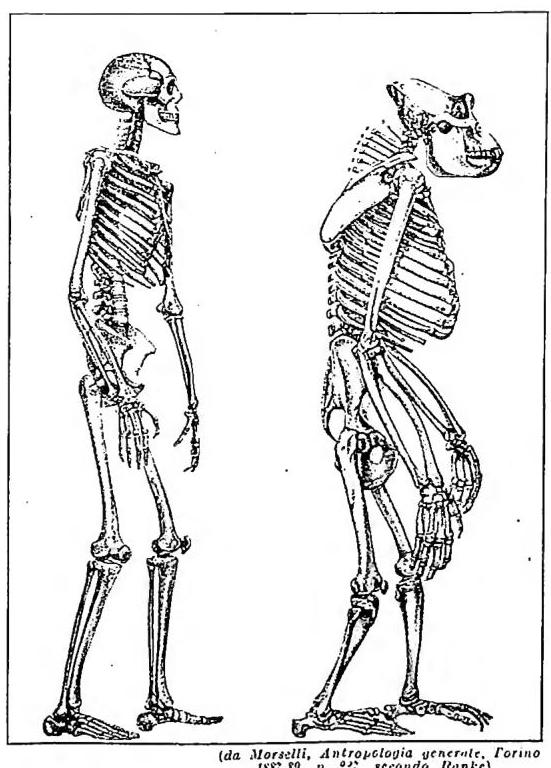 # CRANIAL CAPACITY IN CC. (from Marelli, Antropologia generale, Turin 1887–88, p. 52, after Benke) ANTROPOLOGY - Skeleton of Homo sapiens and Troglodytes gorilla. | Genera | Min. | Average | Max. |
|---|---|---|---|---|
| Gibbon: (Hagedoorn in Gieseler, 1936) | 100 | 128 | 150 | |
| Orangutan: (Hagedoorn in Gieseler, 1936) | 320 | 443 | 575 | |
| Chimpanzee: (Hagedoorn in Gieseler, 1936) | 350 | 411 | 480 | |
| Gorilla: (Hagedoorn in Gieseler, 1936) | 387 | 511 | 655 | |
| Australopithecus | (Dart, 1925) | juvenile | 520 | |
| (Dart, 1925) | adult | 600 (calculated) | ||
| (W. Abel, 1931) | juvenile | 380-390 | ||
| (W. Abel, 1931) | adult | 450 (calculated) | ||
| Paranthropus: (von Koenigswald, 1939) | 600 | |||
| Pithecanthropus II: (von Koenigswald and Weidenreich, 1939) | 835? | |||
| (Dubois) | ca. 900 | |||
| Pithecanthropus I: (MacGregor) | ca. 940 | |||
| (Weinert) | ca. 1000 | |||
| Pithecanthropus IV: (Weidenreich, 1940) | 900 | |||
| Sinanthropus: (Weidenreich, 1937) | 850? | 1023 | 1200 | |
| Neanderthals: Neandertal, La Quina, Gibraltar, La Ferrassie, La Chapelle: (Boule, 1923) | 1300 | 1450 | 1600 | |
| Modern man: (Martin, 1914) | 900 | 1400 | 1950 | |
| (Biasutti, 1941) |