
LAMAISM. – It is the Buddhism of the “great vehicle” (māhāyāna), in the particular ritual form it has assumed in Tibet. The name derives from the word bla-ma (pron. lāma), master, which properly applies only to monks of the highest rank.
CONTENTS:
I. The doctrine
II. Worship
III. History
IV. The present situation.Like other religions of Asia, Lamaism has a doctrinal and a popular aspect, the former less well known, while the latter has often been described by European travelers.
I. THE DOCTRINE
The theoretical basis of L. is māhāyānic Buddhism, as it developed in India during the first centuries of the Christian era; more precisely, L. is based on a particular form of it, the vajrayāna, or Tantrism. The vajrayāna (“adamantine vehicle”) is Buddhist gnosis. Of the māhāyāna, it accepts all the philosophical foundations and especially the postulate of the insubstantiality of all things (ēunyatā); but it is hostile to philosophical knowledge and centers upon mystical intuition (prajñā). This is reserved exclusively for the initiated, regenerated through mystical baptism. Prajñā as a symbol is then transformed into an almost divine concept, practically into a śakti, or active principle of the divinity. The mystical process and prajñā itself are symbolically represented by the mystical formula (mantra or dhāraṇī), whose sounds are exalted until they themselves become a divinity. Another symbolic representation is the mudrā, or mystical position of the fingers and hands. Finally, both as a theoretical representation and as a practical aid to intuition, the vajrayāna makes extensive use of the maṇḍala, a mystical diagram of the divinity and, at the same time, of the psychic processes leading to it, symbolizing eternal becoming in the macrocosm and the microcosm. All these expressions and symbols are systematized in an immense series of liturgies (sādhana), practical methods for realizing, according to the various schools, the divinity in the soul of the mystic. The vajrayāna and its tantras also have a pronounced sexual aspect, insofar as copulation, both as a mystical ceremony according to specific rites and as an iconographic representation (Tibetan yab-yum, “father-mother”), symbolizes the conjunction between the divinity and its contingent manifestation (śakti), between knowledge (prajñā) and the means suited to attaining it (upāya), and between the mystic and the psychic forces manifested by him. The boundary between mysticism and magic is moreover rather vague, and one passes imperceptibly from one to the other; some Tantric liturgies have a lofty mystical significance, while others are pure and simple magic, and at times black magic. Hence the great success of the vajrayāna among the lower classes. The texts of the vajrayāna in fact seek to explain to the adept the ways of obtaining knowledge (vidyā), a word that has the technical meaning of knowledge of the power of the formulas and of how to use them. The ideal of the vajrayāna is not so much the mahāyānic ideal of the bodhisattva, that is, of the enlightened one who renounces entering nirvāya in order to lead humanity to salvation through preaching; it is rather the siddha, that is, the sage who through mystical practice has attained siddhi, supreme realization in its transcendent and earthly aspects. In order to reach this goal through contemplation (samādhi), use is made of the yoga technique, even in its most violent form (haṭhayoga). On the one hand, it serves to attain concentration and mystical unity between macrocosm and microcosm; on the other, it seeks to obtain physical faculties superior to the ordinary, such as gtum-mo (pron. tummō), that is, hyperpyrexia; groh-jug (pron. dronggiuk), which is the transfer of one’s vital principle and personality into a corpse, bringing it to life; p'oba (pron. phovā), that is, predetermination of one’s rebirth; and others. Thus siddhi often declines into a mere notion of magical power.At the center of the vajrayānic (and mahāyānic) pantheon stand the five Buddhas (pañcatathāgata): Vairocana, Akṣobhya, Ratnasambhava, Amitābha, Amoghasiddhi, who are hypostases of the one primordial Buddha (Ādibuddha); this is an abstract conception, which no longer has anything to do with the historical Buddha. Of lesser doctrinal importance than the five Buddhas, but of far greater prominence in worship, are certain of the bodhisattvas, especially Mañjuśrī and Avalokiteśvara. Higher in rank is Mañjuśrī, the personification and protector of transcendental consciousness. But much more popular than he is Avalokiteśvara (Tibetan: sPyan - ras - gzigs, pron. Cenresi), the bodhisattva who symbolizes one of the Buddha’s most human acts, that of looking compassionately (vilo-kayati) upon the creature; he is the personification of mercy, and is the tutelary god who protects Tibet, where he is incarnated in the Dalai-Lama.
II. THE CULT
The popular aspect of L. is in part conditioned by its religious substratum. Before being converted to Buddhism, Bon (v.), primitive animism originally very closely akin to Siberian shamanism; today, as a religion still living especially in eastern Tibet and among the Mo-so, it is itself profoundly influenced and transformed by L. Buddhism encountered strong resistance from Bon, which was firmly rooted in the Tibetan aristocracy that constituted its priestly class; and it succeeded in overcoming it only by reaching an accommodation with it, admitting a certain number of Bon-po divinities into its own pantheon and accepting some of its cosmogonic ideas. In addition to Bon, certain Iranian and Central Asian influences also penetrated the vajrayāna, which by its nature was highly suited to this form of syncretism. Thus, for example, dPe-har (pron. Pehār), the tribal god of the north-east, entered the Lamaist pantheon; he retained his semi-demonic qualities and is now incarnated in the c'os-skyōn (pron. ciōkiōng), “protector of the law,” the official oracle of the Tibetan State, residing at gNas-c'ūn (pron. Neciūng) near Lhasa. Beg-tse likewise entered it, a warlike deity armed with a sword and clad in armor, imported from Mongolia and becoming for the dGe-lug-pa one of the principal defenders of the doctrine. It should nevertheless be noted that, while the pantheon continued to be enriched by ever new divinities, the fundamental foundations of the doctrine, by contrast, remained intact and free from every external influence.Lamaist worship is complex and sumptuous. In the great temples, populated by innumerable statues arranged according to strictly fixed iconographic schemes, worship takes place in grand collective ceremonies, with prayers recited in chorus and individually, offerings (never bloody ones), and blessings. In the villages, the local divinities of Bon-po origin continue to be worshipped: the sablag (pron. sadāk) and the btsan (pron. tzen), almost invariably malevolent deities, merely tinged with a light veneer of L.
III. HISTORY
The historical fortunes of l. begin with the very introduction of Buddhism into Tibet. A first contact took place with King Sroñbtsan-sgam-po (pron. Songtzèn-gampō; ca. 620–49). The introduction of Buddhism as a state religion, however, occurred only under King K'ri-sroñ-ldbtsan (pron. Thi-song-de-tzen; 755–97), under whom the assiduous work of translating the sacred texts from Sanskrit into Tibetan began, in collaboration between Indian masters (paṇḍita) and Tibetan translators (lot-sava). This is the period that the Tibetans call the earlier propagation (sña-dar, pron. ngadār). The resistance of Bon was extremely vigorous—indeed, vigorous enough to produce, after the reign of the bigoted Buddhist king Ral-pa-can (pron. Ralpacèn), a furious reaction under King gLañ-dar-ma (pron. Langdārma; 836–41).Buddhism was systematically persecuted and practically became extinct in Tibet, with the dispersal and exile of the monastic communities that constituted its core. After the assassination of the King and the disintegration of the monarchy, the surviving centers of Buddhism struggled on for approximately a century. Then, through the efforts first of Klu-mes (pron. Lumē, beginning of the 10th century), and subsequently of Rin-c'en-bzan-po (pron. Rincen-sangpō; 958–1055) and the great Indian master Atīsa (d. 1054), the monastic community in Tibet began to be founded anew and on somewhat different foundations. This is the “later propagation” (p'yi-dar, pron. cidār), which resulted in the definitive victory of Buddhism and the defeat of Bon, now reduced to small communities in the outlying regions of Tibet.
This entire period (11th–14th centuries) is characterized by a great flourishing of spiritual life, by the foundation of most of the Lamaiste sects, and by the translation of the greater portion of the canon. In the second half of the 13th century, the abbots of Sa-skya (pron. Sākia) acquired great influence at the court of Kubilai Khan and his successors, obta-
(courtesy of Prof. G. Turci)
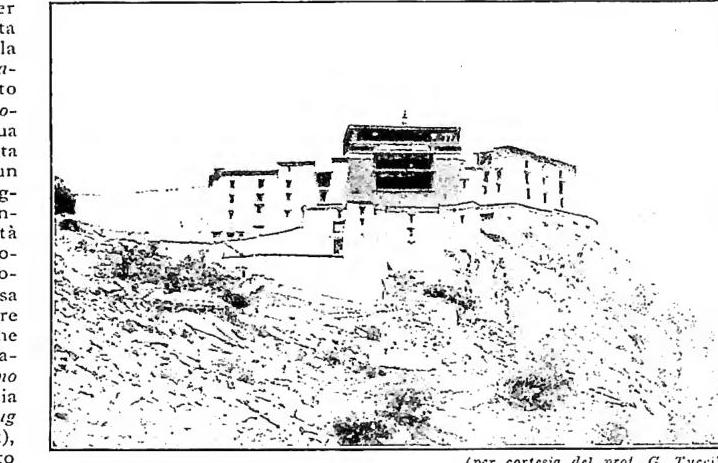
LAMAISMO - Castle of Dkon-Dkar Rdson in the valley of the Tsang-po.
(courtesy of Prof. G. Tucci)
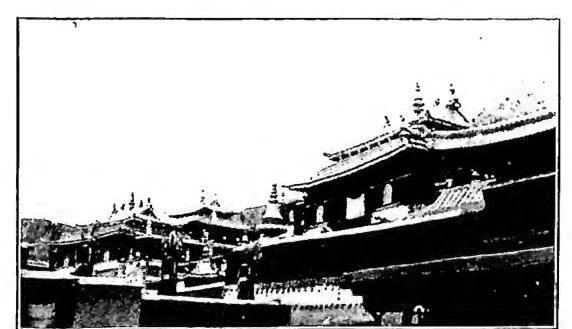
LAMAISM - Sacred dance in the monastery of Gyantse.
For a long time confined to Tibet, Lamaism subsequently gained ground beyond its frontiers as well. The protection granted by the Chinese emperors of the Yüan dynasty to the abbot of Sa-skya led to a certain diffusion of Lamaism among the Mongols, especially those settled in China. With the expulsion of the Yüan (1368), Lamaism disappeared from China and languished almost to the point of extinction in Mongolia as well. Its revival was due in considerable part to political motives: in order to secure the support of the Mongol princes in the arduous struggle he was waging within Tibet, the third Dalai-Lama bSod-nams-rgya-mts'o (pron. Sönam-ghiamtzö; 1543-88) went to Mongolia, where he succeeded in obtaining the conversion of the principal Mongol chiefs, and where he died. His successor was the son of a Mongol chief. Mongolia was thereby definitively won over to the dGe-lug-pa. Mongolian Lamaism differs in no respect from Tibetan Lamaism. The most learned Mongol lamas receive their theoretical training in Tibetan monasteries, and there has never been the slightest doctrinal deviation. The bKa'-gyur and the bsTan-gyur were translated into Mongolian, giving rise to a considerable exegetical literature in that language. At the head of Mongolian Lamaism was the incarnation of Urga, the rJe-btsun Dam-pa (pron. Getsün-dampà), in Mongolian Maidari Qutuqtu, together with other lesser incarnations. A little later Lamaism also spread to the Buriats of eastern Siberia and to the Kalmyks of the Volga.
The first Chinese emperors of the Manchu dynasty protected Lamaism, above all for political reasons. The Emperor Yung-cheng (1722-35) converted into a monastery (Yung-ho kung) the palace in which he had lived before ascending the throne. The Yung-ho kung became the principal of the numerous Lamaist monasteries of Peking and Jehol. The capital became a centre of Lamaist life; numerous incarnations resided there, for example, the lCañ-skya (pron. Ciängkia) Qutuqtu and the T'u-kuan Qutuqtu, and the bKa'-gyur and the bsTan-gyur were printed there in fine editions. In China, however, Lamaism always remained the religion of foreign circles connected with the court, and never penetrated the mass of the Chinese people. From Peking, attempts were made to introduce Lamaism into Manchuria. The bKa'-gyur was translated into Manchu; but the undertaking was not carried through and had no practical result.
IV. THE PRESENT SITUATION
Lamaism as it exists today is divided into various sects, which are customarily grouped into two major sections: a) the red sects, that is, those preceding the reform of Tson-k'a-pa; b) the yellow sect, that is, the(courtesy of Prof. G. Tucci)
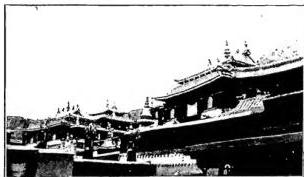
LAMAISMO - Tombs of the Tashi-Lama at Tashi-Lhunpo.
1) The rĪn̄-ma-pa (pron. Gningmapā), that is, the “ancients,” descendants of Padmasambhava. They are the last remnant of the “earlier propagation,” and practise a tantric Buddhism more contaminated than any other by Bon-po beliefs. Magical practices have very great importance among them. The monks may marry.
2) The bKa'-gdams-pa (pron. Kadampā), the first great school of the “later propagation,” descendants of Atīsa. Today they have almost disappeared, absorbed by the dGe-lug-pa reform that arose from their midst.
3) The bKa'-rgyud-pa (pron. Kaghutpā), descendants of Mar-pa (1012-53); they are characterized by the particular importance they attribute to hathayoga and to the severest ascetic practices.
4) The 'Brug-pa (pron. Drukpā), descended from Glīn-ras-pa (pron. Lingrepā; 1122-88); they are merely an offshoot of the bKa'-rgyud-pa, of little religious interest, but politically important, constituting the dominant sect in Bhutan; until a century ago they were also dominant in Ladakh.
5) The Sa-skya-pa (pron. Sakiapā), descended from 'K'on dKon-cog (pron. Khön Konciō, 1034-1103), had, as has been said, great political importance. Their abbot, still the temporal lord of a small territory, is hereditary and must therefore marry. The sect has its own system of meditation, called lam-'bras (pron. landrē), “the way and the fruit.”
The yellow sect, or dGe-lug-pa, is dominant in Tibet and is the only one recognized in the extra-Tibetan Lamaist territories. The reform of Tson-k'a-pa constituted a return to tradition. In the doctrinal field, he restored the mahāyānico ideal of the bodhisattva to prominence, in preference to the tantric ideal of the siddha. Above all, however, he was a restorer of monastic discipline, which had become so lax among the red sects. The dGe-lug-pa must observe chastity and abstain from intoxicating liquors and meat; monastic life proceeds strictly according to the ancient rules. The “curriculum” of studies is organized through a judicious gradation of texts and with strict discipline; students may obtain various academic degrees. One of the sect’s most conspicuous characteristics is precisely the enormous monastery-universities of 'Brasspuñs, Se-ra, dGa'-ldan (pron. Gadēn), and bKra-šislhun-po, inhabited by thousands upon thousands of learned lama and ordinary monks (grva-pa, pron. trapā); previously, on the other hand, the monasteries (dgon-pa, pron. gōmpā, “solitude”) were what their very name indicated: hermitages of a type that today one might call Camaldolese. Magical practices are forbidden, and generally the tantric and yogic aspect of l. is relegated far into the background. Great prominence, instead, is given to dialectic, and formal logic is assiduously studied and practised in public disputations. The sect’s principal text is the Lam-rim-c'en-ma of Tson-k'a-pa, a true Summa of Lamaist doctrine, of an intelligently eclectic character.
As a practised religion, l. is today in a distinctly declining phase. It still dominates in Tibet, Bhutan, and certain Indian territories (Sikkim, Ladakh, Spiti, Kunawar, Lahoul). In Outer Mongolia, which for a time was a theocratic state under the last rJe-btsun Dam-pa from 1912 to 1924, the Lamaist Church was gradually weakened and deprived of its authority by the communism prevailing there.
During the last war hundreds of monasteries were abolished and thousands of monks reduced to the lay state; and today Mongolian l. appears headed toward dissolution. In Inner Mongolia, which remained subject to China, this process is still in its early stages, but the tendency is the same; and this also applies to the border zone between Tibet and western China. In Beijing, l. was already in marked decline after the fall of the Empire; this decline is becoming increasingly pronounced today. The l. of the Volga Kalmyks and Siberian Buryats suffered greatly from the anti-religious policy of the USSR from the Revolution until 1942; it is not known, however, whether the partial change in this policy during and after the last war may have encouraged the revival of religious life in the monasteries of Transbaikalia, which had already flourished so greatly under the tsarist regime. - Vedi tav. LI.