
OCEANIA. - I. GEOGRAPHY. - In the broad sense, this name denotes the Australian continent and the insular world accompanying it, including the islands scattered throughout the Pacific Ocean S. of the Tropic of Cancer (that is, an emerged area of just under 9 million sq. km., with 12.5 million inhabitants); in the proper sense, it denotes this insular world alone, which occupies approximately 1¼ million sq. km., with 3½ million inhabitants. Here O. is considered in this second and narrower sense (v. AUSTRALIA).
The western limit of O. may be fixed by means of a line which, starting from the Arafura Sea, passes between the Aru and Kei Islands, leaves the Moluccas and the Philippines outside it, and, continuing approximately along the 130° E. Greenw. meridian, crosses the Tropic of Cancer so as to embrace the entire Hawaiian archipelago. From there, proceeding SE., the line cuts across the Ocean until, beyond the Tropic of Capricorn, it reaches the Sala y Gomez and Easter Islands, and then runs
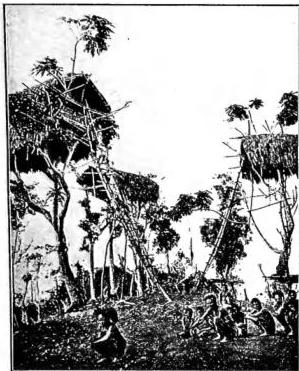
The traditional division speaks of: 1) Melanesia (“Islands of the Blacks”), or Macronesia (“Great islands”), for the islands bordering Australia to the NE., from New Guinea to New Caledonia and the Fiji Islands, where the territories are mountainous and the Melanesians or Papuans live; 2) Micronesia (“Small islands”) for the archipelagos that extend
(from P. Scotti, I popoli della terra, Turin 1917, Sg. IV)
OCEANIA - Houses built on trees - in Melanesia.
from Palau to the Ellice Islands (Bonin, Mariana, Caroline, Marshall, Gilbert); 3) Polynesia (“Many islands”) for the swarms of islands that enclose the two preceding sectors in a semicircle, extending from Hawai to New Zealand (Samosa, Tonga, Marquesas, Society Islands, Paumotu, etc.).
Of the smaller islands, the low-lying ones generally correspond to atolls (coral reefs formed on submarine elevations, often enclosing lagoons), more numerous to the E. and N.; the high and mountainous ones are volcanic formations (there are at least thirty active edifices known since historical times), the highest of which are found in New Guinea, Hawai and New Zealand. Submarine eruptions are also frequent.
Climatic conditions vary far less than differences in latitude would lead one to expect, but there is an evident contrast between the large islands, where subcontinental or continental forms are also found, and the small ones, in which, despite local variations, oceanic forms predominate, with constantly high temperatures, slight annual and diurnal variations, and more or less abundant precipitation. These climates naturally take on an equatorial character between 10° N. and 15° S.; a subequatorial character on both sides of the Tropics, up to 10° N. beyond the Tropic of Cancer and up to 15° S. beyond the Tropic of Capricorn; and finally a temperate character, more suited to Whites, in the southern hemisphere S. of the Tropic (N. Zealand), or in the extreme E., where the influence of the trade winds is felt throughout the year. The contrast is typical between the eastern quadrants, swept by the trade winds and consequently luxuriant in vegetation (rainforest), and the western ones, where drought or lesser humidity permits scarcely more than savanna or steppe.
The vegetation is poor in species and becomes even poorer in the eastern archipelagos. The most common plants are palms, pandanus, mangrove, sandalwood, breadfruit, ferns, etc., foremost among them the coconut palm, whose fruit constitutes the principal export article. The terrestrial fauna is likewise poor, lacking, as in Australia, the large mammals, whereas the avifauna and ichthyofauna are exceptionally rich.
The population (4.3 million inhabitants) is very irregularly distributed: approximately nine-tenths are concentrated in New Zealand (more than two-fifths), New Guinea (over one-third), and Hawai. In the small islands, densities always reach modest figures (91 per sq. km. in American Samosa): the exceptions correspond to the few cases in which mineral resources are exploited (phosphates, gold; in Nauru the density exceeds 160 inhabitants per sq. km.). The indigenous peoples form almost the entire population; they are all probably descended from a primitive transmanoid type, but subsequently differentiated into several groups and usually classified into three branches: Papuans, Melanesians, and Polynesians. Of these, the first two, who live in the western islands, are characterized by dolichocephaly, medium stature, brown complexion, black spiral hair, and a broad, flattened nose, whereas the Polynesians, settled in the distant eastern archipelagos, have lighter skin, taller stature, and straight or wavy hair. Contact with Whites, which became intensive only after the beginning of the nineteenth century, has everywhere reduced the number of indigenous people, aggravating, despite the recent immigration of people of color (mostly Yellow), the shortage of labor which has hindered and continues to hinder the rational development of O.’s resources. These resources, moreover, especially those of the subsoil, are still far from being fully known. Economic and civil development, on the other hand, naturally presents great differences from one part to another: in the larger islands, for example, the contrast is conspicuous between the rapid and brilliant development achieved by New Zealand and the still primitive condition in which New Guinea is kept, although it is so much larger and richer (nor are the reasons for this delay solely climatic). The exploitation of O.’s insular world, begun with the felling of forests and the hunting of whales and seals, later became concentrated in the agricultural sector, where, alongside indigenous plants (tropical fruits), the number of those introduced from other regions has increased (rice, cacao, coffee, cotton, citrus fruits, etc.), although the cost of transport necessitated by the great distances hampers efficient commercial expansion.
Spain, Holland, England, and France were, in chronological order, the first to set foot in the insular territories of O.; but toward the end of the last century Germany also entered them (1884: Bismarck Archipelago, Solomon Islands, N. E. New Guinea; 1888: Nauru; 1898: Mariana Islands; 1899: Caroline Islands), as did the United States (1898: Hawai and Guam; 1899: Samosa), while Spain abandoned its positions (after the disastrous war against the United States, concluded with the Treaty of Paris of 10 December 1898); finally, Germany’s place, after its defeat in the First World War, was taken by Japan (mandate over the Mariana Islands, excluding Guam, the Caroline Islands, the Marshall Islands, and the Palau Islands with Yap), which was itself eliminated to the advantage of the United States after the Second World War. At present, after the greater and better part of the British possessions passed to the two Dominions of Australia and New Zealand, the United States has secured a position which, without being definable as one of privilege, nevertheless clearly balances the influence of all the other powers. With one-half of New Guinea (the only part of the Dutch East Indies remaining outside the Indonesian Union), Holland retains an excellent position in O., more favorable to further development (agricultural, mining, and industrial) than that of France and perhaps even of England, now reduced to possession of the central archipelagos alone. The French Establishments in O. comprise the archipelagos—in all, about one hundred islands—furthest east in Polynesia, between approximately 8° and 28° S., namely (proceeding from N. to S.): the Marquesas Islands (1271 sq. km.); the Tuamotu or Puamotu, or Basse Islands (the most scattered and numerous of the archipelagos; 885 sq. km.); the Society Islands (1647 sq. km.), among which is Tahiti (1042 sq. km.), which by itself gathers approximately half the population of all the Establishments; the Tubusi or Austral Islands, the Gambier Islands, Rapa, and Morotiri. Altogether, 3998 sq. km. and 50,000 inhabitants, mostly Maori, with groups of French, Chinese, and Indochinese. The seat of the governor of the Colony is in Papeete, on Tahiti Island.
The Ground Truth image displays a single, solid horizontal line. According to Rule 2 (UNDERSCORE & LINE RULES), this is a stylistic or background line, not a placeholder underscore. Therefore, the OCR result must ignore it and output nothing or only meaningful text. The provided OCR content is "____", which consists of four underscores. This is an incorrect interpretation of the line as a placeholder, violating the rule that stylistic lines must be ignored. The OCR has hallucinated underscores where none should exist based on the GT's visual context. Hence, the OCR result is inconsistent with the Ground Truth.
[Non-Text]
In the following table, which arranges the island world of O. according to current political affiliations, the territories placed under trusteeship are marked with an asterisk. Since, for reasons of space, it is not possible to indicate the names of all the islands included in the various administrative units, those of the smaller islands, to which the abbreviation dp (= dependencies) refers, have been omitted.
POLITICAL PARTITION OF O.
(1952)| Islands and territories | Area in sq. km. | Population |
|---|---|---|
| Territory of Papua | 234,490 | 304,000 |
| Norfolk Islands | 39 | 1,000 |
| * Territory of New Guinea | 240,870 | 1,007,000 |
| * Nauru Islands | 22 | 3,000 |
| AUSTRALIAN O. | 475,421 | 1,315,000 |
| New Zealand | 267,821 | 1,873,000 |
| Campbell, Auckland Islands and dp. | 793 | 5 |
| Cook, Niue, Kermadec and Tokelau Islands | 559 | 20,450 |
| * Western Samoa Islands | 2,934 | 73,000 |
| NEW ZEALAND O. | 272,089 | 1,966,455 |
| Guam Islands | 534 | 58,754 |
| American Samoa Islands and dp. | 197 | 18,000 |
| Hawaii Islands | 16,661 | 503,000 |
| Wake, Howland, Baker and Jarvis Islands | 14 | 30 |
| * Mariana Islands | 639 | 46,650 |
| * Caroline Islands | 636 | 39,000 |
| * Palau Islands | 478 | 17,800 |
| * Yap Islands | 226 | 6,650 |
| * Marshall Islands | 170 | 9,958 |
| UNITED STATES O. | 19,555 | 699,842 |
| Fiji and Rotuma Islands | 18,344 | 278,000 |
| Gilbert, Ellice and dp. Islands | 971 | 35,600 |
| Solomon Islands | 30,300 | 95,000 |
| Pitcairn Islands and dp. | 39 | — |
| Tonga Islands | 697 | 46,000 |
| Starbuck, Malden, Caroline, Flint and Vostok Islands | 42 | — |
| BRITISH O. | 50,393 | 454,600 |
| New Caledonia and dp. | 18,653 | 61,250 |
| French Settlements of O. | 3,098 | 55,500 |
| Clipperton Islands | 2 | — |
| FRENCH O. | 22,653 | 116,750 |
| New Hebrides Islands | 14,762 | 50,000 |
| ANGLO-FRENCH CONDOMINIUM | 14,762 | 50,000 |
| New Guinea and dp. | 416,000 | 200,000 |
| DUTCH O. | 416,000 | 200,000 |
| Bonin and Volcano Islands | 106 | 4,750 |
| Minamitori Islands | 10 | ? |
| JAPANESE O. | 116 | 4,750 |
| Easter Island | 120 | 250 |
| Sala y Gomez Islands | 0.1 | — |
| CHILEAN O. | 120 | 250 |
| OCEANIA | 1,271,151 | 4,797,647 |
II. EVANGELIZATION
The first Catholic mission in O., after various earlier unsuccessful attempts, began in the 17th century, when the Jesuits of the Philippines undertook the conversion of the Mariana Islands. From 1668 to 1672 the Jesuit Diego Luis Sanvitoros succeeded in establishing a flourishing mission there, and in 1672 he died a martyr. Although by 1682 twelve other Jesuits had also suffered martyrdom, they succeeded in maintaining the mission of the Marianas until the suppression of the Society. It was continued by the Augustinian Recollects (1768–1889) and subsequently by the Capuchins and Jesuits. Other attempts to found missions in O. failed, such as those made by the Jesuits at the beginning of the 18th century in the Palaos and Caroline Islands, where Fr. Juan Antonio Cantova became renowned, and those of the Franciscans in Tahiti from 1772 to 1775.Only in the 19th century was a systematic missionary activity undertaken by Catholics throughout O. The Protestants, however, had already been working there with good results since the end of the 18th century.
In 1827 the first missionaries of the Society of the Sacred Hearts (Picpus) landed on the Island of Hawaii. In 1829 the S. Congr. of Prop. Fide erected the apostolic prefecture of the Islands of the South Sea or Great Ocean, comprising the territories “between the Equator and the Antarctic Pole and between Easter Island and New Zealand,” inclusive, and entrusted it to the priest Henri de Solages. In 1832 two apostolic vicariates were erected: that of “Polynesia or eastern O.,” entrusted to the Congregation of the Sacred Hearts, and that of “Polynesia or western O.,” entrusted in 1835 to the Society of Mary (Marists).
In eastern O., severe persecutions and the expulsion of the missionaries from the Sandwich Islands, the center of the mission, prevented effective activity until, in 1839, the Catholics obtained freedom of action through a treaty with France. Meanwhile, departing from Chile, the Picpusians had established themselves from 1834 in the Gambier Islands, converting almost the entire population, and from 1836 they had begun the mission in Tahiti and the Marquesas Islands. In 1844 the Sandwich Islands were elevated to an apostolic vicariate (in 1941, to the diocese of Honolulu), and the remainder of eastern O. was divided into two vicariates: the Marquesas Islands and Tahiti.
In western O., Jean-Baptiste Pompallier had been appointed the first apostolic vicar in 1836. He took up residence in New Zealand. During his voyage in 1837 he had left the Marists Pierre Marie Bataillon on the Island of Wallis and Pierre-Louis-Marie Chanel on that of Futuna. After the initial difficulties, the Island of Wallis was converted in 1842 and became an exemplary Catholic state. Fr. Chanel, however, incurred the hatred of the chief of Futuna and was martyred; but the successor of the King received Baptism with the majority of the people, so that the Island of Futuna was entirely Christianized in 1843. In 1842 the vicariate of central O. was separated from western O.; from it the other Marist missions of the region gradually originated: New Caledonia in 1847, where they had already been working since 1843; the Archipelago of the Naviga-
(phot. Fider)
OCEANIA - Maori chief with characteristic feathered headdress.
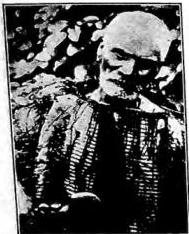
(Int. Fides)
OCEANIA - Papuan type - New Guinea.
In the three years of attempts to establish the mission, two bishops, four Fathers, and a brother lost their lives through assassination or fever, and only on the small islands of Woodlark and Rook did the Marists succeed in establishing themselves. In 1852 the Seminary of the Foreign Missions of Milan undertook the mission, but in 1885, after Fr. Giovanni Mazzucconi had been massacred, it withdrew. In 1881 Melanesia and Micronesia were entrusted to the Missionaries of the Sacred Heart. Msgr. Enrico Verjus began the mission in New Guinea; there, as also in New Britain (or Pomerania) and the Gilbert Islands, they succeeded in establishing themselves. Part of New Guinea passed in 1896 to the Missionaries of the Divine Word. In the Solomon Islands the Marist Fathers began the mission in 1898.
Despite the difficulties arising from the primitive populations, some of them still cannibalistic, and from political upheavals and wars, the mission of O. achieved good results. In 1950 O. was divided into 1 diocese, 18 apostolic vicariates, and 1 apostolic prefecture.
III. ECCLESIASTICAL ORGANIZATION
The ecclesiastical organization (according to the current political affiliation, in alphabetical order) is as follows:AMERICAN O.: ARCIPELAGO DEI NAVIGATORI, apostolic vicariate in 1850, entrusted to the Society of Mary (Marists); GUAM, apostolic vicariate in 1911, entrusted to the Capuchins; HONOLULU, apostolic vicariate of the Sandwich or Hawai Islands in 1844, diocese of Honolulu in 1941, entrusted to the Society of the Sacred Hearts; ISOLE CAROLINE E MARSHALL, in 1886 two missions: western Carolines and eastern Carolines, reunited in a single prefecture of the Caroline Islands in 1905; united with the apostolic prefecture of the Mariana Islands, in 1911 apostolic vicariate of the Mariana and Caroline Islands, in 1923, upon the union of the apostolic vicariate of the Marshall Islands (since 1905), apostolic vicariate of the Mariana Islands, present name: Caroline and Marshall Islands, entrusted to the Jesuits.
BRITISH AND AUSTRALIAN O.: ISOLE COOK, apostolic prefecture of Cook and Manihiki in 1922, present name in 1926, apostolic vicariate in 1948, entrusted to the Society of the Sacred Hearts (Picpus); ISOLE FIGI, apostolic prefecture in 1863, apostolic vicariate in 1887, entrusted to the Society of Mary (Marists); ISOLE GILBERT, apostolic vicariate in 1897, entrusted to the Missionaries of the Sacred Heart; ISOLE SALOMONE MERIDIONALI, apostolic prefecture of the English Solomon Islands in 1897, present name in 1904, apostolic vicariate in 1912, entrusted to the Society of Mary (Marists); ISOLE SALOMONE SETTENTRIONALI, apostolic prefecture of the German Solomon Islands in 1898, present name in 1904, apostolic vicariate in 1930, entrusted to the Society of Mary (Marists); ISOLE TONGA, apostolic vicariate of central O. in 1842, present name in 1937, entrusted to the Society of Mary (Marists); NUOVA GUINEA CENTRALE, apostolic prefecture of Terra di Guglielmo

From western O., subsequently reduced to New Zealand and the Kermadec Islands and divided in 1848 into the dioceses of Auckland and Port Nicholson (v. NUOVA ZELANDA), the two vicariates of Melanesia and Micronesia, likewise entrusted to the Marists, were separated in 1842. In less than
western, present name in 1922, apostolic vicariate in 1931, entrusted to the Society of the Divine Word (Steyl); NUOVA GUINEA ORIENTALE, apostolic prefecture of Terra di Guglielmo in 1896, named eastern Terra di Guglielmo in 1913, apostolic vicariate under its present name in 1922, entrusted to the Society of the Divine Word (Steyl); PORT MORESBY, apostolic vicariate of New Guinea in 1889, named Papua in 1922, present name in 1946, entrusted to the Missionaries of the Sacred Heart; RABAUL, apostolic vicariate of New Britain in 1889, named New Pomerania in 1890, present name in 1922, entrusted to the Missionaries of the Sacred Heart; SAMARAI, apostolic prefecture in 1946, entrusted to the Missionaries of the Sacred Heart.
FRENCH O.: ISOLE MARCHESI, apostolic vicariate in 1848, entrusted to the Society of the Sacred Hearts (Picpus); ISOLE NUOVE EBRIDI, apostolic prefecture in 1901, apostolic vicariate in 1904, entrusted to the Society of Mary (Marists); ISOLE TAHITI, apostolic vicariate in 1848, entrusted to the Society of the Sacred Hearts (Picpus); ISOLE WALLIE E FUTUNA, apostolic vicariate in 1935, entrusted to the Society of Mary (Marists); NUOVA CALEDONIA, apostolic vicariate in 1847, entrusted to the Society of Mary (Marists). - Vedi tavv. II-III.