
PAKISTAN. -
I. GEOGRAPHY
Federal state established on 15 August 1947, formally associated with the British Commonwealth. It consists of two separate territories: Western P. (795,000 sq. km.; 35 million inhabitants; 44 per sq. km.), comprising the former (British) units of Western Panjab, Sind, the North-West Frontier Province, and Balucistan; and Eastern P., which lies 1,500 km. to the east (140,000 sq. km.; 45 million inhabitants; 322 per sq. km.), including Eastern Bengal and the district of Sylhet. The attribution of Kashmir (219,000 sq. km.; 5 million inhabitants; 24 per sq. km.) to P. (or to the Indian Union) is still undecided; its population is predominantly Muslim, whereas the ruling dynasty is Hindu. With an area of 935,000 sq. km. and more than 80 million inhabitants, 42 million of them in Eastern P., P. is thus the largest and most populous Muslim state in the world; Muslims constitute approximately three-fourths of its population (more than two-thirds of the Muslims living in the former Indian Empire). Catholics number 225,000. The possible annexation of Kashmir would further strengthen the Muslim character of the state; its dimensions would increase to 1.15 million sq. km., with more than 85 million inhabitants (74 per sq. km., as against 110–120 in the Indian Union).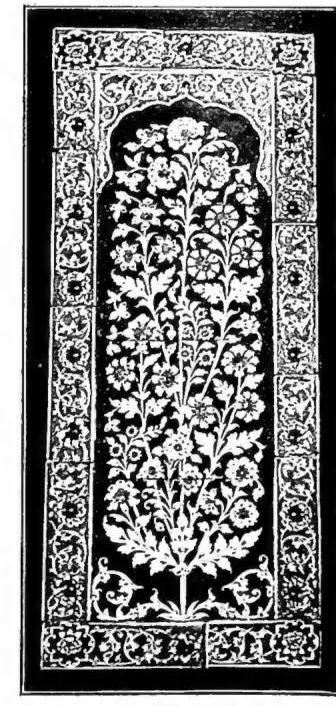
The division of the former Indian Empire left P. only a very small part of its pre-existing industrial infrastructure (for example, the principal jute-manufacturing center, Calcutta, lies outside P.), but large-scale plants have already been established both in the food-processing sector and in the textile and engineering industries, especially in Western P.
Trade has already assumed significant proportions and is tending to free itself from its traditional dependence on the metropolis. The two principal ports are Karachi (1.2 million inhabitants) in Western P., which is also the capital of the state, and Chittagong (125,000 inhabitants) in Eastern P. There are also about fifteen population centers with more than 100,000 inhabitants: Lahore (in Panjab) has approximately 1 million, and Dacca (Bengal) more than 500,000; Haiderabad (Sind) and Rawalpindi (Panjab) have more than 300,000.
II. HISTORY
Until 1947, the history of P. India (v.); with regard to the immediate antecedents of the new state formation, it may be recalled that, in the movement for the autonomy and then the independence of India, led from 1885 onward by the Indian National Congress party,the movement of the All India Muslim League joined it in 1906, as the first symptom of the Muslims’ separate aspirations. Until 1932 Hindus and Muslims acted jointly in their common demands; in 1932 a P. National Movement arose, later absorbed by the Muslim League, which demanded an autonomous Muslim state; it resisted the project of a federal state of India envisaged by the Constitution of 1935, which entered into force in 1937; in 1940 the leader of the Muslim League, in a speech in
Lahore, stated in precise terms the demand for a Muslim state. After the Second World War, negotiations with the British authorities effectively led to the formation of the two new Dominions of India and P. The proclamation of P., with Karachi as its capital, took place on 15 August 1947.
Pending the Constitution, which is still being drafted, the president of the Constituent Assembly of P. is head of state. The first president of the Constituent Assembly was Mohammed 'Alī Ginnāh (Jinnah), born in Karachi in 1876 and leader of the Muslim League since 1937. He died on 11 September 1948; he was succeeded by Tamīz ad-Dīn Ḥān. The general outlines of the new Constitution so far set forth in the debates of the Constituent Assembly (among other things in a spee-
(courtesy of Dr Gaetano Ballardini)
PAKISTAN – Large panel in painted majolica, with leaves and flowers in white on a turquoise and blue ground, donated by the Government of P. to the Museum of Ceramics in Faenza.
The general outlines of the new Constitution thus far set forth in the debates of the Constituent Assembly (among other things, in a speech by the prime minister Lijāqat 'Alī Hān at the beginning of 1949) suggest that P. will be a federal state with a republican democratic system; Islam will be the religion of the State, and the laws will be framed according to Islamic principles. The official language is currently English, but proposals have been made to replace it with urdu (the lingua franca of the Muslims of India) and with Arabic (the language of religious instruction in Muslim countries).
P. is divided into two territories, western and eastern, separated by approximately two thousand kilometres of Indian territory; this situation weakens its political cohesion, also because there are very marked ethnic differences between the two enormously distant parts. During its three years of existence, P. has had to overcome serious economic difficulties, also in connection with the movement of millions of people from one part to the other as a consequence of the partition of 1947. In foreign policy, P. acts in agreement with Great Britain, seeking to promote cooperation with the other Islamic States. Relations with neighbouring India have been and remain difficult; the most arduous issue remains that of Kashmir, whose government acceded to the Indian Union in 1947, while part of the predominantly Muslim population rose up under a free government (Azad Kashmir Government) with the assistance of P. The situation repeatedly threatened to degenerate into open war between P. and India. Mediation by the United Nations led to an armistice between the parties, but has not yet succeeded in defining the arrangements for a plebiscite. The last proposal, made by Sir Owen Dixon in 1950, that the plebiscite should take place under the authority of United Nations officials, with the temporary suspension of the authority of the existing governments of the two disputed zones, failed because of India’s opposition.
There are also disagreements with Afghanistan over frontier questions, the Afghan side supporting the aspirations of the Pathān, who wish their territory to have autonomy. Ettore Rossi
III. EVANGELIZATION
In eastern P., formerly East Bengal, toward the end of the sixteenth century Jesuits, Dominicans, and Augustinians were present, primarily to exercise their ministry among the Portuguese in the various commercial settlements and among those employed in the service of the Great Mogul. The Augustinians in particular founded several parishes in East Bengal, which remained entrusted to their care until the nineteenth century, under the bishop of S. Tommaso di Meliapor; also in Dacca, Chittagong, Dania, etc.After the reorganization of the missions of India in the nineteenth century, East Bengal constituted an apostolic vicariate from 1850, entrusted to the Congregation of the Holy Cross; from 1876 to 1886 it was served by the Cassinese Benedictines of the Anglo-Belgian Congregation. In 1884 it was definitively declared exempt from the jurisdiction of the archdiocese of Goa, and only a few parishes remained under the jurisdiction of the diocese of S. Tommaso di Meliapor until the convention between the Holy See and Portugal in 1929. In 1886, with the establishment of the ecclesiastical hierarchy in India, East Bengal was elevated to a diocese, called Dacca from 1887. The diocese of Chittagong was separated from Dacca in 1927 and was likewise entrusted to the Congregation of the Holy Cross. In the northern part of eastern P., in Dinajpur, the mission was begun in 1855 by the Lombard Seminary for Foreign Missions. From 1870 it formed part of the apostolic prefecture of Central Bengal, which was erected as a diocese in 1886 under the name of Krishnagar in 1887; from it Dinajpur was separated in 1927 as an independent diocese, entrusted to the Pontifical Institute for Foreign Missions of Milan. As a result of the creation of the new State of P., the territory of the dioceses of Chittagong and Dinajpur came to be divided between India and the new State; consequently, on 14 and 15 July 1950, the territory of the two dioceses was reduced to the area belonging to eastern P. At the same time, on 15 July 1950, Dacca was elevated to a metropolitan archdiocese, with Chittagong, Dinajpur, and the new diocese of Jessore as suffragans.
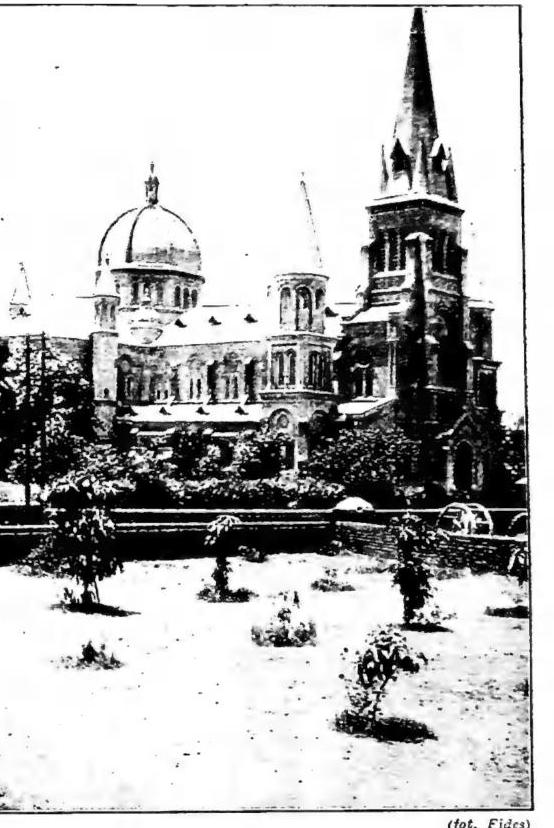
(phot. Fides)
PAKISTAN – Exterior of the cathedral of Lahore.
Akbar at Lahore in 1591, but they were expelled from there in 1614. The year 1624 marked a revival of the mission, which, however, could not be sustained. The few faithful were subsequently visited occasionally from Agra and Delhi. During and after the English occupation of the Panjab, the Capuchins founded churches in various localities, including Lahore, Multan, and Rawalpindi. In 1880 the apostolic vicariate of Panjab was established, later elevated to a diocese in 1886 under the name of Lahore. In 1887 the apostolic prefecture of Kafiristan and Kashmir was detached from it and entrusted to the missionaries of the Society of St Joseph of Mill Hill; it was elevated to a diocese in 1947 under the name of Rawalpindi. The apostolic prefecture of Multan, entrusted to the Dominicans, was detached from the diocese of Lahore in 1936 and elevated to a diocese in 1939. In the other part of western P., in Sind and Baluchistan, Carmelites and Augustinians were present at the beginning of the seventeenth century; because of persecutions, however, they had to cease their activity around 1672. After the English occupation of Sind, the Carmelites returned there. In Baluchistan, the Fathers of Mill Hill founded a station at the end of the nineteenth century. Both the Carmelites and the Fathers of Mill Hill yielded their place to the Jesuits, the territory becoming part of the diocese of Bombay. In 1935 the Dutch Franciscans took over the mission of Sind and Baluchistan, which was elevated in 1948 to a diocese under the name of Karachi. In 1950 Karachi became an archdiocese with Lahore, Multan, and Rawalpindi as suffragans; at the same time the archbishop of Karachi was appointed apostolic delegate for P., and in 1951 became apostolic internuncio to the government.
In P., the Catholic Church, with approximately 225,000 members among approximately 80 million inhabitants, constitutes an almost imperceptible minority. Socially as well, Christians find themselves in disadvantageous conditions, since for the most part they are Chouhara in the Panjab or Santals in Bengal. The Catholic mission seeks contact with Muslims through schools and charitable institutions; above all, there are hospitals of the « Catholic Medical Missionaries » and the « Medical Missions Sisters » in Rawalpindi and Karach