
PANAMA. -
I. GEOGRAPHY
The Republic of P., the southernmost of the Central American republics, which broke away from Colombia in 1903, occupies the narrow (70-100 km), elongated isthmus that connects the broader zone of Central America to South America; the isthmus is divided into two parts by the canal of the same name.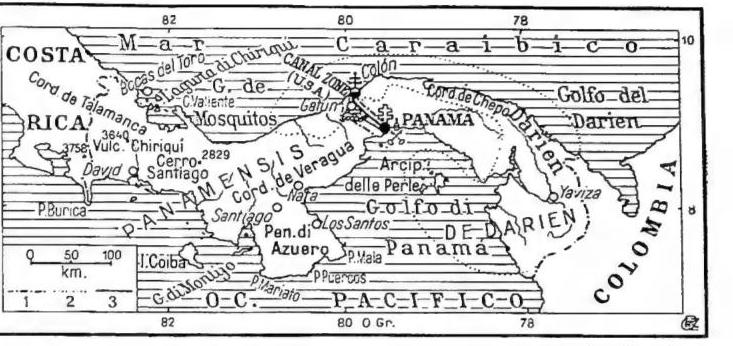
II. EVANGELIZATION
The evangelization of P. immediately followed the Spanish conquest through the work of the Franciscans. In 1513, in fact, the diocese of S. Maria in Darien (within the present-day borders of Colombia) had already been established: it was entrusted to the Franciscan Giovanni di Quevedo. It was the first diocese of the entire New Continent.In 1519 the seat of the diocese was transferred from Darien to Panama, where the Dominican Reginaldo di Pedrazza was sent from S. Domingo along with a few companions. Panama was the starting point of all military expeditions, and the apostolic conquests of the north and the south had their base of support in the diocese of the same name. Toward the middle of the 16th cent. the Augustinians also joined them. In 1648 the Capuchins entered Panama, where they immediately made great progress. From 1604 the Jesuits, setting out from their colleges in New Granada (Colombia), organized flying missions that achieved good results. But then came the suppression of the Jesuits, the struggle for independence against Spain (the Spanish missionaries were expelled), followed by revolutionary turmoil, and the Church suffered very severe damage.
Currently it includes the archdiocese of Panama (Nov. 29, 1925) Darien (v.).
III. EDUCATIONAL SYSTEM
Article 26, Title III, of the Panamanian Constitution provides for freedom of teaching of any religion that does not conflict with Christian morality and public order. The Catholic religion is defined as that of the majority of the inhabitants of the Republic, and consequently the State undertakes to lend its aid to it by permitting the existence in the capital of a Catholic seminary and the activity of Catholic missions among the indigenous peoples. The foundation of private schools is permitted only when they follow the teaching curriculum of public schools. The entire school system depends on the Secretariat of Education and includes 815 primary schools divided into 763 rural primary schools and 52 urban primary schools. There are also 13 elementary schools for Indians, as well as secondary, industrial, vocational, and higher schools. The latter include the Escuela de pintura, the Conservatorio nacional, and the Universidad de Panamá, founded in 1935. - Vedi tav. L.Miroslav Štumpf