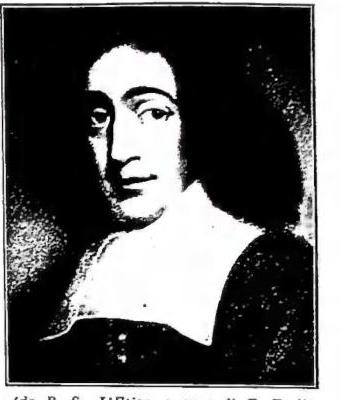
SPINOZA, BARUCH de. — Philosopher, born in Amsterdam on 24 November 1632 to a Jewish family of Portuguese origin, died at The Hague on 21 February 1677. He represents the highest and most coherent expression
Vita del p. C. S., Roma 1628; with corrections and additions, edited by G. Boero, ibid. 1869; G. Boero, Della gloriosa morte di CCV bb. Martiri nel Giappone, ibid. 1867; L. Pagès, Hist. de la religion chrétienne au Japon, depuis 1598 jusqu'à 1651, 2 vols., Paris 1870–71, V. indici.
Celestino Testore
FABIO AMBROGIO. – Ascetical writer and preacher, born in Genoa on 3 October 1593, died there on 28 August 1671.
He entered the Society of Jesus (1610) and was professor of philosophy and Sacred Scripture, preacher, rector of the Collegio Germanico in Rome, and four times of the professed house of Genoa. Among his orations, those that became famous were the one entitled In Parascene ad Urbanum VIII, delivered in the Vatican (1626), and that of the
of modern rationalism—Cartesian, mathematical, phenomenalistic—which he logically carries to its extreme rationalistic-monistic conclusions, unhindered by practical motives, Leibniz (v.), and he belongs to the small company of the great modern philosophers.
I. LIFE AND WORKS
S. drew from his rigorous Jewish education that overwhelming and absorbing sense of the divine which is characteristic of him. He was consequently introduced to Jewish, Neoplatonic-medieval philosophy by the celebrated Rabbi Morteira; from this came his pantheistic conception of the divine. But such a conception—where God and the world are resolved into a unity of nature—is in no way coherent with a Revelation, which presupposes divine transcendence. S.’s acute intellect must soon have become aware of this; while his straightforward will prevented him from adhering to a religion of which he was not rationally convinced. Thus, refusing every practical compromise, he was solemnly excommunicated by the Synagogue, which had set him on the path to the rabbinate, on 27 July 1656; and he was consequently also banished by the Protestant authorities of Amsterdam as a blasphemer of Scripture. S. first withdrew to the environs of Amsterdam, then to Leiden and from there to The Hague (1664). At twenty-four, without a country, family, health, or wealth, S. would remain isolated also in religious terms. The other most noteworthy elements in his spiritual and speculative formation were his discipleship under Francesco van den Ende and his participation in certain Dutch Christian-Protestant circles. From van den Ende S. learned above all Cartesian science and philosophy, which would be a precious instrument for the rational systematization of his fundamental mystico-pantheistic intuition, and then Latin and a little Greek. The Dutch religious circles that S. frequented advocated a Christianity without dogmas and essentially moralistic in content (Collegians, Mennonites, etc.); from these derived his substantial knowledge of Christianity and, at least in part, his religious philosophy. Apart from these, it may be said that no other external events occurred during S.’s brief and intense life. He provided for his very limited material needs chiefly by preparing optical lenses for microscopes and telescopes, much sought after on account of their perfection; and also with some small assistance from the select group of admirers, friends, and disciples. But he rejected every position that might have limited or disturbed his speculative quiet and scientific independence (the rich testamentary bequest of Simone de Vries; the lifetime pension offered him by the great Condé; the chair at the University of Heidelberg proposed to him by the Elector Palatine Carlo Ludovico, brother of Princess Elisabetta, an admirer of Descartes). As Pascal observes, he seems to have understood—in contrast with the worldly Leibniz—that «tutti i mali vengono dal non saper stare in riposo in una camera».Afflicted with hereditary tuberculosis, after several months of illness S. quietly passed away at the age of only forty-four. His savings were barely sufficient to pay the few insignificant debts incurred during his illness. His weak health did not prevent S. from being a great thinker; indeed, according to his contemporary Pascal, it would have been a necessary condition. Another characteristic feature of S.’s personality is his ethical conception of philosophy as the solver of the problem of life, whence also the rigorous conformity of his life to his philosophy; but at the same time his firm conviction that the resolution of this ultimate problem is possible only theoretically, through the rational and intellectual contemplation of eternal and infinite Reality (cf. the opening of the De intellectus emendatione and the appendix to Book I of the Ethica). But since human intellect is not granted the concrete vision of the world’s rationality, owing to the imposing presence of the evil of negation and privation, S. needed tremendous strength of spirit in order to overcome, in human terms, this twofold resistance of evil, which culminates in spiritual pride.
S.’s works are relatively few but deeply considered, synthetic, and, even where unfinished, containing a complete philosophical system. The principal ones are the Ethica, more geometrico demonstrata, in five books (posthumous, Amsterdam 1677), which contains his philosophical system and is his masterpiece; and the Tractatus theologico-politicus, published anonymously (Hamburg 1670), which contains his religious and political philosophy. The list of (philosophical) works also includes Renati des Cartes Principiorum philosophiae porx I et II more geometrico demonstratae (Amsterdam 1663); Tractatus de intellectus emendatione, unfinished (posthumous, ibid. 1677); Tractatus politicus, unfinished (posthumous, ibid. 1677); Tractatus de Deo et homine eiusque felicitate, discovered in the last century, originally written in Latin, but of which two Dutch versions remain (ed. by E. Böhmer, Halle 1852); Epistulae, considerably expanded in the more recent editions and highly important for understanding his thought.
II. THOUGHT
The sources of Spinozian thought are essentially four: a) orthodox-theistic Jewish religion; 2) Jewish-Neoplatonic-pantheistic speculation; 3) Cartesian philosophy in particular; 4) modern thought in general (Bruno, Hobbes, etc.). Ignored and despised for approximately a century after his death, S.’s thought particularly and powerfully engaged and influenced German culture after Kant (Lessing, Goethe, Fichte, Schelling, Schleiermacher, Hegel, Schopenhauer), providing idealism with the monistic metaphysical element, naturally filtered through Kantian criticism.a) God. — Theology, that is, Spinozian metaphysics, is contained essentially in Book I of the Ethica (De Deo). From God S. would rationally, logically, geometrically deduce all reality. As God is the sole cause, so he is the sole substance (Ethica, Book I, definition 3). The divine substance is eternal and infinite, that is, beyond time and expressing itself in an infinite number of perfections or infinite attributes. Of these attributes, however, the human intellect, although it can realize its identification with the divine intellect, knows only two: spirit and matter, cogitatio and extensio. These, from being diminished substances as they were in Descartes, become in Spinozian monism attributes of the one substance. Thought and extension are different and irreducible expressions of the absolute substance, but are unified and correspond within it through the Spinozian doctrine of psychophysical parallelism. Here arises the exegetical-critical problem of the relation between substance and attributes, particularly discussed by Erdmann and Fischer, above all on the basis of definition 3 of Book II of the Ethica. Substance and attributes constitute natura naturans. From natura naturans (God) proceeds the world of things, that is, the modes: these are modifications of the attributes, and S. calls them natura naturata. The modes, in turn, are divided into primitive and derived. Primitive modes represent the most immediate and universal determinations of the attributes and are eternal and infinite: for example, in the attribute of thought, the intellectus infinitus, and in the attribute of extension, motus infinitus. Derived modes in turn represent modifications of the primitive modes, and are temporal and finite: for example, the various human souls and bodies, which are not substances but complexes of derived (elementary) modes of thought and extension. The law of psychophysical parallelism, which governs the world of the attributes, consequently governs the entire world of primitive and derived modes: so to speak, every body has a soul (mens), just as every soul has a body, which would constitute the fundamental content of its knowing (mens = idea corporis: cf. Ethica, Book II, proposition 13). That is, to every mode of being and acting in extension there corresponds a mode of being and acting in thought: «ordo et connexio idearum idem est ac ordo et connexio rerum» (ibid., proposition 7). No action is possible between soul and body, as Descartes also thought, and as S. maintains consistently to the end. The supreme law of the one universal Spinozian reality is necessity (c.). Just as everything is necessary in natura naturans (that is, the relation between substance and attributes), so everything is equally necessary in natura naturata (that is, the relation between the various modes within their respective attributes), and equally necessary is the bond uniting natura naturans and natura naturata. God is rationally necessitated not only in his inner life, but necessarily manifests himself (determines himself) in the world, in which, in turn, everything is necessitated—matter and spirit, intellect and will.
The principal interpretations of Spinozian monism may be distinguished as emanationist and acosmic. According to the emanationist interpretation (e.g., Delbos), alongside natura naturans (substance and attributes) there would stand natura naturata (primitive and derived modes), even though the two are connected by the necessity of emanation. According to the acosmic interpretation (e.g., Camerer), natura naturata would be (ontologically) resolved into natura naturans, through the passage from illusory, sensory knowledge to true, rational knowledge. The most credible interpretation seems to be the pantheistic-emanationist-causal one (with regard to the relations of natura naturata to natura naturans), although the pantheistic-acosmic-rational conception also plays a part (insofar as natura naturans* is considered in itself).
b) Man. — In Book II of the Ethica, S. considers the human spirit (De mente), or rather the integral human being, soul and body: because, in accordance with his psychophysical parallelism, it would not be possible to consider soul and body separately. It need hardly be repeated that for S. man is not a substance. But the so-called soul is merely a complex of elementary derived modes of the thought attribute of the one substance. And likewise the body is merely a complex of elementary derived modes of the extension attribute of the substance itself. Man, soul and body, is dissolved into a complex of psychophysical phenomena. While denying the soul and its faculties, S. nevertheless recognizes various psychic activities, theoretical and practical, each divided into a sensory and a rational degree. As regards sensory knowledge (imaginatio), it would as such be entirely subjective. In other words, sensory knowledge does not provide the nature of the thing known, but a representation in which the qualities of the known object and of the knowing subject would be confused, these representations being arranged in a fragmentary and irrational order (association, memory, etc.). Hence, if this sensory knowledge is regarded as absolute, error results (cf. Ethica, Book II, proposition 35). Rational knowledge is divided into two degrees: general and particular. General rational knowledge gives the attributes (and the primitive modes) in their universality. The order provided by particular rational knowledge is none other than the divine substance, which rationally embraces in its unity the infinite attributes and the infinite modes that determine II. And from this intuitive (mystical) knowledge there necessarily follows supreme happiness and virtue (toward which general-rational knowledge was a preparation): just as pain and passion necessarily follow from the limitation of sensory knowledge, given the universal Spinozian correspondence between the theoretical and the practical (ibid., corollary to proposition 49). In reality, this wisdom that generates happiness ends by becoming a more or less rational resignation before universal necessity.
Given psychophysical parallelism, it need hardly be said that for S. knowledge is not constituted by the relation of the
c) Morality. - The moral problem is dealt with in books III-V of the Ethica. In book III (On the Origin and Nature of the Passions) S. offers a natural history of the passions; that is, he considers the passions theoretically, scientifically, not practically or moralistically. The philosopher must « humanas actiones non ridere, non lugere, neque detestari, sed intelligere », as S. vigorously expresses it in the preface to book III. In his case, moreover, this rigorously scientific attitude is favoured by his universally deterministic conception of reality, according to which the mechanism of human passions is as necessary as the physical-mathematical mechanism, and the passions may be treated with the same serene indifference as lines, surfaces, and geometrical figures. Thus S. seeks to reconstruct, to deduce, the world of passions from certain fundamental passions, themselves derived from human nature. Having provided a system of the mechanism of the passions, in book IV (On Human Bondage, or the Force of the Passions) S. illustrates in particular the bondage of man subject to the passions. This servitude is necessarily connected with the error of sensible knowledge, whereby man regards finite things as absolute and hence as clashing with one another and with himself, and consequently finds himself fatally in a condition of passivity before them. Liberation, then, will necessarily be connected with true rational knowledge; the attainment of which, however, does not depend upon human free will—which S. denies—but upon the particular nature with which individual persons are originally endowed. « The fool is no more obliged to live according to the laws of reason than the cat can be obliged to live according to the laws of the nature of the lion » (Tractatus theologico-politicus, chap. 16). If liberation from the passions depends on rational knowledge, it must nevertheless be borne in mind that pure knowledge (that is, abstract knowledge) cannot exert any efficacy upon passions (which are concrete), unless it becomes itself practical and affective: for only passion can overcome passion, just as only one knowledge (true) can render another knowledge (false) true (Ethica, V, prop. 42).
Given this Spinozistic morality—eudaimonistic, monistic, rationalistic—it is natural that it is by no means ascetic, despite the misconception that may arise from S.'s contempt for the empirical world: not in itself, because it is substantially divine, but solely as it is presented by the illusion of sensible knowledge, upon which alone evil, moral and physical as well as metaphysical, depends (Ethica, IV, scholium to prop. 45).
In the fifth and final book of the Ethica (On the Power of the Intellect, or Human Freedom) S. illustrates in particular the condition of the wise man who, now free from the bondage of the passions and from ignorance, has attained happiness and virtue together with rational knowledge. Since happiness and virtue depend upon science, upon intuitive rational knowledge, which is in turn the knowledge of things in God, the sage who has reached this point will necessarily love God, who is the cause of his happiness and power: amor Dei intellectualis, that is, joy accompanied by the rational cause that produces it: God. This love of man for God is reciprocated by God to man: not as between two persons, since personality is excluded from S.'s metaphysics, but in the sense that man is pantheistically identical with God; and therefore the love of men for God is identical with God's love for Himself (ibid., V, corollary to prop. 36). Having attained knowledge and rational life, the sage already lives in eternity, in the sense that he has eternal knowledge of the eternal. As for the immortality of the soul, this is naturally excluded by S. as personal survival, because personhood and memory belong to the imaginatio. Immortality, then, can only be understood as the eternity of true ideas, which belong to the same divine substance. Thus immortal, that is, eternal—or for the most part immortal—will be the souls or thoughts of the wise, that is, of philosophers. Whereas for the soul and thoughts of the common people, almost confined to sensible knowledge and life, there is reserved an almost total nullification within the rational system of the divine substance.
d) Politics and religion. - S. examined the political and religious problem in particular in the Tractatus theologico-politicus, considering the State and the Church as irrational means for the advent of rationality (cf. especially chap. 16, and also 6 and 20). Actions performed—or omitted—in view of the temporal and eternal punishments and rewards threatened and promised by the State and the Church depend upon fear and hope: which for S. are irrational passions, but serve the tranquillity of the sage and the training of the common people. In the state of nature, preceding political organization, men find themselves in perpetual war, in a struggle of all against all. It is egoism itself that drives men to unite, to come to an agreement among themselves in a kind of social pact, by which they promise to renounce all violence, benefiting one another. But the pact alone is not enough unless it is endowed with a force capable of sustaining it, since through it men have not ceased to be more or less irrational; and right without force has no efficacy. The members must then yield to a central power the force at their disposal, entrusting it with the task and means of protecting the rights of each. Only thus is the State truly constituted. Yet the State, the government, the sovereign may do whatever it wishes: it has the power and therefore has the right, since it still finds itself in the state of nature from which the subjects have emerged. The State, however, cannot be the supreme ruler, because it does not represent man's supreme end. His supreme end is to know God through reason and to act accordingly; hence reason will be the supreme norm of human life. The office of the State is to assist man in the rational attainment of God. Therefore, if the State were to remain in primitive violence and irrationality, obstructing the rational development of society, the subjects—if more rational and hence more powerful than it, by virtue of psychophysical parallelism—will necessarily rebel against it and it will fall. Lacking force, it will also lose its right. And from its ruin a State more consonant with reason must arise. Thus S. derives the rational state from the naturalistic State.
The other great irrational institution at the service of rationality is, according to S., religion, which represents a substitute for philosophy for the common people. The content of positive, revealed religion is rational, but its form is absolutely irrational. For rational knowledge of God declines into mythical revelation; rational action, which should proceed from rational knowledge with the same necessity with which light emanates from the sun, declines into the heteronomous divine commandment. That is, positive, revealed religion represents sensibly and symbolically, in a manner suited to the popular mentality, the rational philosophical truths concerning God and man that may contribute to the latter's good, giving them concrete form in dogmas. Hence what matters in them is not, according to S., their outward formulation, but their moral content; nor should one seek in them arcane metaphysical meanings, because their purpose is essentially practical: namely, to induce submission to God and love of neighbour, in the final unification of all and of all in God.