
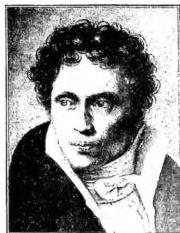
SCHOPENHAUER, ARTHUR. – Philosopher, born in Danzig on 22 February 1788, died in Frankfurt am M. on 21 September 1860. Educated in France and England, he spent part of his adolescence travelling through Europe with his parents. At about eighteen he was assigned to a commercial firm in Hamburg, where his father Enrico Floris, a prosperous liberal merchant, had established his residence after Danzig had passed to the Prussians. After the death of his father (probably by suicide), he obtained permission to resume his interrupted studies and moved to Weimar with his mother Giovanna Trosiener, a well-known writer. Here, within his mother’s circle of acquaintances, he met Wieland and Goethe, with whom he shared an interest in the theory of colours. At Göttingen and Berlin he had Schulze (v.) and Fichte (v.) as his teachers of philosophy. At this time, both in the Indian sacred texts translated by Anquetil Duperron and in Plato and Kant, he sought motives for pessimism (v.). He received his doctorate at Jena in 1813, after a period of scholarly isolation in the small town of Rudolstadt, undertaken out of patriotic indifference and pacifism; then, for approximately five years, he devoted himself in Dresden to his principal work. In 1818–19 he travelled in Italy: in Venice, where he stayed longer, he made plans for marriage, but abruptly abandoned them after becoming jealous of G. Byron. Having qualified in philosophy (as a privatdozent), he attempted to teach Hegel (v.). He gained no recognition either as a teacher or as an author, and this was confirmed in the years following another journey to Italy (1822–23). In 1831 he withdrew to Frankfurt, where, during his final decade, the fame he desired finally reached him. He died, unprepared and unready, from a sudden chest ailment.
S. distinguishes here between the principle of causality and the principle of sufficient reason, presenting the latter as an a priori norm of our representations, from whose connection according to four forms the world results. Here the idealism of Kantian doctrine is developed in a Fichtean manner. Über das Sehen und die Farben (Leipzig 1816): this is the result of the conversations S. had with Goethe concerning the theory of colours. A physiological explanation of them is given, in which, as in the preceding work, the realistic presupposition of an intellect separated, in the Kantian manner, from sensible intuition is excluded. Die Welt als Wille und Vorstellung, with a Kritik der kantischen Philosophie in an appendix (ibid. 1818): the principal work. It consists of four books, the first two setting forth S.’s epistemological-metaphysical doctrine and the last two his soteriological doctrine. The world, phenomenon (v.) (book I) of the blind noumenal Will (book II), can be overcome, with regard to knowledge, through aesthetic intuition, which transcends its principle (book III), and, with regard to the Will, through the renunciatory conversion of that Will itself (book IV). This work appeared in an expanded form in the 2nd edition (ibid. 1844), with a volume of Supplements. Über den Willen in der Natur (Frankfurt a. M. 1836): S.’s cosmological doctrine is set forth here; it partly takes up the subject of book II of his principal work and, among other themes, also treats magic. Die beiden Grundprobleme der Ethik (ibid. 1841): a) Preisschrift über die Freiheit des Willens, an energetic critique of phenomenal human action, which, according to S., sequitur esse; b) Über die Grundlage der Moral; in opposition to Kantian ethical rationalism (which he significantly misunderstood), S. seeks to vindicate the spontaneity of virtuous action by grounding it in the feeling of compassion. Parerga und Paralipomena (2 vols., Berlin 1851): a collection of minor essays of a popular and expository character. The Neue Paralipomena, published after the philosopher’s death through the efforts of E. Grisebach, who edited the publications of Schopenhauer’s unpublished works, are of a similar kind: A. S. Handschriftlicher Nachlass (4 vols., 2nd ed., Leipzig 1895–96).
(courtesy of Dr B. Degenhart)
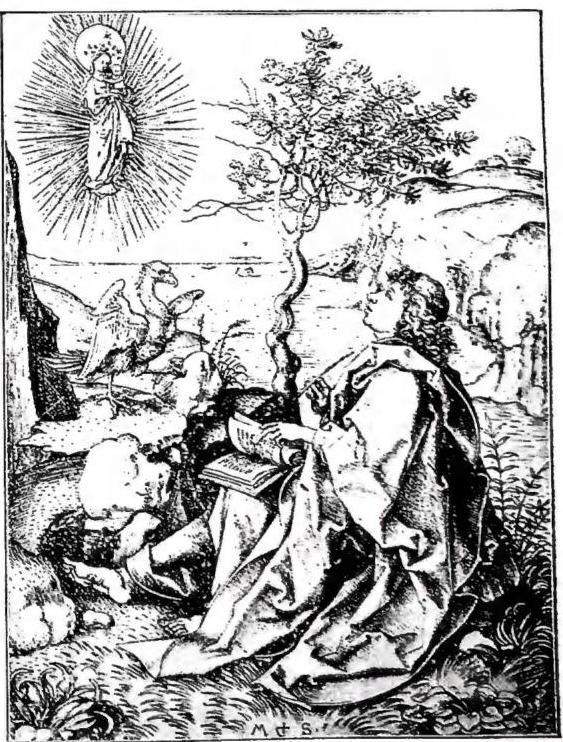
SCHONGAUER, MARTIN - S. John on Patmos. Engraving.
In the conflict he experienced between contemplative vocation and sensual ardor, S. recognizes the very drama of the universe, which is representation and will. Will is a turbid, painful desire; representation, which culminates in philosophy, aesthetically intuitive, in the objectivity of the Absolute, is in itself clear light (Die Welt, I, § 15; II, 17, 34). The representation that reveals things and individuals, however, is not of this kind. Discovered by us through a process of analogy—we grasp ourselves in inner experience, and immediately, as willing—they are nothing but the correlate of our constitutive deficiency (ibid., I, § 18-19): the knowledge one has of them and of the world in which they belong is therefore mere illusion. By identifying phenomenon with illusion, S. employs, for certain purposes, Kantian phenomenalism, which, in complete divergence from the idealists Fichte, Schelling, and Hegel, he considers founded upon noumenon (v.). The unknowable noumenon is precisely the being that lies at the foundation of knowledge: it is Will in its original irrational dynamism. Although, thus understood, subject (v.), S. object (v.) by presenting it as the will to live (Wille zu leben), which devises the means for realizing itself (ibid., I, § 35). Here S. follows the schemes of Neoplatonic emanationism, thereby returning to the traditional Plato of archetypal ideas. In these, Will, which, projecting itself into multiplicity, fixes its models beyond time, has its first stage of objectification; then comes the passage from typical ideas to individuals (second stage) by virtue of the principle of sufficient reason, determined in four ways: principium essendi (space and time); principium fiendi (cause and effect); principium cognacendi (principle and consequence); principium agendi (motive. Cf. Über die vierfache Wurzel, § 46). Everything included within this framework, which is like the scaffolding upon which Will constructs the edifice of its definitive objectification, is without value and insubstantial: a work worthy of its blind author. Naturally, there is no exception for man, who, individuated in space and time, acts on the basis of motives. In accordance with this, S. devalues and denies both history, devoid of a true end and of progress (Die Welt, I, § 58), and the virtue of actions, reducible to far-sighted egoism (ibid., § 70). Value and virtue enter the scene only then: when egoistic illusion withdraws and, in withdrawing, brings about the simultaneous disappearance both of the individual and of the action. Indeed, the maxim of right, which for S. constitutes the first chapter of morality, has a negative formulation: neminem laede. The ethical imperative added to it, completing and surpassing it, imo omnes quantum potes iuva (Über die Grundl. der Mor., 17), merely affirms the positivity of a feeling that negates reason. And this feeling is pity (Mitleid). In pity or compassion (which S. exchanges and confuses with Pauline ἀγάπη because of his lack of experience of genuine sociability [ibid., 18]), man, having recovered from the deception of individuation, experiences the pain of others noumenically and, precisely for that reason, as his own. S., however, cannot explain how such a recovery takes place, since it is incompatible with man as such, who is man because he is a phenomenon; he therefore has recourse, once again in his own manner, to another Christian concept: that of Grace. Authentic virtue, not imposed as a duty, is a true miracle of Grace (of the Grace that is immanent in us [Die Welt, I, § 70]) and is neither the only miracle nor the last. The supreme miracle is asceticism (beyond evil as well as good), relating to the conversion of Will which, abdicating itself as Noluntai, leaves us clear-sighted knowers; free even from the Mitleid of morality (ibid., 7, § 68; II, § 48). And beyond this miracle, sanctity, there is another, however impermanent, that of aesthetic contemplation (on whose plane the arts arise). In it the subject crosses beyond the phenomenon and, reaching the eternal idea beyond the sphere of illusory concepts governed by the principle of reason, becomes a participant in it (ibid., I, § 36). In this connection, S. speaks of a loss of individuality in the object attained by it (the empirical individuality already posited as exclusive), but in fact his Platonism fruitfully exceeds, in a positive mystical sense, both the epistemological letter that depresses it and the irrationalism that formally subordinates it, with the consequent upheaval of concepts and
values. S. aspires (and this is his true, though implicit, demand) to the foundation of a mysticism within a pure reason that provides the means for judging the worldly empirical ratio deceptive and rooted in blindness. On the basis of this demand, S. seeks to reinstate as persons the subjects denied as phenomenal individuals, assigning to idea (v.) in the intelligible world. Restoring freedom and responsibility to this world, he shows
S. declared himself an atheist but perhaps was such only with regard to the pre-Christian and anti-Christian God (the «Jewish God», as he called it) instituted by secular humanism. From the intention of condemning this impiety in the name of Christianity, S. was led to contradict it with his pessimistic metaphysics. His thought is essentially a Gnostic heresy (cf. Ch. Renouvier, Schop. et la métaphysique du pessimisme, in L'année phil., 1892).
Among the vast bibliography on S., the Jahrbuch der S. Gesellschaft, Kiel 1912-48, may above all be consulted for comprehensive information. Here we limit ourselves to indicating the studies of greatest interest from a Christian point of view: E. Seillière, S., Paris 1912; G. Faggin, A. S. e la mistica, in Sophia, 1 [1933], pp. 430-35; and 2 [1934], pp. 84-105; P. Mignosi, S., Brescia 1934; U. A. Padovani, S., Milan 1934; T. Moretti Costanzi, S., Rome 1942. The best-known general works on S., cited everywhere, are: K. Fischer, S. (Gesch. d. n. Philos., 9), Heidelberg 1893; 3rd ed. there 1908; J. Volkelt, A. S., Stuttgart 1900; A. Covotti, La vita e il pensiero di A. S., Turin 1909; Th. Ruysen, S., Paris 1911. For information concerning the person and family of S., the most comprehensive work is that of R. Borch, S., Berlin 1941. Recent bibliography in G. A. De Brie, Bibliographia philosophica 1934-45, I, Utrecht-Brussels 1950, pp. 455-59; G. Faggin, S., il mistico senza Dio, Florence 1951. Teodorico Moretti Costanzi