Machine translation of the 1948–1954 Italian original. The original text is authoritative.
JACOBI, FRIEDRICH HEINRICH. — Philosopher, born in Düsseldorf on 25 January 1743, died in Munich on 10 March 1819. He cultivated literary and philosophical studies, but was neither a professional philosopher nor a systematic thinker. Nevertheless, he possessed a powerful intellectual coherence that enabled him to link his rich and brilliant output ideologically around a solid nucleus of philosophical and moral convictions.
He began with two novels, Allwill and Woldemar (1722), which were intended as a battle cry Enlightenment (v.). In the Briefe an M. Mendelssohn über die Lehre des Spinoza he took a stand against the atheism of the philosopher of Amsterdam; in David Hume über den Glauben oder Idealismus und Realismus (1787) he laid the fideistic premises of his realism; he subsequently took a position against Fichte (Sendschreiben an Fichte, 1799), against the Critica della ragione pura (Über das Unternehmen des Kritizismus, 1802), against Schelling, and against Hegel. He reproached Kant for having founded the moral conception on the formalism of law and duty rather than on feeling; he reproached Fichte for presenting a materialism without matter, in which mere and empty consciousness represents mathematical space; Schelling for the reincarnation of Spinozism—that is, a pantheism in which human personality and freedom are shipwrecked; and Hegel for wishing to overcome the standpoint of the understanding through a dialectical effort of thought.
Like that of Hamann and Herder, with whom he was bound by bonds of friendship and with whom he had joined in the struggle against the Enlightenment and rationalistic tendencies of the century, J.’s speculative conception has been defined as a philosophy of faith. At first J. wished to preserve for reason only a logical and regulative function: it is feeling that must oppose reason and assert its own supremacy; later he clarified his thought and called the feeling of faith reason; he then made it the feeling of the divine, the aspiration toward that absolute in which one believes even without seeing. The intuition of the absolute, this “feeling of the true” (cf. Werke [V. BIBLICA.], III, p. 317), possible to every human being, is not only superior to intelligence but entirely distinct from II. Reason is therefore regarded as a higher faculty, “intuition enveloped in tendency” (ibid., II, p. 101; III, p. 32). Here rests the edifice of J.’s speculation, which, affirming the incontestable value of immediate conviction, formulates a mystical doctrine of faith. The problems of spirituality and the immortality of the soul, as well as ethical and psychological problems (not to mention the question concerning freedom of conscience, which he discussed at length), are treated by J. sporadically and only in passing. Their solution is implicitly contained in his religious metaphysics and in his conception of God. For him, philosophical doctrine is always closely connected with his religious faith, and his entire metaphysics is based on the “continuous miracle, of which each person can have experience: the regeneration of man through a superior force” (Auserlesener Briefwechsel [V. BIBLICA.], II, p. 146, letter of 29 January 1794). This force must be acknowledged.
(Int. Max. Borcellone)
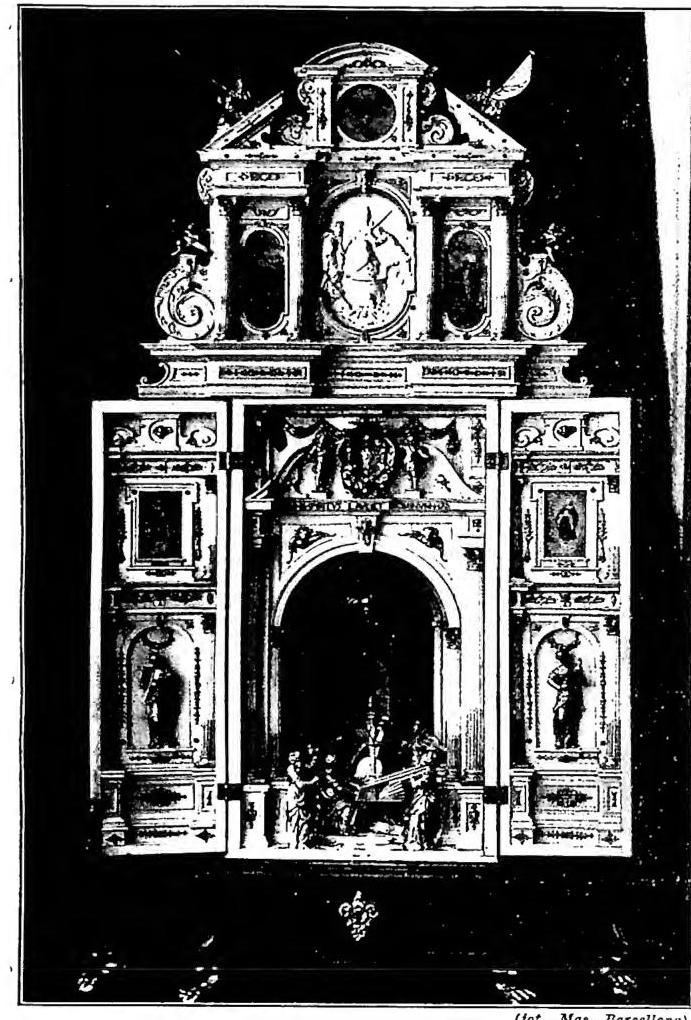
JAÉN, diocese of — Cathedral. Reliquary of St. Cecilia. Italian art (16th–17th centuries).
Despite his lack of systematicity, J. was a philosopher in the strict sense of the word. His thought responded not only to the needs of the age but also to the aspirations of souls wearied by Enlightenment rationalism, and, in accordance with Schelling’s statement, which defined J. as “perhaps the most instructive personality in the whole history of modern history and philosophy” (K. Fischer, Geschichte der neueren Philosophie, VI, Stuttgart 1894, pp. 294–96), it was transformed into something extremely significant and highly fruitful for the culture of the time.
BIBL.: The complete edition of the works was begun by J. himself and completed by F. Köppen and F. Roth, Werke, 6 vols., Leipzig 1812–25; cf. also: Auserlesener Briefwechsel, edited by J. Roth, 2 vols., there 1825–27; R. Läppritz, Briefwechsel aus J. z. Nachlass, 2 vols., there 1869. In Italian: Sulla dottrina della Spinoza: lettera a Mosè Mendelssohn, translated by I. Capra, Bari 1914; Idealismo e realismo, edited by N. Bobbio, Turin 1948. Studies: L. Lévy-Bruhl, La philosophie de J., Paris 1894; F. A. Schmid, F. H. J., Heidelberg 1908; Th. C. V. Stockum, Spinoza, J., Lessing, Groningen 1921; B. Magnino, La filosofia nastiera di F. H. J., in Giornale critico della filosofia italiana, 12 (1931), pp. 381–88, 457–79; 13 (1932), pp. 57–70, 103–16; G. Durante, Gli epigoni di Kant, Florence 1943, pp. 2–18; B. Croce, Discorsi di varia filosofia, I, Bari 1945. Bianca Magnino
Cite this article
“JACOBI, FRIEDRICH HEINRICH.” Enciclopedia Cattolica, vol. VII (1951), p. 355. Azione Romana digital edition, https://azioneromana.com/article/jacobi-friedrich-heinrich.