
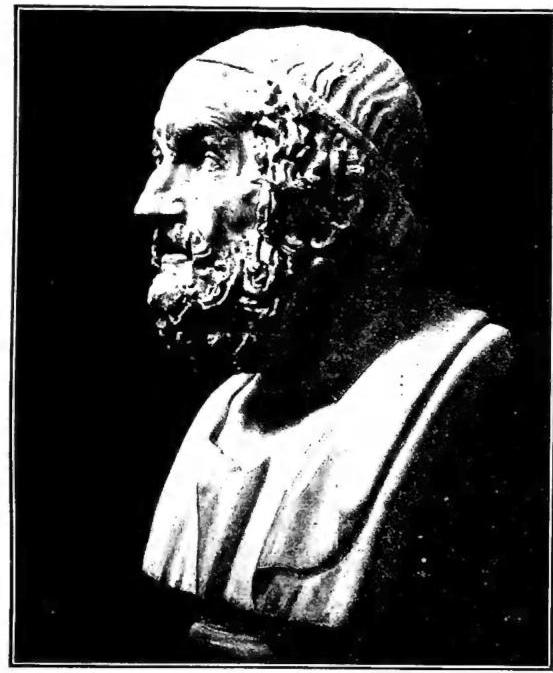
HOMERIC POEMS. - I. THE HOMERIC QUESTION. - Of Homer's person we know nothing. The Vitae, compiled in different ages, confirm the uncertainty of his place of origin and the lowliness of his birth, and embrace the legend of his blindness; yet the name remained attached to Greek literary tradition (v. E. Schwartz, Der Name Homeros, in Hermes, 75 [1940], pp. 1-9); indeed, at least until the 5th century B.C., it was held that Homer, besides the Iliad and the Odyssey, had also composed the Cyclic Poems, that epic storehouse of legends, the Epigrams, the Margites, the Batrachomyomachia and the Hymns.
However, Herodotus (II, 117; IV, 32) already denies him the authorship of the Cypria, and so does Aristotle (Poet., XXIII, 1459b) as regards the Cycle, until, in the early Alexandrian age, Zenodotus and Hellanicus held that the two poems were not to be ascribed to the same person. The historical-grammatical studies of Aristarchus restored the unitary tradition accepted in the subsequent Greek-Roman and Byzantine criticism. F. A. Wolf, with the publication of his Prolegomena ad Homerum (Halle 1795), inaugurated what is called the "Homeric question," concerning the person of the poet and the origin and transmission of his poetry. The writings that followed were subject in varying degrees to philosophical or romantic influences, especially as regards the popular origin of the epic; an intuition already expressed by Vico, who in his Principi di una scienza nuova held Homer to be "an idea or rather a heroic character of Greek men insofar as they narrated their stories in song" (ed. Nicolini, II, Bari 1928, p. 33; v. G. Perrotta, in Italia e Grecia, Florence 1939, pp. 21-58). The excavations in the Troad, begun by Schliemann and later continued by Dörpfeld, and the subsequent Italian and English ones in Crete, threw new light on the Minoan-Mycenaean civilization and the the two poems were re-examined in the light of these discoveries. In all probability the rise of Homeric poetry must be sought in the numerous heroic legends and songs of deeds that flourished in Ionia and, perhaps earlier, in northern Greece. As is well known, the Iliad, in 15,693 verses, recounts an episode of the ten-year war of the Achaeans against Troy, centered on the wrath of Achilles and its consequences; the Odyssey, in 12,000 verses, recounts the events of the troubled return of Ulysses to his Ithaca. These legends were sung in the courts of dynasts by aoidoi to the sound of the cithara and among the people by rhapsodes. Tradition in fact tells us of a lineage, or rather a guild, of poet-rhapsodes residing in Chios and known under the name of Homeridae (Rzach, Homeridai, in Pauly-Wissowa, VIII, 11, p. 2145 ff.) and in the "Homeric" hymn to Apollo mention is made of a blind poet who sings the praises of the god (v. 169 ff.). The two poems transmitted orally may have had a first recension, so to speak "official," in the time of Pisistratus, when these recitations were still going on (Plato, Hipparch., 228 B; Pausanias, VII, 26). The date of composition oscillates between the 9th and the 7th century B.C. The language is an Ionic dialect mixed with Aeolic elements.
II. ETHICAL AND RELIGIOUS CONTENT OF THE HOMERIC POEMS
The society, especially that of the Iliad, is feudal and chivalric and grants great importance to the nobility of ancestors, to wealth, to personal valor. The latter, « ἀρετή », is a moral privilege belonging to the lineage, hereditary and granted by the gods, who alone can take it away or diminish it as a punishment. The hero who incurs divine wrath falls into the most miserable condition, as happens to the mythical Bellerophon (Iliad, VI, 200 ff.). « ἀρετή », enclosed in its caste pride, admits no deviations, demands deference from the anonymous crowd or from inferiors, and must be defended against any form that might sound like an act of offense and a diminution of prestige.
The soul leaves the body with regret and proceeds toward "the houses of Hades." As long as the body is not buried it still retains a perception (ibid., XXIII, 71). The complete separation of the "psyche" from the body is achieved by the cremation of the latter. Only then can the soul enter Hades, without self-awareness, similar to a
εἴδωλον desiring nothing. In fact, the Homeric Hades, except for the islands of the blessed, which are not a dwelling place of the dead but of heroes snatched before their time in life and transported there, does not possess the aspect of Elysium, if we except those few verses of the Nekyia (Odyssey, XI, vv. 568-627) that describe it as a place of expiation and are generally regarded as a late Orphic interpolation. Religion in Homer surpasses and unifies in a harmonious synthesis every trace of earlier and Mycenaean cults. The "Olympian" conception of Homeric religion has an aristocratic character. The gods, similar to mortals in appearance and in passions, often take no interest in earthly cares, according to the concept that reigns undisturbed in the archaic age of the powerful divinity, far from the prayers and the anxieties of men and sometimes hostile to them (v. W. Chase Greene, Moira, Harvard 1948, p. 48). Often, in the Iliad, humans blame the gods for their misfortunes, tending to absolve themselves of all responsibility (Iliad, III, 65, 164-66; XIX, 86-90). If there exists a pessimism in the epic, it is the heroes' resignation to the power of fate, to the "μοῖρα κρατάνη" over human fortunes. This dominates the nature of gods and men. Zeus himself submits, albeit reluctantly, to the "moira" by which his son Sarpedon is destined to die (ibid., XVI, 431 ff.). At other times the "moira" is identified with the will of Zeus. Mortals are subject to the "gaze of the gods" (ibid., XVI, 388) and actions that fall under the sin of "ὕβρις" are punished (v. C. Del Grande, Hybris, Naples 1947, p. 10). The gods thus become guardians of a universal law, by breaking which man must pay a penalty (v. R. Mondolfo, Responsabilità e sanzione nel più antico pensiero greco, in Civiltà moderna, 2 [1930], pp. 1-16). The "δαίμων" too is a force emanating from the external world that can bring men evil as well as help for the attainment of their goals. It can cross the will of man (Iliad, XV, 467; Odyssey, X, 64) or it can also be chance (Odyssey, XIV, 386). Later it comes to lose that blind force by identifying itself with the energy that arouses human will (Iliad, VIII, 166; XV, 418).
While the Iliad is built upon a rigidly warrior and caste morality, the Odyssey shows the clear traces of a different evolution. The State and the norms of law appear to us more advanced, and numerous new words are noticeable in the lexicon that express changed religious and moral sentiments. There are in it undeniable hints of free will, and man becomes the creator of his own destiny and is responsible for the action performed and for its inevitable consequences (v. G. Pasquali, La scoperta dei concetti etici nella Grecia antichissima, in Pagine meno stravaganti, Florence 1935, pp. 67-68). The object of the poet's song is man with his joys and his vicissitudes, refined by a greater experience and by a different sorrow than the heroic and aristocratic man of the Iliad (for a modern interpretation of the figure of Ulysses, v. G. Audisio, Ulysse on l'intelligence, Paris 1945). The wonderful adventures of the protagonist Odysseus himself, who seems to reflect in his figure the adventurous spirit of the Ionian navigators (v. K. Deichgraeber, Die Ziele und Formen der griechischen Ethnographie, in Zeitschr. für Ethnologie, 73 [1941], pp. 1-12) mirror the eternal drama of the veteran who in his long wandering yearns to be reunited with his family and, even after reaching his homeland, is forced to face new struggles to regain the serenity of his family affections. The poem shows a certain understanding toward the humble, such as the figures of the poor Eumaeus and the nurse Eurycleia; it presents moving episodes such as that of the dog Argos, and hospitality is further ennobled if one holds that the gods hide themselves under the appearance of suppliants.
In substance, the atmosphere and the different unitary design with which the two poems are conducted lead one to hold that the Odyssey, although deriving from the same stock of traditions, is later than the Iliad, and belongs to a poet of different sensibility and of a different homeland, whereas the Iliad seems more clearly to reflect its Ionian origin.
Bibliography18 works
Lanfranco Fiore