Machine translation of the 1948–1954 Italian original. The original text is authoritative.
TEISMO. - From Θεός, God, is in general the religious or philosophical attitude that admits as the first principle of being a God (v.): atheism (v.).
Depending on the more precise conception of God that man envisions, t. takes various forms: it is pantheism
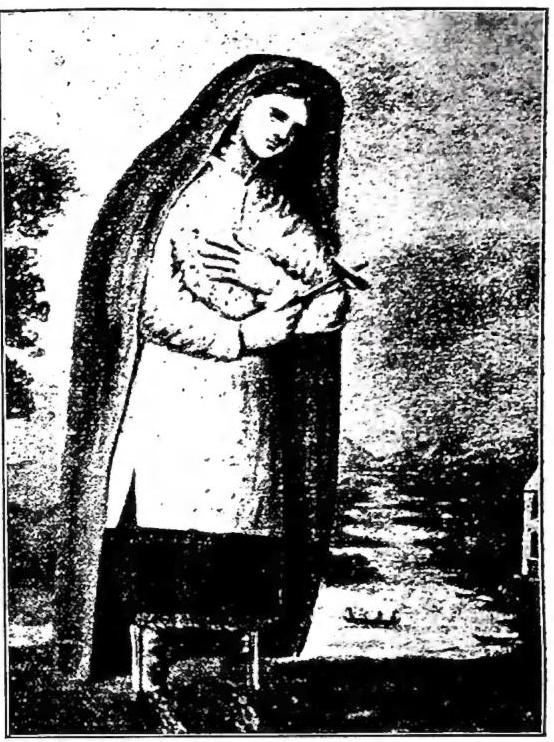
TEKAKWITHA CATERINA, venerable. - The Lily of the Mohawks. Oil painting by Fr. Claude Chauchetière, S. J. from 1687. (from R. G. Thwaites, The Jesuit Relations and Allied Documents, LXII, Lower Canada, Iroquois Ottawa 1881-82, Cleveland 1988 Jan. 1, p. 1-27)(v.) if God person (v.) but as the subsistent reality of the whole; polytheism (v.) if divinity is attributed to the multiplicity of forces or forms of the real, both in the human and in the infrahuman world; monotheism (v.) if God is conceived as the transcendent First Principle upon which both the world of nature and the history of man depend. With a narrower meaning, t., in opposition to polytheism, pantheism, deism (v.), is the conception of God as a supreme, unique, personal being, the efficient and providential Principle of the world. The first progress of philosophy over mythology consisted in the affirmation of the unity of the First Principle and in the distrust directed against polytheism. More arduous was the path from monotheism to the conception of a personal, creator, and providential God, which was clarified only through Revelation (v. ATEISMO; DEISMO; DIO; TEOLOGIA NATURALE (TEODICEA)).
BIBL.: R. Eisler, Wörterbuch d. philos. Begriffe, III, 4th ed., Berlin 1930, p. 231; A. Lalande, Vocab... de la philos., 5th ed., Paris 1947, p. 1101. See bibl. for the entries ATEISMO; DIO; TEOLOGIA NATURALE. Cornelio Fabro
Cite this article
“TEISMO.” Enciclopedia Cattolica, vol. XI (1953), p. 1129. Azione Romana digital edition, https://azioneromana.com/article/teismo.