
SUBSISTENCE. — In general, this indicates the consistency substance (v.) acquires through possession of its essential and real principles.
Subsistence therefore constitutes the mode of being of the individual substance, which is complete in itself, in opposition to inherence, which is proper to accidents: « illa enim subsistere dicimus, quae non in alio sed in se existunt » (Sum. Theol., 1º, q. 29, a. 2, c; cf. q. 75, a. 2 ad 1).
Subsistence is therefore the actuality of substance as such: « Ratio substantiae est quod per se subsistat » (s. Tommaso, In III Sent., dist. 6, q. 1, q. 1, a. 1 c), so that subsistence coincides with the individual substance existing through itself. As the actuality of substance, subsistence is realized in different beings according to their respective ontological structure. In God, subsistence consists in possessing being in simplicity and fullness as pure actuality (cf. Sum. Theol., 1º, q. 13, a. 11). And since the perfection of being is, for s. Tommaso, graded according to the independence that substance has with respect to matter, subsistence belongs principally to spiritual natures that have no matter in themselves but are pure forms: such are the angels, hence called « forme sussistenti » (ibid., 1º, q. 3, a. 3, c). soul (v.) too, although the substantial form of the body, must be recognized as endowed with subsistence insofar as it exercises the operations of understanding and willing, which manifest its spiritual nature (ibid., q. 75, a. 2; cf. Q. de anima, a. 14).
To clarify the terminology, one may therefore distinguish: a) essence (v.) nature (v.), which is the formal constituent of any given thing; b) the « sostanza prima », that is, the real individual or « ipostasi » or « supposto », which is concrete reality existing in its ontological sufficiency (cf. Quodl., II, q. 2, a. 2, c); c) subsistence denotes the actuality of the said first substance, through which it exists in itself and is distinguished from abstract essences or « sostanze seconde », existing only as concepts in the mind, and in reality through the individuals that realize them; d) persona (v.) adds to subsistence the dignity of a rational nature.
The development of the notion of subsistence coincides with that of reality: for Plato, universal species and genera subsist because they constitute the « in sé » of the real, withdrawn from the becoming of sensible appearance (cf. Resp., 476 A sgg.). In Aristotelian metaphysics, although in reality subsistence belongs to the individual substance, it is nevertheless the effect of the « forma » and it is therefore the species as such that subsists amid the vicissitudes of physical contingencies, whereas individual beings are born and die (Met., VII, 3 1028 b 36-1029 a 2). In Neoplatonism, subsistence, designated by the term ὑπόστασις (the Aristotelian meaning of the term is foreign to metaphysics: cf. H. Bonitz, s. V. in Index Aristot., Berlino 1870, 801 b 35-802 a 8), corresponds to indefectible existence, ἀνακλείπτως ὑπόστασις, which the emanations acquire in their derivation from the One (cf. Proclo, The elements of theology, ed. E. R. Dodds, Oxford 1933, prop. 84, 94; pp. 78, 6; 84, 24 e passim). Moerbeke translates the title of Proclus’ treatise, lost in the Greek text, on the problem of evil as De malorum subsistentia, and rightly so, as Cousin observes, because « bona habent ὑπόστασιν, mala παρ' ὑπόστασιν », insofar as « bonum species, malum sine specie ac velut privatio » (Procli opera..., I, Parigi 1820, p. 188). In its original Greek meaning, therefore, subsistence as ὑπόστασις is « fondamento », both transitively from ὑρίστημι and intransitively from ὑρίσταμαι: within the ontological sphere, although it belongs to singular substance in relation to accidents, it also belongs—both for Plato and for Aristotle—to universal essence in relation to individuals. Greek philosophy therefore stands for the real identity of οὐσία and ὑπόστασις, of subsistence or ὑπόστασις with substance (first and second).
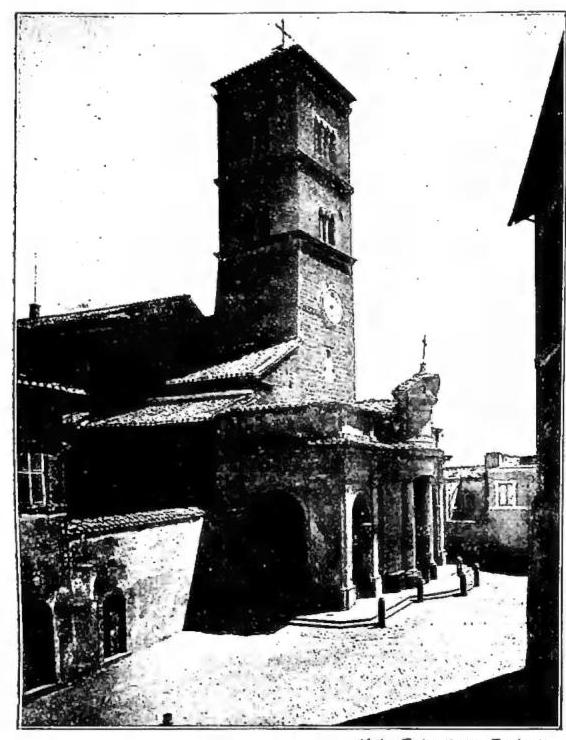
(phot. Fotostiere, Torino)
SUTRI, DIOCESE of — Bell tower (1207) and Renaissance façade of the Cathedral.
terms οὐσία-ὑπόστασις continued through heated controversies and conciliar discussions. The uncertainties were overcome when, thanks to the activity of the Cappadocians in the East, agreement was reached, with Pope Damasus, on the identification of ὑπόστασις with πρόσωπον in his approval of the common formula elaborated at the Council of Constantinople (381), which treats the two expressions as equivalent: ἐν τρῷ τελεῖοις ὑποστάσεσις and ἐν τρῷ τελεῖοις προσώπους (in Teodoreto di Ciro, Eccl. hist., V, 9; PG 82, 1216 BC). In the Latin world, ὑπόστασις was translated as subsistentia by Rufinus of Aquileia (d. 410) in his Hist. eccl. (I, 29; PL 21, 499 C-500 A), and its use became increasingly consistent in the West. The notable exception is Boezio (v.), who retained the Greek usage of ὑπόστασις = first substance, which passed into his definition of « persona »: « rationalis natura individua substantia » (cf. De duabus naturis, cap. 3: PL 64, 1343-44. Cf. Sum. Theol., 1ª, q. 29, a. 1-2 and especially the Prooemium of the Contra errores graecorum, ed. De Maria, III, Città di Castello 1886, p. 411 sgg.).
Scholasticism, especially from the sixteenth century onward, debated the problem of the constitutive principle of subsistence, which was resolved in the various schools in accordance with their respective metaphysics of substance. In the neo-Thomist school, Gaetano (v.), which placed the principle of subsistence in the formal line, had prevailed, there was a return to the traditional position of Capreolo (v.), according to which, in conformity with the Thomistic distinction between essence and the act of being in creatures, this principle is supplied by esse as actus essendi, which is the proper act of substance.