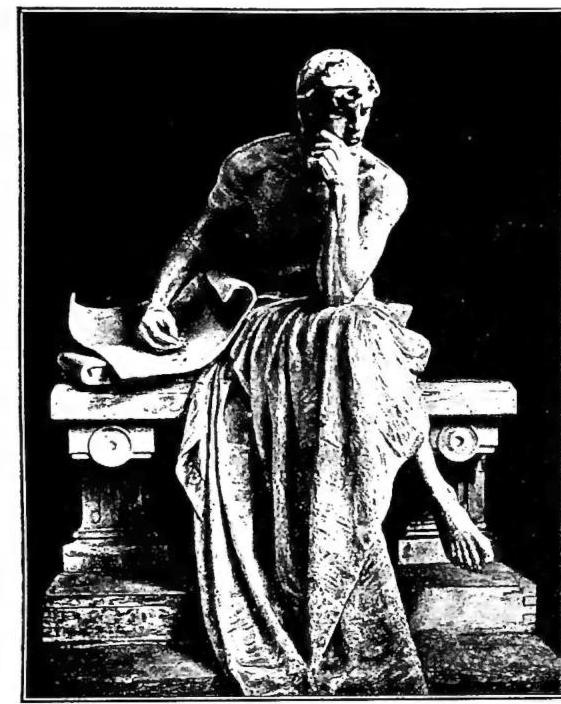
PENSIERO. — From the Latin pensare, pesare, ponderare (the Greek νόμος, διάνοια has a different derivation), the term retains its etymological reference in one of its meanings most proper today, as intellect (v.). Although less frequent, the use of «pensare» in the sense of «considerare», versare animo, is not absent from classical Latin: «vulnera laude pensabimus» (Quintil., Declam., 3, 16; cf. E. Forcellini, Lexicon totius latinitatis, III, Padova 1940, p. 625). Our modern «pensare», however, corresponds more exactly to cogitare (from cogere, a contraction of coagitare, almost adunare and sommovere mentally: where there is a certain semantic parallelism with «pensare» in the sense of «ponderare»; cf. op. cit., I, ibid., p. 672).
In a very broad sense, after Cartesio, for whom, however, it is not exclusive, p. is every conscious activity of the spiritual being: «What is a thinking thing? It is a thing that doubts, conceives, affirms, denies, wills, does not will, that also imagines and feels» (Medit., II: Italian trans. by A. Tilgher, I, 2nd ed., Bari 1928, pp. 98-99; cf. Princ. philos., part 1, § 9). In a more restricted sense p. is at times coextensive with cognitive activity: it therefore excludes the acts of the appetitive-volitional faculties. In a stricter sense, common to contemporary neoscholasticism, p. is only each moment of intellectual-rational knowledge, that is, the spiritual perception of the universal values, causes, principles, reasons, ends, and relations of being and things. It therefore includes, concept (v.), the fundamental acts of judging (v. GIUDIZIO) and reasoning (v. RAGIONE; RAGIOCINIO), and is the constitutive activity of science, philosophy, and also, in part, of ethical-juridical-economic praxis, religion, and art. Taken in this sense, it may be affirmed that p. knowledge (v.), if this is understood, in a generic meaning, as the presence of any given datum whatsoever to consciousness. But p. is not simply convertible with knowledge if by this is meant an effective perception of being and reality. The activity of p. can in fact, owing to its (relative) spontaneity, turn toward immanent and subjective constructions that have no correspondence, wholly or in part, in reality: «in abstract concepts, in thoughts, in words, everything imaginable enters, and therefore also the false, the impossible, the absurd, the senseless» (A. Schopenhauer, Die Welt..., Suppl., I, I, chap. 6; Italian trans. by G. De Lorenzo, II, Bari 1930, p. 85). Thus a foundation must be acknowledged for the Kantian assertion: «to think an object and to know an object are not the same thing» (Kritik d. r. Vernunft. Transzendent. Logik, § 22). This is so although Kant’s further thesis is anything but demonstrated, namely, that «the categories have no use in the knowledge of things except insofar as these are taken as objects of sensory experience» (ibid.), or, in other words, that human p. functions in a void unless it refers to an object of empirical intuition (v. KANT; OGGETTIVISMO).
idealism (v.) p. is the structure and essential foundation of reality, which, by its intrinsic and absolute