
PENNE and PESCARA, DIOCESE of. — Diocese with its see at Pescara, it has 235,000 inhabitants, 70 parishes grouped into 14 deaneries. It has a further 290 churches and oratories. The territory, predominantly hilly, covers 2,000 sq km, comprising 39 municipalities, of which 30 belong to the province of Pescara and 9 to that of Teramo. The Chapter, established at Penne in the year 1000, consists of 12 canons (Ann. Pont., 1952, pp. 314–15). The diocese is directly dependent on the Holy See.
Legend attributes the evangelization of the present diocesan territory, anciently inhabited for the most part by the Vestini, to Patras, one of the seventy-two disciples of Jesus Christ, who is said to have been the first bishop of Penne. It is also related that, during the persecution of Diocletian, Massimo the Levite, Venanzio, Luciano, and Donato suffered martyrdom in the territory of Casauria; their relics were transferred to the cathedral of Penne in the year 868 by a bishop Giraldo. They were probably, however, martyrs from other places (Lanzoni, I, p. 371). The diocese appears during the ninth century, but its origin may be considerably earlier. In 958 Penne extended its jurisdiction over the territory of the ancient city of Atri, which possesses a monumental church of great historical importance. In 1252 Atri was erected into a diocese but united with Penne « aeque principaliter ».
During the first centuries of the second Christian millennium, the diocese of Penne-Atri enjoyed great splendor and considerable influence over a vast, prosperous area of Abruzzo. It was visited by s. Francesco d'Assisi, who went to Penne to settle serious enmities that had arisen among several noble families. The Franciscan Friars Minor convent in that city dates from the year 1225.
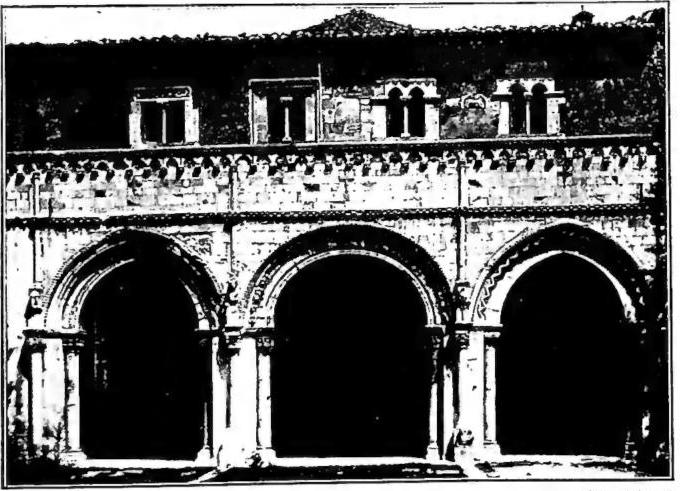
(Ist. Alinari)
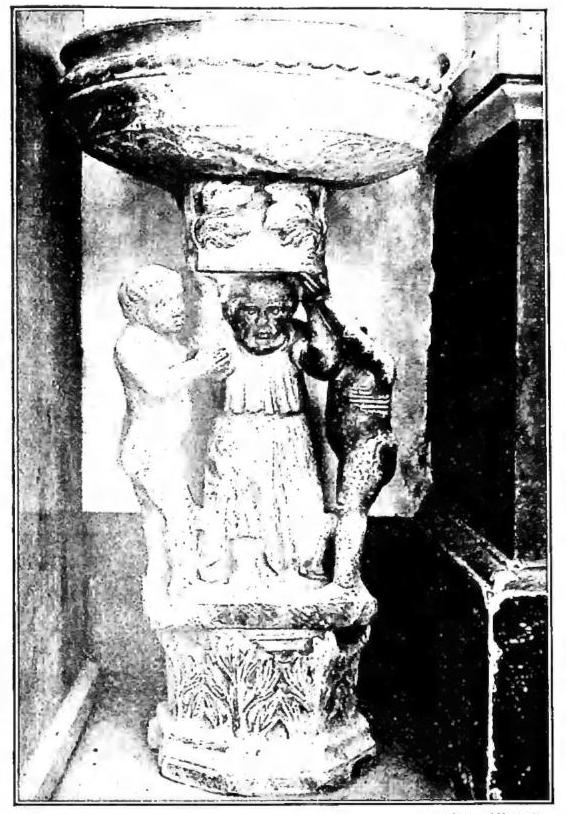
PENNE AND PESCARA, DIOCESE of. — Holy-water font (11th century). Penne, Cathedral.
The ancient cathedral of Penne (now a co-cathedral), dedicated to s. Maria and s. Massimo, was destroyed in 1943 by an aerial bombardment. Reconstruction began in 1951. The diocesan Seminary, founded in 1570, is still located in Penne and educates about one hundred students. The new Cathedral, built in Pescara in 1933, dedicated to s. Cetteo and to all the holy supreme pontiffs, is also the national Temple of the Concordat. After that of S. Clemente at Casauria, it is the most notable church in the diocese. It was devastated during the period when the city of Pescara was deserted because of the events of the war (Oct. 1943–June 1944).
The diocese has no small number of saints and illustrious figures born or long resident in its territory: s. Guidone, abbot of S. Clemente at Casauria, thaumaturge; s. Bernardo, born at Isola del Gran Sasso, in the diocese of Penne, who was one of the greatest bishops of Teramo, where he is still greatly venerated today; s. Gabriele dell'Addolorata (v.), who died in the Passionist convent at Isola del Gran Sasso. The sanctuary where his remains are preserved, a destination for numerous pilgrimages, has been dependent on the bishop of Teramo since 1950. Monastic life underwent considerable development in the diocese. First among all stands the illustrious abbey, originally of the Most Holy Trinity, later of S. Clemente di Casauria (Casa aurea), erected on a small island formed by two branches of the Pescara River by the Emperor Lodovico II in 871; relics of s. Clement are said to have been brought there from Rome. Ravaged by the Saracens in the tenth century, it again excelled in fame and wealth among the abbeys of royal jurisdiction, endowed with privileges by the sovereigns; but Urban II placed it under the dependence of the Apostolic See. Its decline began in the thirteenth century, and in the fifteenth it was granted in commendam. Celestine monks and later Reformed Franciscans officiated in its great Basilica until its suppression in 1860; today
it is maintained by the State as a national monument. S. Bartolomeo di Carpineto was founded for the Benedictines in 962 by the count of Penne, entrusted to the Cistercians by Galvano Lancia in 1258, and was a very wealthy monastery. Other Benedictine abbeys were: S. Maria di Picciano, whose possessions were confirmed by Leo IX and which was granted to the Olivetans by Alexander VI; Loreto Aprutino, existing in the twelfth century; S. Salvatore di Castelli; while S. Giovanni di Casanello, in the territory of Atri, subject to the abbey of SS. Quirico and Giulitta at Antrodoco, belonged after 1252 to the cathedral of S. Maria di Atri.