
PECORA. - Symbol of the soul, it is known from the parable of the Good Shepherd (v.). Gregory of Nyssa addressing the Good Shepherd with the e. on his shoulders
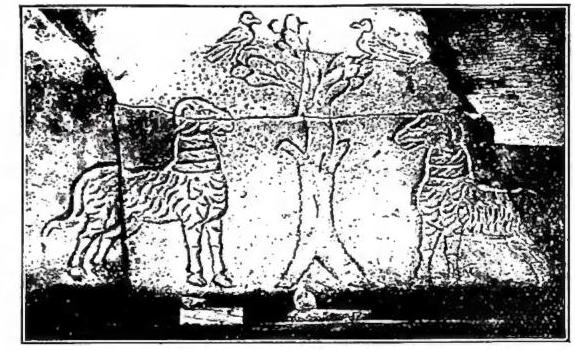
This explains why in early Christian art the representation of the Good Shepherd with the sheep on his shoulders or pasturing the flock of the elect is so frequent; as are scenes of orants among sheep, that is, the deceased in beatitude (Wilpert, Pitture, tavv. 75; 116, 2; 168), and also on sepulchral tombstones (G. B. De Rossi, Roma sotterr., II, Roma 1867, tavv. 49-50, n. 14; A. Silvagni, Inscript. Christ. Orbis Romae, nuova serie, II, Roma 1935, n. 4456); or sheep going to quench their thirst (O. Marucchi, Monum. del Museo crist. lateran., Milano 1910, tav. 57, 50). Jesus Christ is the door of the heavenly fold (Io. 10, 7); St. Peter Chrysologus calls his faithful « filioli dominici gregis portio » (Serm., 173: PL 52, 651). The Church constitutes the flock of Christ, entrusted to his pastors; of Sixtus II Damasus affirms that « pastoris meritum numerum gregis ipse tuetur » (A. Ferrua, Epigrammata Damaziana, Città del Vaticano 1942, n. 19); of the bishop Andrew of Formis it will be said that « utque bonus pastor textit ab hoste gregem » (CIL, X, 6218); of Bishop Celsus of Vercelli that he was the « cultor gregis ovium Christi »; of Pope Boniface II that « adunavit divisum pastor ovile » (G. B. De Rossi, Inscript. christ., I, Roma 1857-61, n. 1029); of John II that « commissum tibi pascens bonitate magistra, servasti cunctum sub pietate gregem » (ibid., II, p. 126, 5); of Gregory I: « hoc pastor agebas ut domino offerres plurima lucra gregis » (id., loc. cit., p. 52, 1; 78, 3); of John III that « sibi commissas pascere novit oves » (id., loc. cit., p. 65, 19); Sergius I wrote on the tomb of Leo I that « ne lupus vastet ovile Dei, sed dudum ut pastor magnus Leo septa gregemque christicolam servans, ianitor arcis erat » (id., loc. cit., p. 98, 1). On the fabric donated by Queen Hildegard to the altar of St. Peter in the Vatican one read « Pastor ovile Dei servans », and in the poem placed in the consignatory near St. Michael it was written: « Pastoris summi dextera signat oves » (id., loc. cit., II, 139, 26). In the poem now in the Lateran Museum the « grex sacrate Deo » is commemorated (A. Silvagni, op. cit., I, n. 1485). Enrico Josi