
EPICURO. —
I. LIFE
Greek philosopher, founder of the school that took its name from him, born of Athenian parents on the 10th of Gamelion (January–February) in 342 B.C. on Samos, died in 270 in Athens. On Samos he heard the Platonist Panfilo and, by his own testimony, devoted himself to philosophy at the age of 14. At the age of 18 (323) he went to Athens for the ephebeia, and, when, after Alexander’s death, Perdiccas expelled the Athenians from Samos, he joined his father at Colophon. In nearby Teos he heard the Democritean Nausifane. At the age of 32 he opened a school at Mytilene, but shortly thereafter moved to Lampsacus, where he remained until 306. In these two cities he found his most faithful disciples: Ermarco at Mytilene; Metrodoro, Polieno, and Colote at Lampsacus, the four who in the later tradition are designated by the name of “leaders” (καθηγημένες). In 306 he moved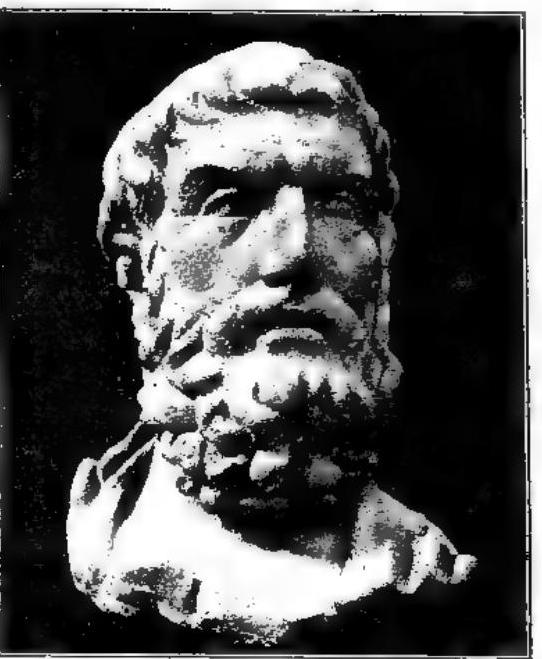
The teaching was dogmatic in character, and the disciples in general were asked to do nothing more than memorize the truths discovered by the master and reduced by him for this very purpose into formulas and maxims (cf. Epist., i, proem.). But far more important than theoretical and didactic activity was practical activity. E. made his school the center of an association whose principles were general adherence to his vision of life and a commitment to mutual assistance. When they were in a position to do so, members paid the school an annual contribution of 120 drachmas, equivalent to 2 obols a day, “the earnings of a slave,” as E. himself writes in a letter to Mitre. The sums collected served, besides maintaining the “garden,” to assist the needy and for charitable purposes.
Apart from a few journeys to Asia to revisit his friends, E. remained in Athens until his death, caused by cystitis.
II. WORKS
E. wrote a great deal: his works comprised approximately 300 volumes. Diogenes Laertius has preserved a selection of 41 titles: the first place is occupied by the Περὶ φάστω in 37 books, the last by the Letters; the other titles are of psychological, ethical, and polemical works; only one work was devoted to logic: the Canon and On the Criterion. The works that have come down to us must be divided into two groups: those preserved by the manuscript tradition and those discovered in the papyri unearthed at Herculaneum in 1752–54. The first group consists of 3 summaries in epistolary form and a collection of maxims (both in Diogenes Laertius, X). The three letters deal respectively with meteorology and ethics. The “maxims” (40 in all) bear the title Κύριαι δόξαι, Sentenze capitoli, and consist for a good half of excerpts from E.’s works. To all this was added a gnomic collection discovered in 1888 by K. Wolke in a Vatican codex, which, besides sayings of E. (some of which repeat the Κύριαι δόξαι), also contains passages from his earliest disciples;new fragments came to light in a large inscription commissioned in the second century A.D. by Diogenes of Oenoanda (in Lycia) and discovered in 1884. Sayings and passages of varying length are gathered from several ancient writers. The Herculaneum papyri, amid works by various Epicurean writers, especially Philodemus, contain the remains of approximately nine books of the Περὶ φύσεως.
III. THE SCHOOL
E.’s immediate successor in the direction of the “Garden” was Hermarchus of Mytilene, but superior to him in talent and productivity was Metrodorus of Lampsacus, who died in 277. Among the scholarchs, whose succession is known to us down to the middle of the 1st century B.C., Apollodorus should be remembered; he was nicknamed “the tyrant of the Garden,” composed more than 400 books, and flourished in the second half of the 2nd century B.C. His disciple was Zeno of Sidon (born ca. 150 B.C.), who was heard by Cicero and Atticus in 79 B.C. After him we know the names of Phaedrus, who was in Rome in 90 B.C.; Patro, scholarch until 51 B.C.; and Philodemus of Gadara, who lived in Naples and whose library was discovered at Herculaneum. Among the Roman Epicureans, the only one whose work survives is Titus Lucretius Carus (died in 55 B.C.), who in De rerum natura, a poem in six books, left us an almost complete and wonderfully precise exposition of E.’s physics. Little or nothing is known about Epicureanism in the 1st century A.D. E.’s works were nevertheless commonly read and provided Seneca with material for frequent quotations. A revival occurred in the 2nd century. To this century belongs Diogenes of Oenoanda (between Pisidia and Lycia), who had his works engraved on the wall of a portico in his native city. In the age of St. Augustine Epicureanism was dead, but its influence can still be discerned in Marcian.IV. DOCTRINE
E. had an organically constructed system, every part of which can be more or less rigorously traced back to a single principle: the immediate opposition of being and non-being, from which Leucippus atomism (v.). Formally and genetically, however, his thought follows the opposite course: not only because, unlike Democritus, he places the criterion in the senses, but because the problem from which he proceeds is practical rather than theoretical—the determination of the end and the preparation of the means suited to attaining II. For him science has no value other than that of an instrument (frg. 219), or, if it were possible, he would do without it (S. C., XI).[The end, according to the Aristotelian definition accepted by E., is that toward which the will tends. To determine it, Aristotle had begun with a definition of man; E. turns to experience and asks the animal for the answer. He concludes that the end is pleasure. “Every animal, in fact, as soon as it is born, delights in pleasure and recoils from pain” (Diog. L., X, 137). The ethics of pleasure had Cyrenaics (v.), who understood by pleasure only that which is actually experienced by the senses. E. goes further and, in a certain sense, reverses their doctrine. Sensory pleasure is indeed pleasure, but not insofar as it is motion; rather, insofar as it is “a gentle and favorable motion” in relation to the nature of the organ on which it acts: pleasure in its essence is εὐστάθεος, the equilibrium and harmony of being with itself, and it is wherever pain is absent. As such, it is perfect in the instant, and everything that the motion of the senses may add to it merely “varies” its content; it does not increase its “magnitude” (S. C., III; XVIII). “The health of the body and the absence of disturbance in the soul constitute the limit of the happy life. And it is toward this that all our actions are directed: to have neither pain nor disturbance” (Epist. to Menezes, § 128). Wisdom, therefore, is nothing other than the art of measuring the harms and advantages of each action, a calculation (λογισμός) in which the quality of pleasure is sacrificed to quantity (ibid., §§ 129–30), sumptuous banquets to a piece of bread (frg. 181), power and glory to a secluded and tranquil life (S. C., XIV, cf. VII). The supreme maxim is: be content with little (frg. 478) and live hidden, Λέθε
βιώσας (fr. 551). But these are only the subjective conditions of the happy life; there is too much uncertainty “in the affairs of the world for the wise man to be able by himself to protect himself from the blows of men (τὰ ἐξ ἀνθρώπων) and of fortune (τὰ ἔξωθεν). Since his desires are limited, he must therefore secure safety (ἀσφάλεια), and he seeks it in friendship (S. C., XXVII–XXVIII). Friendship is a pact of mutual assistance and arises from utility (S. V., 23); but, like every pact, it has its law and must be observed: E. therefore does not shrink from the conclusion that the wise man dies for his friend (Diogene Laerzio, X, 121).
If the cause of human errors lay only in desires, this wisdom founded solely on prudence (φρόνησις) would suffice. But, besides desires, there are fears (frg. 485), and two are the greatest: fear of death and fear of the gods. Hence the necessity of science (S. C., XI). Yet to construct it a method is required, and the method (the subject of the Canon) comes down to this: complete confidence in perceptions, the source and criterion of all knowledge, and the use of induction. By these means, and starting from the existence of bodies, E. arrives at the atoms of Leucippus and Democritus; but he arrives at them through Aristotle’s problematic, and profoundly modifies their conception. The universe of his predecessors was governed by mechanical necessity and chance; he adds to it the concept of a natural necessity, the foundation of the order found in things, and to which he gives, above all, the name of “nature”; and that of free causality (cf. Ep., III, 133), necessary to explain the freedom of motion found in man and the animal.
To this end, he first distinguishes three forms of motion in atoms: a natural downward motion resulting from weight, a forced motion caused by collisions, and a free and wholly indeterminate motion of “declination” (παρέγγελισις) from the straight line. Secondly, he makes the number of forms proper to atoms finite. This provides the basis for the finite number of phenomenal qualities; but by itself it is not enough, because, since the number of similar atoms is infinite, the number of possible combinations would also prove infinite. Here E. makes his greatest speculative effort and also the most substantial leap in his logic: moving from the concept of negative infinity proper to earlier atomism to the positive concept of infinity as “self” (“summa summarum,” Lucretius, V, 361), he derives from it the law of the universal compensation of all forces, “isonomy” (Cicero, Nat. d., I, 50; Lucretius, II, 522 ff.). On this, closing the circle of events, he bases a theory of cyclical returns analogous to that of the Stoics (frg. 266; Lucretius, II, 297 ff.; III, 854 ff.). This enables him not only to justify without teleology what Lucretius calls the “aeterna foeder” of nature and the harmony of its parts, but, more importantly, to create in his universe of atoms the conditions for the existence of blessed and eternal beings, such as the gods, whom he regarded as attested by the evidence of the representations that men have had of them in every age (Cicero, loc. cit.; Ep., III, 124; Lucretius, III, 123 ff.). Anthropomorphic and composed of atoms of extremely tenuous structure, these gods live in infinite numbers in the infinite intermundane spaces, caring for nothing but their own blessedness. Like all other bodies, they are knowable through the atomic images that emanate from them, except that, given their subtlety, these are perceived by the mind and not by the senses (Cicero, Nat. d., I, 51; scholium to S. V., I). In them the wise man sees the models to which he should liken himself, and from contemplating them draws his purest joys (Philodemus, De pietate, p. 124, 1 ff.).
Having eliminated, on the basis of this physics and the theology consequent upon it, the fear of the gods, E. dispels, through the psychology that he derives from it, the fear of death. For the soul is and can be nothing other than one body within another body: only within the envelope of the flesh are the atoms composing it capable of sensation; as soon as death has dissolved that envelope, the soul too dissolves, and with it all sensitivity (Ep., I, 65). Death is nothing other than this “privation of sensation”: it therefore “is nothing to us, since, when we exist, death is not present, and when death is present, we no longer exist.”
when death is present, we are no more” (Ep., III, 124;
Lucretius, III, 828 ff.). It is true that death is feared not
only because of what may be expected in the hereafter,
but also and above all in itself, as eternal non-being. This
widespread feeling is, in E.’s view, the cause of all the passions
that disturb human life (Lucretius, III, 58 ff.; Porphyry, De obst., I,
54). Against this fear, the arguments must be drawn from
ethics, and specifically from the nature of pleasure. If pleasure,
indeed, is perfect in the instant, and “finite time and infinite
time contain an equal amount of enjoyment” (S. C.,
XIX), every desire for immortality is vain (ibid., XX):
with respect to the goal, “everyone departs from life as
though he had just been born” (S. V., 60). Hence Horace’s
“carpe diem”; hence the Epicurus of Metrodorus, which Horace
repeated in the well-known verse: “ille potens sui laetusque deget
cui licet in diem dixisse: vixi” (Carm., III, 29, 41). The
conviction that death is nothing to us, and that “the end proper
to human nature” is attained in the first moment of life, also
makes pain contemptible, since “if it is long, it is slight, and
if it is severe, it is short” (S. C., IV; Ep., III, 133), and ends
in death. While it lasts, since for E. sensation is localized, and
what the body experiences is entirely distinct and independent
of what the soul experiences, and vice versa, while the latter
has control over the representations that are the causes of its
affections, the wise man need only substitute for the image of
present pain that of past pleasures (S. V., 55; fr. 444). In this
respect, the soul is the wise man’s last stronghold of pleasure,
and he can be happy even in the bull of Phalaris” (Cicero, Tusc.,
II, 17). E. provides an example of this in the letter written
to Idomeneus at the moment of his death: “This is a happy day
and at the same time the last of my life, on which I write to you.
The present pains in my bladder and viscera are of such intensity
that they could not become greater. But ranged against all this
is the joy that my soul experiences in the memory of our former
conversations.” All E.’s wisdom is condensed in the so-called
“Tetrapharmakos,” preserved by Philodemus: “The gods are not
to be feared; death is not a thing about which one need have
apprehension; the good is easy to obtain; evil is easy to endure”
(Pap. Herc., 1005, col. IV, 8).
E.’s physical atomism was an anachronism in his time; his ethical
atomism was not, but answered a general tendency of his age and
gave, for the first time, form to one of the typical attitudes of
human life. His disciples venerated him as a god, and his followers
in every century of antiquity saw in him the “revealer” and the
“saviour.” The Stoics and the Cynics, and later the Fathers of the
Church, attacked him fiercely. In the modern age, attempts have
been made several times to rehabilitate him: Valla (in De
voluptate) went so far as to place his morality beside that of
Christ. Today there are not a few who are enthusiastic about his
asceticism, his maxims on friendship, and the innocence of his
life. This is an error: a doctrine that places the supreme good in
the “stable equilibrium of the flesh” and refers every value back
to it is the perfect antithesis of Christian doctrine. To dispel
every ambiguity, E. himself proclaimed “the source and root of
every good to be the pleasure of the belly.” What he means is the
pleasure of “not being hungry,” not that of gluttony; but the
maxim is not thereby improved. If, according to the testimonies,
he affirmed that “the wise man will die for his friend,” he
preserved the man within himself, but brought the philosopher
into contradiction and revealed the insufficiency of his principles.
V. EPICURISIMO
By this name is understood every current of thought and every attitude toward life that directly or indirectly can be traced back to the principles of the philosophy of E. or repeats its doctrines. As an attitude toward life, it is one of the more or less unreflective forms that human conduct may assume, and not only does it have no need of the corresponding theory, but, where the disposition is lacking, the latter remains without effect: such is the case of Lucretius, who, Epicurean in doctrine, is not so in the feeling for life that inspires his poetry. More or less widespread in every age, it prevails in those in which the vision of the universal becomes obscured and the religious sense of things and of life declines. As a current of thought, Epicureanism is characterized by three features: nominalism in logic, materialism in ontology, and utilitarianism in ethics. In open and conscious forms it reappeared during the Renaissance. Already in the fifteenth century, as has been indicated, Lorenzo Valla, preceded by fleeting hints from Petrarch, had attempted the first revaluation of E., whom the entire Middle Ages had regarded as anti-Christian (cf. Dante, Inf., X, 13). The first two great Epicureans by mentality and at the very center of their doctrines were Guicciardini in Italy and Montaigne in France. And it was under Montaigne’s influence that the system of E., while nevertheless preserving the principal truths of the faith, arose again in its entirety in the work of the Provençal canon Pietro Gassendi (1592–1655). At the same time, in England, Thomas Hobbes (1588–1679) made its first great and coherent application to ethics and politics. French society and culture of the seventeenth and eighteenth centuries were particularly steeped in Epicureanism (v. LIBERTINI). Among the most characteristic Epicurean moralists, La Rochefoucauld (1613–79) and Saint-Evremond (1613–1705) should be remembered. Claudio Helvétius (1715–71) gave Epicurean ethics the form of an experimental science. From him derive La Mettrie, D’Holbach, and, in England, Jeremy Bentham (1748–1832). The utilitarianism of the nineteenth century belongs to the Epicurean current, whose greatest representative was Stuart Mill.BIBLI: Editions: H. Usener, Epicurea, Leipzig 1887; id., Epicurische Sprachammlung (Wiener Studien, 10–12). Vienna 1888–90; Epicurus, Epistulae tres et rates sententiae... Accedit samologium Epicureum Vaticanum, ed. P. V. der Muehl, Leipzig 1932; Epicurus, The extant venatus (with translation), ed. C. Bailey, Oxford 1926; Epicuri et Epicureorum scripta Herculonemibus papyris servata, ed. A. Vogliano, Berlin 1928; A. Vogliano, Nivea lettere di E. e dei suoi scolari, Bologna 1928; id., I frammenti del XIV libro del Repi Qosaq di E., ibid. 1932; id., I resti dell’XI libro del Repi Qosaq di E., Cairo 1940; Epicuri Ethica, ed. C. Diano, Florence 1946; C. Diano, Lettere di E. e dei suoi, ibid. 1946. For the Herculaneum fragments V. Herculonemibus Volumina, Collectio prior. I–XI, Naples 1793–1853; Collectio altera, I–XI, ibid. 1862–76; Collectio tertio, I, Milan 1944; Metrodori Fragranta, ed. A. Körte, Jahrb. f. Philol., suppl. 17 (1860); K. Krohn, Der Epikoreer Hermarchos, dissertation, Berlin 1921. For the works of Philodemus V. Überwre, i. p. 439 ag. and 134 sc. (bibliography). For Lucretius V. the editions of C. Giussani, Turin 1921–23, and of A. Ermon, Paris 1935. For Cicero, De Finibus I, V. the edition of C. Diano, 3rd ed., Florence 1948. For Diogenes of Oenoanda, V. the edition of Ioh. William, Leipzig 1907. Italian translation by E. Bignone, E. Opera e frammenti, Bari