
ISIDE (ISIS; Egyptian i.t [“throne”]; Greek 'Iσις). –
I. GENERAL
The best-known Egyptian female divinity. Her original cult center was the Delta, perhaps the city of Buto. The ancient testimonies reveal her character as a cosmic divinity, personifying the sky, and for this reason she was soon assimilated to Hathor and to the star Sirius (Sothis).But these primitive aspects disappeared before what may be called the fortune of I.—namely, her being Osiride (v.) as his faithful Horo (v.). The triad I. – Osiride – Horo is the most celebrated in the Egyptian pantheon. How this association of I. with Osiride came about cannot be established with certainty; it may have resulted from the accidental proximity of their respective sanctuaries (cf. K. Sethe, Urgeschichte und älteste Religion der Ägypter, Leipzig 1930, § 63). According to the legend, I. lovingly reassembled the corpse of Osiride, dismembered by Seth; then, having transformed herself into a bird, she restored life to her husband by fanning him with her wings. Subsequently, having become the mother of Horo, she protected the child from Seth’s persecutions, raising him secretly amid dangers of every kind. The vitality and popularity of the cult of I. are precisely connected with her aspects as an exemplary wife and mother.
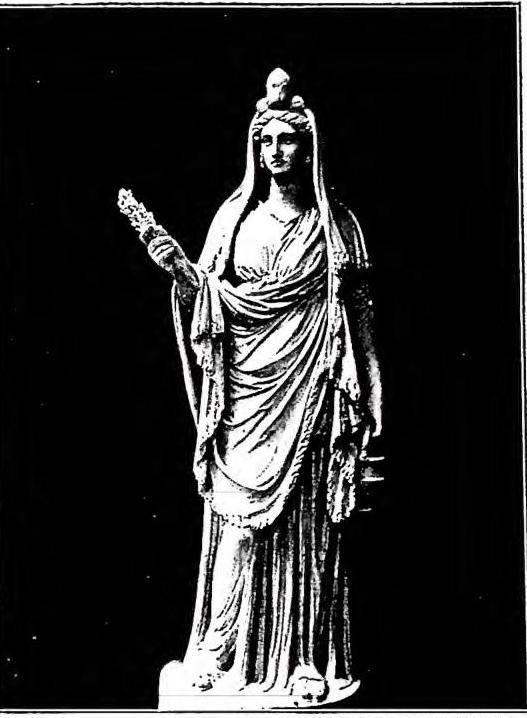
I. was associated through syncretism with the Greek divinities (I
Aphrodite; I.–Tyche; I.–Demeter; I.–Artemis; I.–Hecate), on the other she acquired the character of a universal divinity: “the beautiful essence of all the gods” (Pap. Oxyr., XI, 1381, line 126). Alexandria became the center from which the cult of I. radiated; Serapis (the deceased Apis), the national god adopted by the Ptolemies, was associated with her. Patroness of the port of Alexandria and protectress of sailors ('Iσις πελάγια'), she gradually conquered the ports of the Mediterranean where colonies of Egyptian merchants resided, also winning the favor of the local populations(photograph: Vatican Museums Gallery)
ISIDE – Hellenistic-Roman statue (2nd century A.D.) – Vatican Museums, Braccio Nuovo.
Local communities of devotees of I. and Serapis arose in Crete, Rhodes, Smyrna, Greece, and southern Italy.
In Rome, the Isiac cults attained such development that between 59 and 48 B.C. the Senate was compelled to enact severe repressive measures against a movement that endangered the religion of the State. The persecution intensified under Tiberius after a scandalous incident that occurred in A.D. 19. Caligula, on the other hand, promoted the construction of a magnificent sanctuary dedicated to I. in the Campus Martius, subsequently enlarged by Domitian and adorned with monuments imported from Egypt. The cult of I. also spread northward, where it is attested in Britannia, Gaul, and Germany. The last public festivities in honor of I. were celebrated in Rome in A.D. 394, while in Egypt the last temple of I. to remain in operation was that on the island of Philae, near the First Cataract.
II. RITES AND MYSTERIES
In the pharaonic age I. appears in the so-called mysteries (a kind of sacred representation of a liturgical nature) at Abydos and in some genuine theatrical dramas performed by lay actors. The fundamental subject was the legend of I. and Osiris, with particular emphasis on its poignant episodes. However, the fragmentary nature of the texts does not permit a concrete understanding of this ritual-dramatic aspect of the Isiac cult.During the Hellenistic period I. was the centre, in the countries of the Mediterranean world, of a mystery cult whose ritual elements were described in veiled form by Apuleius of Madaura (2nd century A.D.) in Book XI of the Metamorphoses. He, concealing himself under the name Lucius, describes the initiatory ceremony to which he was admitted at Corinth by the Isiac priesthood after a series of fasts, abstinences, and prayers to the goddess, relating that he descended into Hades, traversed the elements of the cosmos, contemplated the flashing Sun, and greeted the gods above and below. The following day, clothed in twelve stoles and seated upon a throne, he received the homage of the fellow worshippers who had already been initiated. He thus underwent a burial rite and contemplated the otherworld—either through representations, the mechanism of which is unknown, or through an ecstatic sleep—the realm of Osiris-Sun, whence he returned to the world assimilated to the god and therefore venerated by his fellow worshippers as a new Osiris. It is thus the familiar experience of death and resurrection characteristic of the mysteries, into which he is admitted through the intercession of I.
Among the great public festivals, the most famous was the spring festival of the Isida navigium, during which the faithful and the priests, invoking the goddess as patroness of sailors, went in procession down to the seashore and consigned a sacred boat to the waves (Apuleius, Met., XI, 8-17; Firmicus Maternus, De err. prof. relig., 2). This festival marked the beginning of the resumption of navigation after the winter months. Another important ceremony took place in November over three consecutive days, devoted to commemorating the painful wanderings of I. in search of Osiris, and culminated in the joyful discovery (inventio) of her husband (cf. Juvenal, VII, 29).
These religious celebrations had a public or semi-public character, whereas the secret ones were reserved for the initiated, who were required to maintain strict inner and outer purity, abstain from certain foods during specified periods, and observe absolute secrecy concerning the mystical rites. These privations were amply compensated by the joy of being able to serve “the holy, eternal protectress of the human race, ever generous in her favours toward mortals, who bestows a motherly affection amid misfortunes” (Apuleius, Met., XI, 25).
III. ICONOGRAPHY
I. appears anthropomorphic, wearing on her head the hieroglyphic sign of her name (the seat), or the coiffure of Hathor (the solar disk prominently displayed between two lyre-shaped bovine horns). At times, with reference to the legend, she is depicted winged, in the act of fanning Osiris. A common image of I. is that of her represented in the act of suckling the young child Horo (Harpocrates). In the Greco-Roman period she also appears in the form of a uræus serpent.The attributes characterizing I. are the sistrum and the situla for libations.