
MAYA, RELIGION of. — At the time of the Spanish conquest, the M. occupied southern Mexico, Guatemala, and Honduras. Their civilization, one of the oldest and most splendid of pre-Columbian America, had attained particular excellence especially in architecture and mathematics.
Important sources for the study of the r. of the M. are the accounts of the Spaniards who came into contact with the M. immediately after the discovery of the New World (one of the most notable is that of Bishop Diego de Landa); three codes, not completely deciphered: the Dresdensis, the Tro-Cortesianus, the Peresianus; inscriptions and various representations on marble stelae, vases, and mural paintings. Of some importance, too, is the information contained in certain sacred books written by the indigenous peoples after the conquest, in their own language but using Latin characters, such as the Popol Vuh, also called the Bible of the Quiché M., the book of Chilam Balam (Book of Hidden Things), and the Annals of the Cakchiquel. A notable contribution to the study of the r. of the M. has also been made by the surviving elements of the ancient cult that are still found among Maya-speaking populations surviving in Central America.
The oldest form of religion seems to have consisted in a cult of the forces of nature that influence human life: the sun, the moon, rain, lightning, etc. When, with the introduction of agriculture, Maya civilization assumed new aspects, the religious system also became more complex, enriched by beliefs and rites relating to new beneficent divinities who protected agriculture. At a third stage, following the invention of the calendar, knowledge of chronological and astronomical elements, and the acquisition of hieroglyphic writing, religion underwent further development and acquired greater substance, also giving rise to the formation of philosophical conceptions.
According to ancient traditions, the M. believed in a god who created the world, called Hunab or Hunab Ku (Hu = one, ab = essence, state of being, ku = god). He was the father of Itzamna, the Zeus of the M., lord of the sky and the sun, and therefore of day and night. Itzamna was the first priest, invented writing and the codices, gave names to the various localities of Yucatan, and distributed the land among the people. In the month of Mac, a rite was held in his honor and that of the rain gods, the Chac. He was also the protector of the harvests: the priest, in fact, while offering cooked maize to his image, prayed: “Great Lord of Heaven, you who dwell among the clouds in the blue sky, grant us a good maize harvest.” He was called upon in times of famine with special ceremonies. On the occasion of the New Year rites, the faithful commended themselves to him so that he might avert misfortunes.
Chac, the beneficent god of rain and the cardinal points, was greatly venerated; he was at the same time regarded as one and as four distinct persons: indeed, when he was associated with the cardinal points, there was said to be a “chac” for each of them. In this connection, there was also talk (according to Cogolludo, De Landa, and others) of four brothers, the Bacab (= around the earth), gods of rain and wind, beekeeping, and divination, who supported the vault of heaven at the four cardinal points. Each was distinguished by a special color and had a specific role in a rite concerning the directions of the world. Chac corresponds to the Aztec Tlaloc and is one of the oldest divinities in the religion of the peoples of Central America.
The wife of Itzamna, or of Kinich Ahau Itzamna, the personification of Itzamna’s solar aspect, was Ixchel, goddess of the moon, protectress of women in childbirth, and inventor of the art of weaving. While in these aspects she was regarded as a benevolent divinity, in other cases she was considered a malevolent power, representing the destructive force of water in floods and deluges.
Another important divinity in the pantheon of the Maya gods was Kukulkan: his name means feathered serpent, like that of the Aztec divinity Quetzalcoatl. This god was introduced into Maya religion fairly recently, probably by the Mexicans, together with another new element, human sacrifice.
The god of grain, the god of death, the god of the pole star (protector of merchants), the god of wind, the god of war, of human sacrifices and violent death, the goddess of suicide, etc., should also be remembered.
The M. believed in an existence beyond the grave, after death. Those who had led a wicked life went after death to Mental, an underground, damp, and cold place where, however, they were not subjected to torture. Those, on the other hand, who had been victims of sacrifices, suicides, mothers who had died in childbirth, priests, and warriors fallen in battle had the privilege of reaching an abode filled with delights.
Official worship was expressed in numerous complex and varied ceremonies comprising different stages. The constituent elements of the ritual were, broadly speaking, the following: a preliminary fast; the expulsion of the evil spirit from the bodies of the worshippers; the censing of the idols; prayers; sacrifice; banquets. Living beings were preferably chosen for sacrifice—land animals, fish, and also human beings. Human sacrifices, however, did not form part of the ancient religion, having been introduced from Mexico at a later period. At times the worshipper offered the divinity whom he intended to honor his own blood, with which he sprinkled the god’s statue. Confession of sins was practiced, especially of sexual sins.
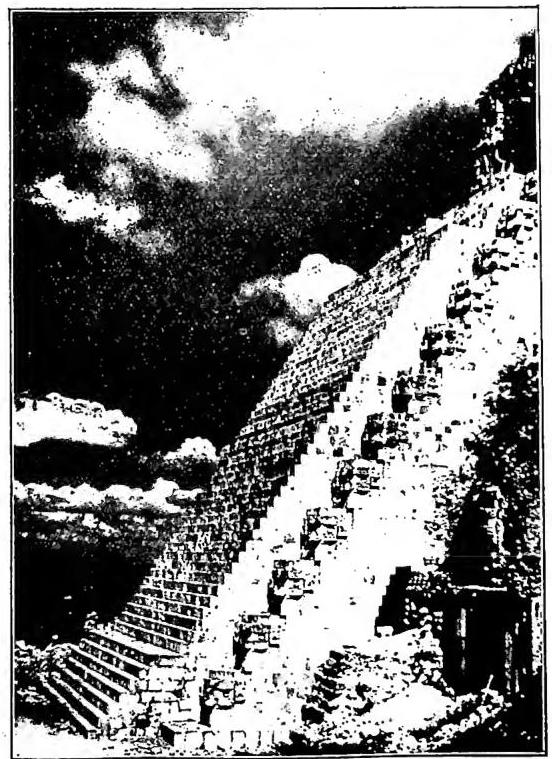
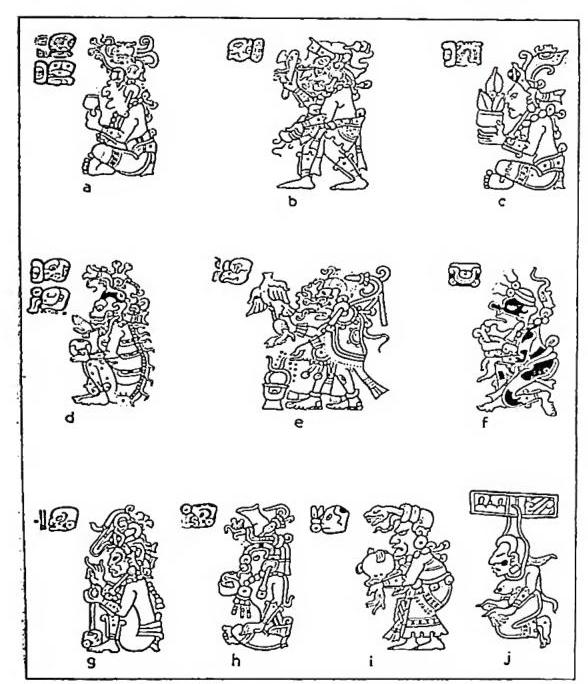
MAYA, RELIGION of — Principal M. divinities reproduced in codices: a) Itzmna, supreme god of the M.; b) Chac, god of rain; c) Yum Kax, god of grain; d) Ah Puch, god of death; e) Kukulan (perhaps), god of wind; f) god of war; g) god of sudden death and human sacrifice; h) Xaman Ek, god of the northern star; i) Ixchel, wife of Itzamna, goddess of childbirth; j) Ixtab, goddess of suicide.
on this occasion, were assisted by the chac, venerable elders of authority. The priests’ task was not only to attend to the practices of worship and guard the temples, but also to know and follow the movements of the stars, oversee the compilation of the calendar, perform chronological calculations, draw up hieroglyphic documents, etc. In view of these duties, they had to be true sages. — Vedi tav. XXXI.