
VALERIANO BOLZANI, GIAMPIETRO (Pierius Valerianus). - Humanist, b. in Belluno in 1477, d. there
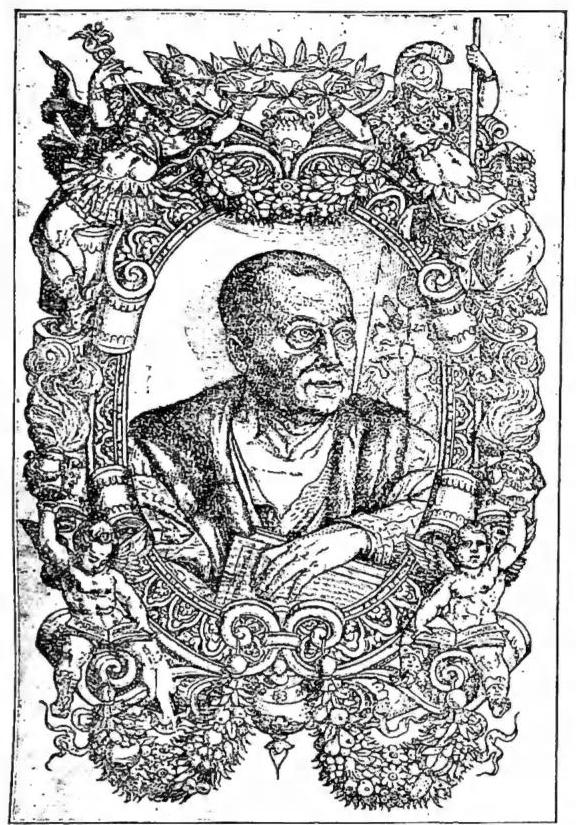
VALERIANO BOLZANI, GIAMPIETRO - Portrait. Copper engraving, prefixed to the work Hieroglyphica, sive de sacris Aegyptiorum literis commentarii, Basel 1556 - Specimen from the Vatican Library.
he remained there until 1509, except for the period of his studies in Padua.
In the shadow of the Medici, he lived in Rome and Florence. After the assassination of Alessandro de' Medici in 1537, he returned to Belluno. He died in Padua in 1558. He participated in the extreme ideas and enthusiasms of humanism, those that characterized the Rome of Leo X. He always used Latin. Convinced that the vernacular was not derived from it, but was an inferior language coeval with it, he struggled to admit that it had by now taken its place, or was destined to take it as a successor. From this humanistic devotion of his, which was also consecrated by the priesthood, his Italian and Catholic sentiment radiated. In the hymn to St. John the Evangelist, the invocation to the Saint in favor of the Latin homeland is moving. He wrote a short poem Leucippus, five books of love elegies, Poëmata (Basel 1538), Amorum libri quinque et alia poëmata (Venice 1549). The epistle Studiorum conditio represents the most notable pre-Aristotelian ars poetica after that of Vida. Characteristic for its melancholic accentuation is the small work Contarenus, sive de literatorum infelicitate (Venice 1620), which is essentially a brief literary history where men of letters are viewed from the perspective of unhappiness. And yet, despite this participation of his in the enthusiasms of the humanists, what inspired him most deeply and best recommends him to posterity is a sentiment that distinguishes him from them. Ancient ruins had been loved by Petrarch and by the whole of the 14th century; but with a love that one might call romantic and pre-Piranesian. The taste for scientifically studying, collecting, and cataloging them, from which modern museums will arise, now dawns with Bembo and Pierio. This is the merit
of the Antiquitates Bellunenses, which V.B. compiled by studying the relics of his homeland. Even richer in a sensibility that was still embryonic among scholars at the time are the Hieroglyphica, sive de sacris Aegyptiorum aliorumque gentium literis commentarii, 58 books, where, even without first-hand research, everything that antiquity handed down regarding those old symbols is gathered. They were soon translated and reprinted several times; they pleased the following century, which, loving erudition for its own sake greatly, but skeptically and as a pastime, believed it recognized a precursor in the author of the Hieroglyphica. At the origin of these, however, is the old humanistic enthusiasm: and it can still be perceived.