
PURGATORIO. – A state of the afterlife, lasting until the Last Judgment, in which the souls of those who have died in Grace, but with imperfections or venial sins or temporal penalties to be expiated for remitted grave sins, atone and are purified before ascending to paradise.
SUMMARY:
I. The existence of p
II. The punishments of p
III. The joys of p
IV. Iconography.I. EXISTENCE OF PURGATORY
I. Sacred Scripture
The Bible does not speak explicitly of purgatory, but it contains texts that suggest the idea. The concept of personal responsibility, which became increasingly clear with the progress of Revelation, joined to the idea—so widespread in the Old Testament (cf. Sap. 10:2; Num. 20:12; II Reg. 13:13–14)—that, once sin has been remitted, a temporal punishment remains to be expiated, is an important premise of the doctrine of purgatory. If this explicit conception of the Old Testament is associated with the New Testament idea of the individual’s personal participation in his own salvation, especially within the penitential economy, it does not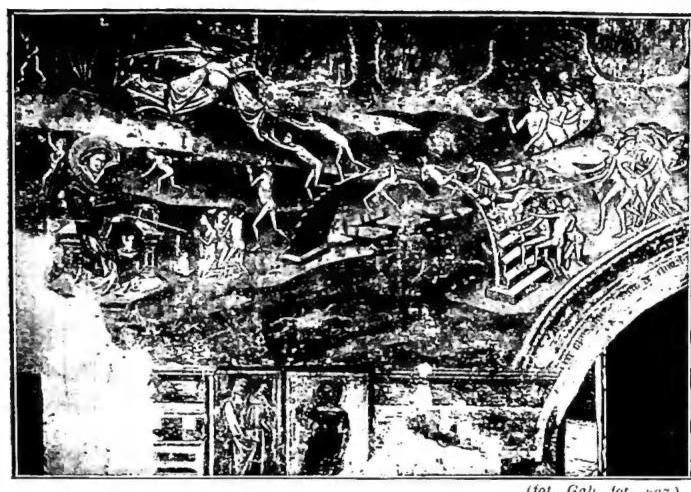
PURGATORIO - The passage of souls, on the bridge of p., according to the vision of the Cassinese monk Alberico. Detail from the Last Judgment, fresco by an unknown artist of the 14th century - Loreto Aprutino, church of S. Maria del Piano.
it is not difficult to observe that, if some biblical text intimates the fact of an otherworldly prolongation of this economy, Christian thought, guided by the Church, could, at some point in its development, deduce the existence of that intermediate state between hell and paradise which for centuries has been called p.
This intimation emerges precisely from certain passages, among them II Mach. 12:43-46. On the day after the victory over Gorgias, Judas Maccabeus discovered beneath the garments of those fallen on the battlefield idolatrous objects, taken in the sack of Iannia, and saw in this grave transgression of the law the cause of the soldiers’ deaths; therefore, “having taken up a collection, he sent 12,000 silver drachmas to Jerusalem, so that a sacrifice might be offered in expiation of the sins of those who had died on the battlefield.” He did this, first, because as a pious and religious man he believed in the resurrection of the flesh (for if he had not possessed a firm hope in the future resurrection [connected, in Jewish thought, with the survival of the soul] of those who had fallen in battle, it would have been superfluous or useless to pray for the dead), and then because he held that an excellent reward was reserved for those who had died piously. It is therefore a holy and beneficial idea to pray for the dead, so that they may be freed from their sins. In the original text, the hagiographer restricts his view to the sin of those fallen in battle, but the principle established is universal in scope. This text, at least indirectly, affirms that God grants the dead cum pietate, even if stained by some fault, forgiveness of sins through the prayers of the survivors (cf. P. E. O'Brien, The scriptural proof for the existence of Purgatory from 2 Machabees 12, 43-46, in Sciences eccles., 2 [1949], pp. 80-108; P. Heinisch, Teologia del Vecchio Testamento, Italian trans., Rome 1950, p. 318; and also *E. Stauffer, Die Theologie des Neuen Testaments, 3rd ed., Stuttgart 1947, p. 191)
Three passages of the New Testament, although open to another interpretation, can be explained in harmony with the doctrine of II Mach.: 1) Mt. 5:25-26: “Come to terms quickly with your adversary while you are with him on the way, lest he hand you over to the judge and the judge to the officer of justice (minister), and you be led to prison: truly I say to you, you will not come out until you have paid the last penny.” S. Cyprian (Ep. 55 ad Antonianum, n. 20: PL 3, 786) and the Latin Fathers saw in this a clear allusion to p.; modern exegetes hold that the text is not being strained if the metaphor of the prison is interpreted as referring to p.; 2) Mt. 12:31-32: “and whoever has spoken against the Son of man will be forgiven, but whoever has spoken against the Holy Spirit will not be forgiven, either in this age or in the age to come.” S. Augustine (De Civitate Dei, 21, 24: PL 41, 739), s. Gregory the Great (Dial., 4, 39: PL 77, 396), and s. Bernard (Sermo 66 in Cant., n. 11: PL 182, 1100) deduced from the final clause that for certain sins, less serious than blasphemy against the Holy Spirit, remission may also be obtained in the future life: this interpretation should not be rejected, even though some modern scholars prefer to see in the emphatic phrase only the exclusion of every forgiveness for the sin against the Holy Spirit. 3) Particularly important is the pericope of I Cor. 3:10-17: “No one can lay any foundation other than the one that has been laid, which is Jesus Christ. And if anyone builds upon this foundation with gold, silver, precious stones, wood, hay, straw, the work of each will become manifest; for the day (of the Lord) will show it, because it is revealed in fire, and the fire will test what sort of work each has done. If the work that someone has built upon it remains, he will receive a reward; but if someone’s work is burned, he will suffer loss, though he himself will be saved, but as through fire (αὐτός δὲ σωθ. γέτατ. αὐτῷς δὲ ὡς διὰ πυρός).” S. Paul speaks of the work of the ministry, by which the Church is built; upon the foundation of apostolic preaching, centered on the doctrine of Christ crucified, preachers must build with material of equal value. The Apostle, alluding to the use of gold, silver, and precious stones in the construction of temples and royal palaces, applies these names to true and beneficial doctrines, while reserving the terms wood, hay, and straw for false, frivolous, and worldly doctrines, unsuitable for the spiritual edification of the faithful. The work of every preacher will be tested by fire (τὸ πῦρ, αὐτὸ δοκιμάσει, V. 13), on the day of the Lord (ἡ γὰρ ἡμέρα δηλώσει). S. Thomas Aquinas (In I Cor., cap. 3, lect. 2) interprets fire in the broadest sense, as the totality of the judgments and trials (metaphorical fire) to which Christ subjects the work of those who have labored in his Church; he therefore holds that “the day of the Lord” (ἡ ἡμέρα) means all the moments in which God manifests his judgment upon the work of the builders of the Kingdom (tribulations of the present life, particular judgment, final judgment). In each of these moments Providence reveals the value of the works: whoever has built with good material (gold, silver, precious stones) will see the solidity of his work and receive a reward (otherworldly); whoever has built with bad material (wood, hay, straw) will discover the fragility of his work and will himself suffer loss from it (that is, will undergo punishment), but will be saved, not without pain and anguish, like one who, fleeing through the flames, is terrified by them and suffers burns (cf. F. Zorell, πῦρ, in Lex. graecum N. T., Paris 1931). From this perspective, the idea of p. is implicit: in fact, the trials to which the architects of the Kingdom will be subjected cannot be regarded as merely earthly (the entire context principally concerns the future life), nor can they be restricted to those of the final judgment, since then there will be only the elect or the damned, whereas the text speaks of a transitory suffering (a loss, ζητωθήσεται), which will end with the definitive salvation of the one who has built upon the true foundation, but with inferior material. The concept of an otherworldly but not eternal trial corresponds to the Catholic doctrine of p. This interpretation is substantially common to numerous Catholic exegetes (A. B. Allo, Première épître aux Corinthiens, Paris 1934, pp. 59-61; 66-67; F. Prat, La teologia di s. Paolo, I, Italian trans., Turin 1936, pp. 88-91; A. Beel, Docetne s. Paulus dogma purgatorii in I Cor. 3, 11?, in Collat. Brugen., 37 [1937], pp. 77-103; V. Jacono, Le ep. di s. Paolo ai Romani, ai Corinti e ai Galati, Rome 1951, pp. 284-86).
2. Tradition
Christian thought, guided by the Church, arrived at the explicit formulation of the doctrine of purgatory, moving in the threefold direction traced out by Scripture (suffrages, purification, expiation). The “euchological” line, linked to the text of the Maccabees, made a profound impression on the Christian conscience, so that East and West, from the origins down to the present day, are remarkably united in affirming the value of prayers, good works, and above all the Eucharistic sacrifice for the faithful departed. From the brief allusions of II Tim. 1:18, the Martyr. Polycarpi (18, 2-3), and Clement of Alexandria (Stromata, VII, 13: PG 9, 508), one arrives at the solemn testimonies of Eusebius (Vita Constantini, 4, 71: PG 20, 1115: prayers on the occasion of the death of the Christian Emperor), St. Cyril of Jerusalem (Catech. Myst., 5, 9: PG 33, 1115: theological explanation of the value of the Mass for the dead), St. John Chrysostom (In I Cor. hom., 41, 5: PG 61, 361: comparison with Job’s expiatory sacrifice; In Acto hom., 21, 4: PG 60, 170: the memento for the dead is considered to be of apostolic origin), St. Epiphanius (Haeres., 75, 8: PG 42, 513: Aerius is declared a heretic because he was the first to deny the efficacy of suffrages for the dead), and St. Cyril of Alexandria (Adversus eos, qui audent dicere non esse offereudum pro iis, qui in fide obdormierunt, fragmenta: PG 76, 1432).From the brief and evocative invocations of the catacombs: vivas in Christo; in refrigeria anima tua; Deus refrigeret spiritum tuum; vos precor, o fratres, orare hoc quando venitis; rogo vos omnes, qui legitis, orate pro me peccatore (cf. H. Leclercq, Purgatoire, in DACL, XIV, cols. 1978-81; id., Défunts, ibid., IV, col. 427 ff.; P. Kirsch, Die Lehre von der Gemeinschaft der Heiligen im christl. Altertum, Mainz 1900; S. Scaglia, Novissimi nei monum primitivi della Chiesa, Rome 1923, pp. 9-10), throughout the Latin Church one finds the most explicit testimonies concerning the practice and theory of suffrages: Tertullian (De corona, 3: PL 2, 79; De monogamim, 10: PL 2, 942), St. Cyprian (Ep. 1, 2, ed. Hartel: CSEL, III, II, p. 466), St. Ambrose (De excessu fratris sui Satyri, n. 1, 80: PL 16, 1372; De obitu Valentiniani, n. 56, 78: PL 16, 1146; De obitu Theodosii, n. 36, 37: PL 16, 1460). St. Jerome praises the piety of his friend Pammachius in suffraging the soul of his wife through good works (Ep., 66, 5: PL 22, 642). St. Augustine definitively established Christian doctrine concerning suffrages. Explicitly invoking the text of the Maccabees (De cura gerenda pro mortuis, 3: PL 40, 593) and the Church’s constant practice (Sermo 182, n. 2: PL 38, 936), he rejected the error of Aerius (De haeres., 153: PL 42, 593), defending the efficacy of the sacrifice, prayers, and almsgiving for those souls of the departed who, although imperfect, are not unworthy of them (Euch., c. 110: PL 40, 283; cf. De octo Dulcitii quaestionibus, q. 3, n. 3: PL 40, 158); and with filial devotion he prays for his mother Monica (Confessiones, 9, 13: PL 32, 778).
The “cathartic” tendency (otherworldly purification), which is connected with I Cor. 3:10-17, attained its greatest development in the East, while nevertheless remaining within the framework of an Old Testament conception of the future life (souls awaiting the final judgment; V. GIUDIZIO DIVINO; INFERNO). Clement of Alexandria was the first to distinguish two ways of punishing sinners in the present life (for those capable of correction, punishment ἐδιδασκαλικώς; for the incorrigible, ἐκολαστικώς; Stromata, IV, 24: PG 8, 1363) and in the future life, in which two fires will operate: one “edax et omnia consumens: τὸ καταφάγον καὶ βέλθωσιν,” the other “prudens, qui pervadit animam per ignem transeuntem: τὸ φρόνιον” (Stromata, VII, 6: PG 9, 450). Origen is more explicit. apocatastasis (v.) does not absorb the whole of the eschatological theology of the Alexandrian master, since whenever, setting aside bold hypotheses and unrestrained speculations, he rediscovers his believing soul, he consistently draws a clear distinction between grave sins (πρὸς θάνατον ἁμαρτία) and imperfections (ὕποσ; In Lc. hom., 4: PG 13, 1236; In Ierem. hom., 2: PG 13, 280), and consequently between the otherworldly punishments of sinners “ad mortem” and those of the imperfect. Even the good, he maintains, are imperfect, and therefore all the righteous will be tested by the fire to which he refers
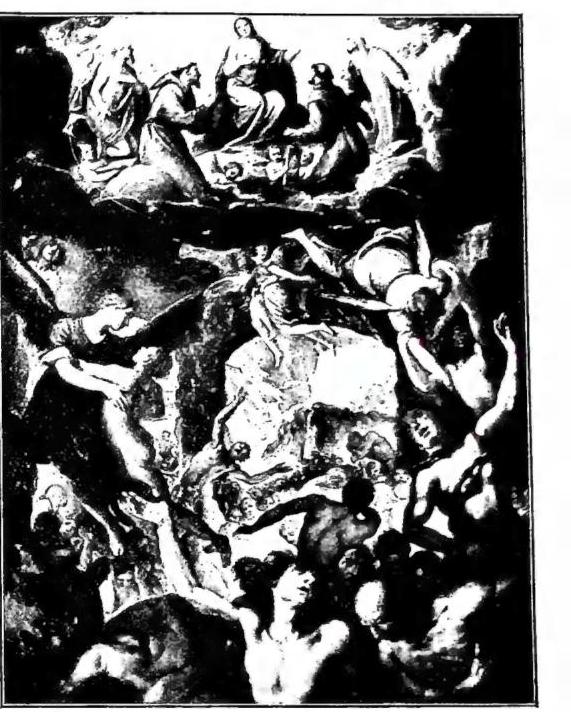
PURGATORIO — The P. by J. Tintoretto and collaborators — Parma, Pinacoteca.
Origen’s teaching was perpetuated and refined in the theology of the Greek Fathers: St. Cyril of Jerusalem (Catech., 15, 21: PG 33, 900: «fluvius ignis»), St. Basil (In Is., 9, 16: PG 30, 519: «non minaccia di distruggerlo», alluding instead to purification according to what the Apostle says [*I Cor. 3, 13]; cf. In Is., 4, 4: PG 30, 342; De Spiritu Sancto, 15, 38: PG 32, 132), and St. Gregory Nazianzen (Oratio, 3, 7: PG 35, 524: «le nostre azioni devono essere provate o purificate dal fuoco: ἠνίκα ἂν πυρὶ κρίνεται τὰ ἡμέτρη ἢ καθαίρεται»; cf. Oratio, 39, 19: PG 36, 357). Origen’s eschatological conceptions also exercised a strong influence on St. Ambrose and St. Jerome, whose doctrine concerning the future life was certainly not free from imprecision; with regard to p. as well, the two Latin Fathers echo the teaching of the Alexandrian (St. Ambrose, In Ps. 118, sermo 3, n. 14-16: PL 15, 1292-93, cf. Ambrosiaster, In I Cor., 3, 13-15: PL 17, 211; St. Jerome, In Is.*, 66, 24: PL 24, 704).
The «juridical» conception (expiation, payment of the debt contracted with justice), founded on Mfr. 5, 25-26, was broadly developed by the Latin tradition, which culminated in the explicit admission of a dark place (prison), where all punishments due for sins are expiated (you will pay to the last penny), and from which one may leave earlier with the help of those who remain. Tertullian, still entangled in the Jewish conception of the afterlife, held that only martyrs ascend immediately to paradise (Scorpiace, 6: PL 2, 158; De contra resurrectione, 43: PL 2, 903), whereas all other souls, good and evil alike, descend into Sheol (ad inferos), awaiting the resurrection. Since the soul is capable of enjoying and suffering even when separated from the body, both the good and the evil, while awaiting Sheol, already possess a foretaste of their eternal destiny. Those destined for damnation will remain in that prison until the final resurrection, which will take place on the eve of the final judgment, after the millennial reign (v. MILLENARIESIO), in which only the good will participate; they will therefore enjoy an anticipated resurrection. Those, then, among the good who will have debts to expiate will remain in Sheol until the last penny has been paid, and consequently their glorious resurrection (a necessary condition for participating in the joys of the millennium) will be deferred («mora resurrectionis», De anima, 58: PL 2, 796) in proportion to the punishments to be expiated. St. Perpetua the martyr recounts that she had a vision of her brother Dinocrates, who had died at the age of seven: « exeuntem de loco tenebroso, aestuantem valde et sitientem, sordido cultu et colore pallido » (Passio sanctarum Perpetuae et Felicitatis, c. 7, ed. C. Van Beek, Bonn 1938, p. 28). She therefore offered fervent prayers, and in a later vision was able to see him « mundo corpore, bene vestitum, refrigerantem... ludere more infantium, gaudentem » (ibid., c. 8, p. 30), and concluded: « Tunc intellexi translatum eum esse de paena » (ibid., p. 32).
St. Cyprian accepted Tertullian’s idea that only martyrs ascend immediately to the vision of God (Ad Fortunatum de exhortatione martyrii, praef. n. 4: PL 4, 683). He held that all other righteous persons await the vision of God shut in a prison, where they expiate « usque ad ultimum quadrantem » and are purified through painful trials and an enduring fire (Ep. 55 ad Antonianum, n. 20: PL 3, 786).
The current of «expiatory» doctrine continued (parallel to Origen’s «cathartic» theory) in St. Ambrose and St. Jerome, to meet and merge in the definitive synthesis of St. Augustine. He introduced decisive precisions and clarifications into the whole of Christian eschatology. Rejecting millenarianism (v.), he concluded that the punishments of p. would not consist in delaying the bodily resurrection of those souls that are not yet worthy to share in the joys of Christ’s kingdom; eliminating the theory of the postponement of reward and the consequent awaiting of the final judgment, he clearly and unequivocally asserted that purifying punishments must take place between the particular judgment (immediately after death) and the final judgment, after which there will be only hell and paradise (De Civitate Dei, XXI, 13: PL 41, 728). Refuting Origen’s hypothesis of the misericordes, he definitively rejected the idea of the universal salvation of the baptized by faith alone, independently of works (De fide et operibus, nn. 24-25: PL 40, 213-14; De Civitate Dei, XXI, 26: PL 41, 744). Having rejected these errors and clarified other obscure points, St. Augustine arrived at a felicitous formulation of the doctrine, directing theological inquiry along the path that the Church’s magisterium would subsequently establish. Christians who, at the moment of death, are free from grave sins but still disorderly attached to earthly goods are in fact in need of God’s mercy and at the same time are not unworthy of it; these precisely will be saved « per ignem » (De Civitate Dei, XXI, 13: PL 41, 728; Enchiridion, 69, 109-10: PL 40, 265, 283). The nature of this « ignis purgatorius » (Enchiridion, 69: PL 40, 265) and « emendatorius » (Enarr. in Ps., 37, 3: PL 36, 397) is not specified; St. Augustine remained hesitant, at times speaking of a metaphorical fire (De Civitate Dei, XXI, 26: PL 41, 743; De fide et operibus, n. 27: PL 40, 216; cf. A. Lehaut.
L'éternité des peines de l'enfer dans saint Augustin, Paris 1912, p. 69), while at other times he admitted the possibility of a real fire: « Si hoc temporis intervallo spiritus defunctorum eiusmodi ignem dicuntur perpeti... non redarguo, quia forsitan verum est » (De Civitate Dei, XXI, 26, n. 4: PL 41, 745).
3. Scholastic synthesis
The thought of St. Agostino passed, as an already established doctrine, to the writers of the early Middle Ages. In the twelfth century, Onoio di Autun (Elucidarium, 3, 3: PL 172, 1158) and St. Bernardo (Sermo 42 de quinque regionibus: PL 183, 663), with the audacious hypothesis of the punishment of cold, show that at that time the punishment of real fire was not regarded as an absolutely certain and common doctrine. In the thirteenth century, the great Scholastics, commenting on the text of Pietro Lombardo, constructed a more consistent synthesis: although they debated certain secondary points (the remissibility of venial sin, the gravity and duration of the punishment, the location of p.: cf. Alessandro di Hales, Summa Theol., IV, q. 14, memb. 3, a. 3-4; St. Bonaventura, IV Sent. d. 21, q. 1; St. Alberto Magno, IV Sent., d. 21), they held as a doctrine of faith the existence of p. and the temporary nature of the punishment, and were unanimous in considering the fire real. Particularly clear is the teaching of St. Tommaso (Contra Gent., IV, 91; Declaratio quorundam articulorum, c. 9 [*contra Graecos et Armenos]; IV Sent. d. 21 and d. 45, reproduced in Sum. Theol., suppl. q. 70, a. 1 [alienum a fide negare the existence of p.], a. 2 [de loco purgatorii non invenitur aliquid expresse determinatum in Scriptura], a. 3 [in purgatorio erit duplex poena, una danni... alia sensus... et quantum ad utrumque poena purgatorii minima excedit maximam poenam huius vitae], etc.; in q. 71, an extensive and profound treatment of the value of suffrages [cf. J. D. Folghera-J. Webert, St Th. d'A. Somme, theol.: L'anedelo*, with notes and appendices, Paris 1935, pp. 303-17; 331-41]).4. Controversy with the Greeks
While Latin theology, after St. Agostino, reached its full development, Greek theology remained at the positions attained in the fourth and fifth centuries; hence one observes a process of crystallization of the archaic doctrine (the souls’ awaiting in their respective subterranean places, the fire of judgment, which will purify the souls destined for glory while tormenting the damned forever), to which those Byzantine theologians who came into contact with the Roman Church from the thirteenth century onward proved particularly attached.At the end of 1231, Giorgio Bardane, bishop of Corcira, having noted the differing position of the Latins, affirmed the souls’ awaiting until the universal judgment, rejecting the fire of p. as a theory of Origenist flavor (cf. the mss. Barb. grec. 297 and Laur. grec. 36, n. 3). The Byzantine patriarch Germano II, informed by Bardane, wrote a treatise (now lost) to refute the Latins. From that time, the conviction spread throughout the West that the Greeks denied p. and the immediate retribution of souls. This twofold error was soon opposed by the Dominicans of Pera.
St. Tommaso d'Aquino bore in mind the two errors attributed to the Greeks when, in De rationibus fidei ad Cantorem Autiochenum, c. 9 (Opuscula theolog. omnia, III, ed. P. Mandonnet, Paris 1927, pp. 274-76), he insisted on the immediata animarum retributio or, in the Contra errores Graecorum (ibid., pp. 303 and 327), affirmed the efficacy of the Mass on behalf of the souls in p. At the Second Council of Lyons (1274), the Byzantine emperor Michele Paleologo presented to Pope Gregorio X, as a sign of adherence to the teaching of the Roman Church, the profession of faith that had been sent to him by Clemente IV (1265-68), during the preparatory period of the Council of union. This professio fidei contains an article concerning p.: “if it happens that some truly repentant believer dies in the grace of God, but before having completed the penance (satisfactio) due for sins, his soul is perfected by purifying punishments (poenis purgatoriis seu cetharteriis, sicut nobis frater Johanne [the Franciscan Giovanni da Balastri, apostle of union] nobis explanavit, post mortem purgari).” After the Council of Lyons, Benedetto XII (1341) and Clemente VI (1351) rejected the denial of p. attributed to the Armenians (Denz-U 535 and 3050), while Latin theologians polemicized against the opponents of union
(Matteo Koëstor, Angelo Panareto, Simone di Tessalonica), who attacked above all the doctrine of the fire of p. as it had been taught by St. Tommaso. Among the Catholic Greeks, the Dominican Manuele Calecas (d. 1410) proved a convinced defender of Western doctrine in his notable work: Adversus Graecos (PG 152, 228 ff.). At the Council of Florence (1439), the debated question of p. (especially of the fire), in which the finest Eastern minds (Marco Eugenico, Cardinal Bessarione) and Western minds (Cardinal Giuliano Cesarini, Cardinal Giovanni Turrecremata) engaged, concluded without any definition by Pope Eugenio IV concerning the nature of the fire, and with the Greeks’ acceptance of the fundamental elements of the dogma already formulated in the professio fidei of Paleologo, reproduced almost literally (with the word catharteria suppressed) in the bull Laetentur caeli of 6 July 1439 (Denz-U, 693), with an important addition concerning the nature of the caelum, to which completely purified souls ascend immediately (mox): “Et intueri clare ipsum Deum Trinum et Unum, sicuti est, pro meritorum tamen diversitate alium alii perfectius” (ibid.). With this clause, taken from the dogmatic bull Benedictus Deus of 29 January 1336 (Denz-U, 530) of Benedetto XII, the Palamite conception of paradise (the non-immediate vision of the divine essence), toward which Marco Eugenico inclined, was rejected (cf. A. D'Alès, La question de purgatoire au Conc. de Florence, in Gregorianum, 3 [1922], pp. 8-50; A. Michel, Purgatoire, in DThC, XIII, cols. 1252-63; M. Gordillo, Comp. theol. orient., Rome 1937, pp. 179-97). Thus at Florence union was achieved on the essential points of the existence of p. and the value of suffrages (defined dogma), while the doctrine of the fire was left with the character of a sententia, which Latin theologians rightly regard as founded on tradition (v. SORA). The attitude of Eastern theologians after the Florentine Council is described in M. Jugie (Purgatoire dans l'Eglise Greco-Russe après le Concile de Florence, in DThC, XIII, cols. 1326-52; id., Theol. dogm. Christian. Orientalium, IV, Paris 1931, p. 362 ff.).
5. Protestant errors. — The existence of p., already denied by certain medieval sects (spostolici [St. Bernardo, Sermo 36 in Cant.; PL 183, 1098], petrobustiana, Waldensians), then implicitly by Wicleff (Denz-U, 622) and by Huss (ibid., 634; cf. nn. 676-77), was opposed by Lutero at first hesitantly and then with increasing decisiveness: in the 95 theses of 1517, by attacking indulgences and therefore the condition of the souls in p., and denying any spiritual relationship between them and the surviving faithful; in the Leipzig disputation of 1519, he rejected the biblical proof of p., and in 1530 definitively denied the dogma. Lutero was followed by Calvino (Inst. relig. christ., I, IV, chap. 5, n. 6) and by the Anglicans (Confessio anglic., 39 articles, art. 22).
6. Council of Trent. — Catholic theologians reacted vigorously with special treatises (Cardinal Caetano, A. Catarino, S. Mazzolini, St. G. Fisher, G. Eck, A. Varani, V. Graccari), and with public condemnations by the Universities (Louvain 1519, Paris 1521), until the Council of Trent issued (3–4 December 1563) the celebrated Decretum de purgatorio (Denz-U, 983), in which Catholic doctrine is formulated in precise and sober terms and disciplinary norms of great importance are promulgated.
II. THE PENALTIES OF P
They consist in separation from God (poena damni, an expression perhaps to be eliminated because it recalls hell too strongly) and, according to the common doctrine of Catholic theologians, in sufferings caused by fire (poena sensu).The greatest torment is separation from God. Souls separated from the body live a more intense spiritual life because they are now free from the burden of the flesh, which weighs upon and aggravates the spirit: far from earthly illusions, the tumult of the passions, and the distractions of life, the souls of P. know the preciousness of the intuitive vision of God in a manner immensely superior to that of the purest souls on earth; and, concentrating their contemplation on the attributes of God, they conceive an ineffable desire to see His essence. But their impetuous aspiration is cut short by the narrow confines of the prison that encloses them, by the threefold burden weighing upon their spirits: temporal punishment (due to forgiven grave sins),
unremitted venial sins, and the evil inclinations contracted during earthly life. Forced to turn inward upon themselves, they feel the emptiness of their being because of the absence of Him who alone can fill it (cf. s. Caterina da Genova, Tratt. del p., ed. di Valeriano da Finalmarina, Genova 1929, p. 17). In this unsatisfied longing for happiness, the imprisoned souls enumerate with regret the infidelities of their earthly life that cause them such anguish: they feel that through their own fault they failed to meet God; having failed on earth to seek above all the Kingdom of God, they now, as exiles, feel its piercing nostalgia.
The souls atone for the «reliquiae of sin» (temporal punishments) not by imposing them upon themselves (satisfactio), but by accepting from God (satispassio) the sufferings of P.; although this acceptance is passive and not meritorious, it cannot be said to be wholly involuntary, because a sacred ardor of penance pervades them all (s. Tommaso, Sum. Theol., Suppl., q. 70, a. 4; s. Caterina da Genova, Tratt. del p., cap. 8, n. 4; ed. cit., p. 20). Venial sins not yet remitted quod culpam are forgiven, according to Scoto (IV Sent., d. 21, q. 1), at the moment of death by virtue of previous merits; according to s. Tommaso (De malo, q. 7, a. 11), through an act of perfect charity; according to l'Arriaga (Disput. theol., VIII, disp. 14, sect. 6), through merits that can also be acquired in P., solely with regard to the remission of these sins (cf. C. Manzoni, De natura peccati deque eius remissione, S. Angelo di Lodi 1890, pp. 387-91).
The penalties of P. are certainly proportionate to each person’s sins and imperfections and are therefore different. Just as among the blessed it is impossible to find two whose earthly histories were identical, so in P. there will not be two souls who suffer the same penalty. Souls preserve, more than their faces, their unmistakable individuality (cf. L. Parè, Les mystères de l'au-delà. Que penser du purgatoire?, Parigi 1936, pp. 100-101). Nothing certain is known about the duration of P. Alessandro VII condemned the following proposition: «Annuum legatum pro anima relictum non durat plus quam per decem annos» (Denz-U, 1143).
III. THE JOYS OF PURGATORY
Sorrow is compatible with joy. The repentant sinner experiences at the same time joy at the forgiveness received and regret for the offense committed against God. The souls in purgatory must experience profound satisfaction in knowing that they are finally making reparation for the outrages inflicted upon God; perhaps for the first time, they feel that they are able to give God what belongs to God, after having so often given the world what did not belong to the world. The visit of the Angels, messengers of God and of Mary, solutium purgatorii, brings them particular relief. The guardian Angel cannot abandon his charge at the moment of trial. This is a pious belief spread by s. Bernardino da Siena, Fénelon, Faber, and above all by Cardinal Newman (Il sogno di Geronzio, final verses; Italian trans., in C. Martindale, Lo spirito del card. Newman, Brescia 1931, pp. 196–97). It is a dogma of faith that the souls in purgatory are relieved by the suffrages of the faithful, above all by the Eucharistic Sacrifice (v. COMUNIONE DEI SANTI; CORPO MISTICO; INDULGENZE; MESSA). The souls do not allow themselves to be surpassed in generosity and repay us by obtaining graces and blessings for us (cf. Giuliano di Toledo, Prognosticon futuri saeculi, I, II, chap. 26; PL 96, 488; F. Suárez, De purgatorio, disp. 47, 2; A. Minon, Peut-on prier les âmes du purgatoire?, in Rev. eccl. de Liège, 35 [1948], pp. 329 ff.). Purgatory, a mystery of justice and love, causes the attributes of God to shine forth.IV. ICONOGRAPHY
A precise iconography of purgatory neither developed nor became established over the course of the history of Christian art. There are, however, various late Gothic representations in which souls are seen subjected to torments and tortures of the kind found in representations of hell; at the same time, these souls are shown here still being assisted by angels.A good example of such a depiction of suffering souls in purgatory is found in a panel by a southern German school, preserved in the National Museum of Munich; Italian art only later began to depict such a subject. Earlier, however, it frequently provided figurative images of the aid brought to the souls in purgatory through the Holy Mass and prayers.
Thus the visions of certain saints are illustrated, for example, those of s. Gregorio Magno and s. Bernardo. Among these representations one may note the marble-carved Storie di s. Gregorio Magno altarpiece in the church of S. Gregorio al Celio in Rome, a splendid work by Luigi Capponi, datable to the final years of the fifteenth century, and a nineteenth-century altarpiece in the church of S. Maria Scala Coeli at the Tre Fontane Abbey in Rome, depicting s. Bernardo celebrating Mass and seeing a cloth upon which those souls for whom he prays in the Divine Office ascend from purgatory to heaven. Purgatory is also often depicted in paintings recalling the Sabbatine privilege: see, for example, Tintoretto’s painting in Parma (Pinacoteca) and Tiepolo’s canvases at the Scuola dei Carmini in Venice (1744).
A fresco from the fourteenth century in the church of S. Maria del Piano at Loreto Aprutino, depicting the Giudizio Universale, is unusual. One detail of this painting represents the passage of souls across the bridge of purgatory, according to the vision of the Cassinese monk Alberico, who lived in the first half of the twelfth century (cf. chap. 17 of the Epistola, ed. M. Inguanez, in Miscellanea Cassinese, 11, Montecassino 1932, p. 93; V. also: A. Mirra, La visione di Alberico, ibid., pp. 33, 79).