
MONICA, saint. — Mother of St. Augustine, born at Thagaste, in proconsular Numidia, in 331, died at Ostia in 387. Her parents were Christians: M.’s education was entrusted to an old nurse who had carried her father in her arms and who often exaggerated in her severity. She married a certain Patricius, a pagan, violent and dissolute. The first years of the marriage were filled with bitterness; but M.’s patience and resignation never failed.
From this union were born three children: Augustine (v.), Navigius, and a daughter. Little or nothing is known of the latter two; Augustine’s glory has attracted the attention of posterity to himself. The figures of Augustine and M. have passed into history as something in-
divisible; beyond natural life, the great convert owed the supernatural light to his mother. Of her he left unforgettable pages in his Confessiones (book IX).
Knowing the inevitable struggles of adolescence, M. had given Augustine a Christian education, but in accordance with custom the administration of Baptism was deferred for him, for fear of seeing sacramental Grace shipwrecked too soon.
The mother’s trepidation increased from day to day as she saw that Augustine was setting out along the path of evil, although she was comforted by occasional glimpses of light, such as Patricius’s decision to receive Baptism (371). But he died shortly afterward. After various vicissitudes, Augustine decided to leave Africa and go to Rome. M. implored him not to leave, following him weeping as far as the port; but everything was in vain. In 385, distraught by her son’s absence and foreseeing grave misfortunes, she embarked for Italy and reached him at Milan. Upon arriving in that city, she learned that Augustine had for some time already established close relations with the bishop Ambrose and was listening to his sermons to the people. The trial lasted a long time, because there were many difficulties to overcome; but at last the work of Grace was accomplished. Then M. remembered the words addressed to her some time earlier by a holy bishop: «It is impossible that the son of so many tears should perish».
During the autumn vacation of 386, mother and son withdrew to the villa of Verecundus at Cassiciacum, in Brianza, and after several months of genuine peace Augustine received Baptism at Milan (387). Toward the end of summer they set out for Africa; but upon reaching Ostia, after a few days of fever, M. died.
Her body was buried at Ostia, and for many centuries her name remained forgotten. In 1162 there was a first translation of M.’s relics to the church of the Canons Regular of Arrouaise (France), where her feast began to be celebrated on 4 May. Under Martin V, in 1430, there was another translation of the Saint’s body from Ostia to Rome. M.’s relics, first deposited in the church of S. Trifone, were later transferred to S. Agostino through the efforts of Maffeo Vegio. The existence of two trans-
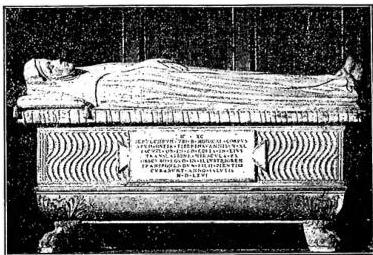
lations unfortunately renders the authenticity of the Saint’s relics problematic. Recently, a significant fragment of the funerary inscription dictated by Anicius Auchenius Bassus came to light. The Roman Martyrology, in addition to the feast of 4 May, commemorates the translation of 1430 on 9 April.