
CATERINA da GENOVA, santa. — Born in Genoa in 1447, posthumous daughter of Giacomo Fieschi and Francesca di Negro, and died there on 14 (or 15) September 1510.
At barely thirteen she had asked, in vain, to be admitted to the monastery of S. Maria delle Grazie, where her sister Limbania was; instead, three years later she was married to Giuliano Adorno, an irascible and prodigal man. After spending the first five years of her marriage in profound melancholy, she wished to emerge from her isolation and take part in worldly life, until that inner illumination, received on 22 March 1473 during sacramental confession, and the vision of Jesus streaming with blood, brought about her lightning conversion. She devoted herself to extraordinary penances which, in her own words, «seemed things that would cause one to die», while at the same time dedicating herself to the service of the sick, including lepers, first at home with the Dames of Mercy and later in the hospitals. Soon afterward (1476), Giuliano himself was induced to live with her in chastity and later to become a Franciscan tertiary. Whether she too was a tertiary is not documented, but, besides tradition and the logic of the inferences, an indication may be furnished by the mention of two tunics of Franciscan cloth in the inventory of the objects found at her death; Franciscan traits in her, without here mentioning the intellectual correspondences, are also her love for creatures, to which the Vita bears witness in chap. 42, and her joyful conception of death as «sweet gentle gracious beautiful rich strong worthy» (ibid., chap. 20).
In 1482 she moved with her husband into premises adjoining the Pammatone hospital (her intact remains are preserved in the attached church of S. Caterina in Portoria), and in 1489 she was elected rector of the women’s ward. While tending a tertiary who was afflicted with a fever, she contracted the plague in 1493. Four years later she was widowed. Subsequently, until her death, she suffered from an illness which the most distinguished physicians declared to be supernatural in nature: one of its characteristics was excessive heat which manifested itself externally from within, especially in the cardiac region, accompanied by an unquenchable thirst and other exceptional phenomena. These might suggest neuropathic symptoms, were it not that study of her doctrine and knowledge of her beneficial activity led to a judgment of profound admiration for the acuity and culture, rectitude and spiritual vigor of this distinguished noblewoman of the Renaissance, whom her contemporaries called «seraphina» and posterity «doctor of Purgatory». She was canonized by Clement XII on 16 June 1737. Feast day: 22 March.
Doctrine. — Caterinian thought unfolds around the following principles: a) the goodness of God, which manifests itself even in Hell and constitutes the secret of his justice, so that the name she most frequently used is «Love God»; b) abhorrence of sin, not only mortal but also venial, insofar as it is an irreconcilable antithesis to God and an obstacle to the soul’s receiving its glorification; c) the importance of free will, which contains within itself eternal life and death and cannot be violated by any creature, just as it is not compelled by God, but only directed along the paths of love through illuminations; d) the burden of self-love, tenacious in its perfidy, a thief and hypocrite that knows how to do evil while clothed in the appearance of good. Hence the absolute necessity of freeing oneself from it through the deliberate, or at least resigned, mortification of the will and the senses, in order to attain the total annihilation of everything that is not «pure, upright, genuine love». The theme of pure love, illustrated with varied and ingenious images, may be called the alpha and omega of the spirituality of «madonna Caterinetta».
Purgatory. — The dispossession of the self, in all its faculties, for the attainment of sovereignty by the spiritual soul (C. subtly distinguishes between soul and spirit) must not be only the concern of militant souls, but also governs those being purified. As has generally been noted, there is an extremely close connection between the statements in her treatment of the state of the souls in Purgatory and her own experiences, especially of passive purification, which made her a most refined and effective interpreter of that otherworldly realm. For this reason she does not dwell on a crude representation of the pains of sense, although she does not exclude them, but ranges through the elevated sphere of the pain of loss, which constitutes the most perfect purification: the loving fire that gradually consumes the rust of sin and is nourished by the pain of the delayed fulfillment of desire, while the soul nevertheless rejoices, because in Purgatory it carries out the divine will, to the point that, even if it had the power, it would not lessen its own sufferings, through which it satisfies the debt incurred. In this, as well as in duration, Purgatory differs from Hell; the souls being purified find a tempering of their suffering in the desire to identify themselves with God’s will, whereas the damned are embittered by rebellion. The sublime indifference of the souls being purified is reflected in their atti-
This is the summit of transforming union, already attained on earth by the great mystic and described by her in bold expressions recalling the teaching and cry of s. Paul. «I find myself (thus in the Vita, chap. 22), by God’s grace, with contentment without nourishment, love without fear, that is, without any fear of ever lacking it; faith seems to me entirely lost, hope dead, because it seems to me that I possess and hold securely what at other times I believed and hoped for. I no longer see union, because I neither know nor can see anything more, except him alone without myself... almost always outside myself». Or again: «My self is God, nor do I know anything else but my own God...» (ibid., chap. 14).
The writings. — Against the traditional attribution to s. C. of the Treatise on Purgatory and the Dialogue between soul, body, self-love, spirit, humanity and God, F. von Hügel maintained in 1908 the thesis that the two works, together with the Vita, were the result of a slow process of development completed between 1495 and 1551—that is, from an initial version written by Ettore Vernazza, C.’s spiritual son,
to the first Genoese edition by Bellono, with the contribution of other followers of the Saint, and especially of Battistina Vernazza, Ettore’s daughter, for the so-called Caterinian Writings. An exhaustive refutation, even if debatable in certain details, was produced in 1935 by Fr. Umile Bonzi da Genova, whose conclusions are accepted here after direct examination of the sources.
The first part of the autobiographical Dialogue may therefore be regarded as a genuine work of Fieschi, in which, through an artistic procedure, she reweaves the propaedeutic to the life of union—that is, the gradual passage from worldliness to the victory of the spirit over humanity and even over the sensitive and intellectual soul. The second part, however (chaps. 2 and 3), is attributed by Fr. Umile, with some hesitation, to bl. An-
The Treatise on Purgatory would have had C. as its inspirer rather than its author; that is, it would appear to be a mosaic of her expressions, which also abound in the Vita, woven around a framework by the priest Cattaneo Marabotto, her confessor and author of the Vita itself. In the manuscripts it was originally joined to it, and together they form a clearly distinct whole, stylistically, from the Dialogue, with
contributions from Ettore Vernazza, Battista Strata, Tommasina Fieschi, d. Giacomo Clarenzio, Argentina del Sale, and others.
The social movement. — C.’s influence in the field of social charity was considerable, both directly exercised through that group of followers which gathered in the Compagnia del Divino Amore, and indirectly through other contemporary apostles who knew her, such as b. Bernardino da Feltre. Thus, quite rightly, S.S. Pio XII proclaimed her in 1944 secondary patroness of hospitals in Italy.
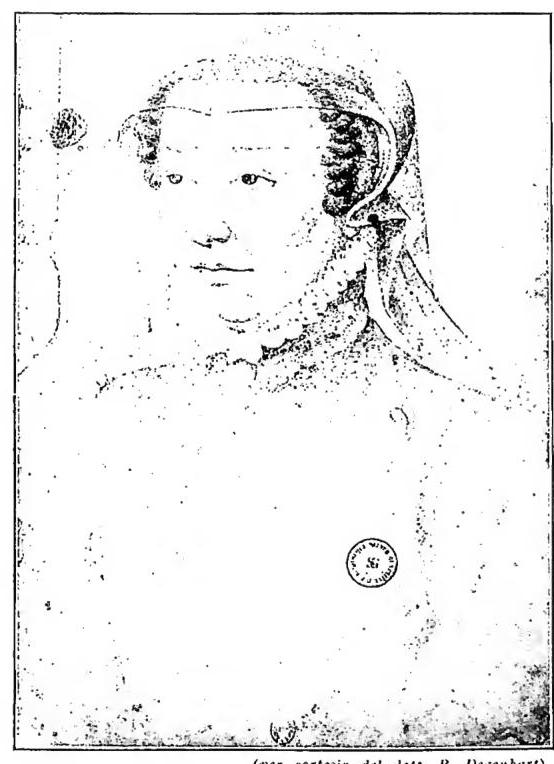
(photograph by Ducate — Genova)
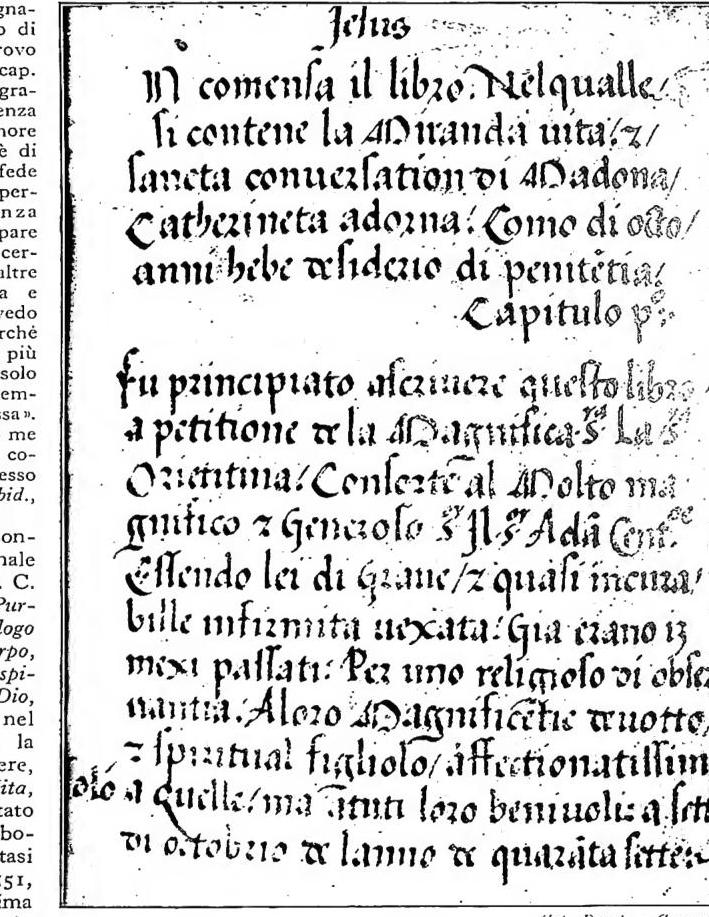
CATERINA da GENOVA, santa — Incipit of ms. A. of the Vita of the Saint, completed on 3 February 1548 — Genova, Biblioteca Universitaria, ms. B. 1.29.
of the book by L. Sertorius, Katharina von Genua. Lebensbild und geistige Gestalt. Ihre Werke, Monaco 1939, based on the work of F. von Hügel, The mystical element of religion as studied in st. Catherine of Genoa and her Friends, London 1908. A fundamental discussion of the Saint’s writings is that of the same p. Umile, a specialist in the matter: L'Opus catharinianum et seu auteur, in Revue d'ascétique et de mystique, 16 (1935), pp. 351–80. Of particular note is the contribution concerning specific subjects promoted in Genova by the Capuchin Friars Minor, publishers of the journal Vita cateriniana (1929–1934) and of biographies and texts, among which may be mentioned: Il Trattato del Purgatorio, with an introduction by p. Valeriano da Finalmanina, Genova 1929; p. Teodosio da Voltri, S. C. da Genova, la grande santa dell'amore, ibid. 1929; p. Gabriele da Pantasina, Vita di S. C. Fieschi Adorno con ricordi e documenti, ibid. 1929; M. Castiglione - Humani, C. Fieschi Adorno, in Frata Francesco, Rome 1941, pp. 199–204; E. Lucatello, La patrona degli ospedali e la patrona delle infermiere, ibid. 1944. Fausta Casolini