
MISERICORDIA. – A moral virtue, a potential part of justice, consisting in feeling compassion for the misfortune of others and being moved to relieve II. The virtue of mercy has in common with charity the fact that both tend toward the good of one’s neighbor; however, the motivating cause is different, since in mercy it is compassion, aroused by the neighbor’s misery, that moves one to relieve him of the evil he suffers, whereas in charity it is benevolence toward the neighbor itself that leads one to desire and procure his good.
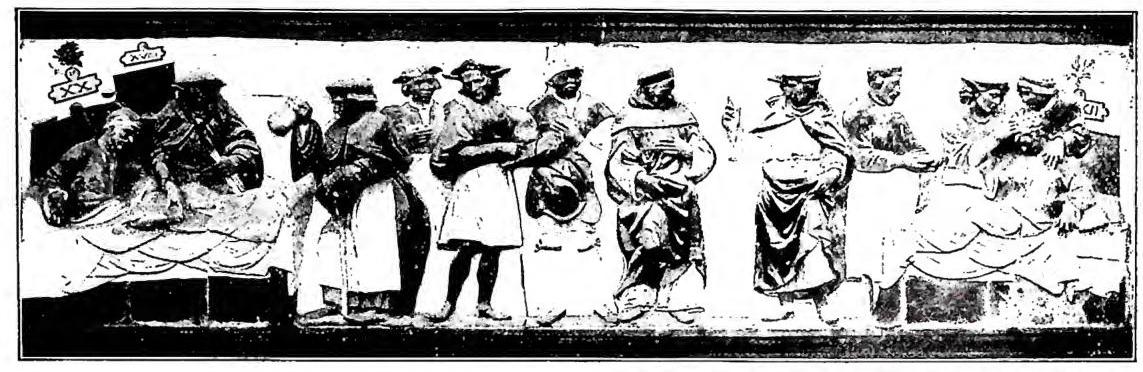
The misery that m. seeks to relieve embraces every kind of suffering or evil affecting one’s neighbor; hence works of m. may be spiritual or corporal. By way of example, the Catechism enumerates 14 of them, 7 for each kind. The corporal works are: 1) to give food to the hungry; 2) to give drink to the thirsty; 3) to clothe the naked; 4) to lodge pilgrims; 5) to visit the sick; 6) to ransom prisoners; 7) to bury the dead (Tob. 6, 12). The spiritual works are: 1) to instruct the ignorant; 2) to counsel the doubtful; 3) to comfort the sorrowful; 4) to correct sinners; 5) to forgive those who offend us; 6) to bear patiently with troublesome persons; 7) to pray for the living and the dead. Among the corporal works of m. must be included almsgiving (v.), understood in the strict sense, that is, a material thing given out of compassion to the indigent in order to relieve them of their misery. The greater the indigence, the more the obligation to help one’s needy neighbor increases; and the greater one’s personal ability to relieve one’s neighbor from the evil in which he lies, the more serious is the moral duty to render assistance.
In extreme necessity and in grave necessity, the obligation is undoubtedly grave; in ordinary necessity, the obligation appears to be slight.
The first six works of m., in the characterization of the individual Gospel statements, entered the iconographic repertoire of Christian art around the year 1000. Their first representation is found on an Ottonian ivory in the British Museum: the cover of the Psalter known as that of Queen Melisende (1050), in which King David performs the six works of m. in the order indicated by St Matthew. A more complete illustration of the Gospel passage is found at Parma, in the exterior decoration of the Baptistery, the work of B. Antelami (12th century), on the portal known as that of the Redeemer. Here, for the first time, the six works of m. form part of a grand allegorical and moral ensemble and, as in the Gospel of St Matthew, are related to the Last Judgment depicted in the lunette and on the architrave. Opposite the works of m. is represented the Gospel parable of the laborers in the vineyard (Mt. 20:1–18), in the Augustinian interpretation of the six ages of man, which in theological writings are often made to correspond to the six works of m. Figures of the Virtues complete the moral teaching. The works of m. are performed by a figure in tunic and mantle who cannot be identified, as some have done, with Christ, owing to the absence of the traditional symbols. Each scene contains admonitory captions. At other times, especially beyond the Alps, the works of m. are related, though simply, to the Last Judgment. Thus at Basel Cathedral (St Gall’s Door, 12th century), in the church of Petershausen at Constance, in a rose window of Freiburg Minster, and in a window in the vestibule of the south tower of Strasbourg Cathedral, where Christ appears as a beggar and says: «Esurivi enim et dedisti mihi manducare... etc.». Even after the Middle Ages, the works of m. retained their character as moral instruction, indicated by their relation to the Last Judgment, as in a window of the church of St Florentius at Niederhasbach in Alsace, in the 15th-century frescoes of the church of St Florentius at Bastia in Piedmont, and, in the later 16th century, in the reliefs of the pulpit of Trier Cathedral (where there is also the very rare representation of the works of spiritual m.). The vitality of this teaching was such that the theme managed to penetrate even into the East, which had never adopted it; with an almost unchanged iconography, the works of m. appear with the Last Judgment in a late-18th-century fresco in the Panaghia Phaneromeni church on the island of Salamis. When they are not linked to the scene of the Last Judgment, they are often represented as deriving from the figure of m. Thus, on the bronze baptismal font of Hildesheim Cathedral, m., represented as a queen on a throne, gives bread to an old man and pours water for a young man; around them are a sick person, a prisoner, a pilgrim, and a poor man who is being clothed. An inscription says: «Dat veniam sceleri per opes inopem misereri», and the prophet Isaiah, who completes the ensemble, holds a scroll bearing the words: «Frange esurienti panem tuum et egenos vagosque induc in domum tuam». A similar scene is also found on a 16th-century carpet in the Musée de Cluny. In the miniatures of the 14th-century parchment codex containing the vernacular adaptation of the Pater mater made by ser Zucchero Bencivenni (Florence, National Library, cod. II-VI-16), m. is a young girl watering a tree (fol. 47), and nearby is the scene of St Martin’s almsgiving, which often symbolized charity in France (the cathedrals of Amiens, Reims, Auxerre, and Chartres). In the Florentine codex, only the scenes of “lodging pilgrims” (fol. 43), “visiting the sick” (fol. 48), “visiting prisoners” (fol. 49), and “clothing the naked” (fol. 52) have survived. At other times, the works of m. symbolize the spirit of charity that distinguished the life of some illustrious person, who is then represented performing acts of piety. Thus St Elizabeth, queen of Germany, appears in scenes of the works of m. in two stained-glass windows in the church of St Elizabeth at Marburg and on the lid of the rich reliquary in the same church (a precious work of Franco-German goldsmithery from 1220), in which, as in the windows, the works of m. are interspersed with episodes from the Saint’s life. The most complete catechetical teaching, however, is found on the portal of the church of St Mary of Health at Viterbo, founded in 1330 as an oratory of the hospice for women who had been rescued from prostitution. Here are represented for the first time the seven works of spiritual m. and those of corporal m., of which the seventh, “burying the dead” (two monks lower a corpse into the grave while an altar boy carrying a cross observes the scene), entered moral instruction, perhaps because of circumstantial factors, well before the 14th century. It was, in fact, practiced chiefly by those institutions (confraternities, hospices, and hospitals) for which charity is a vocation. The theme of the works of m., thus completed, also served to illustrate such charitable activities (an example is offered by the precious illuminated codex of the Hospital of Santo Spirito in Rome, the Liber Regulae S. Spiritus of the 14th century, where the works of m. are represented with greater iconographic freedom because they are related to scenes of hospital life); as such, it continued to appear until very late periods, retaining intact its moral language even when the stylistic forms were differentiated by the individual artists’ imagination.
The six panels with works of m. (including the scene of “burying the dead”) painted by Lorenzo Monaco (Vatican Picture Gallery, nos. 196–201, Porcella catalogue), and the Byzantine-style fresco in Bergamo Cathedral depicting one of the charitable “journeys of the Brothers of m.” (a gentleman and two servants carry bread and drink to naked poor people), will therefore have the same significance; so too the great frescoes by Domenico di Bartolo in the “Pellegrinaio” of the Hospital of Santa Maria della Scala in Siena, with scenes of assistance to the sick and needy; and the seven works of m. painted in the oratory of St Leonard (known as S. Francescuccio) at Assisi, the seat of a confraternity; the 15th-century frescoes of San Martino dei Buonomini in Florence, where the scene of St Martin’s almsgiving is related to the works of m.; and the Robbian terracotta frieze of the Ceppo Hospital in Pistoia, which, with a substantially renewed iconography, Baglioni composed in a popular style while maintaining the ancient Gospel tradition of representing Christ in the poor man and the pilgrim. Finally, there came Caravaggio’s large canvas of the Seven Works of m. for the church of the Pio Monte della m. in Naples; the freedom of its pictorial language and iconography (the original idea of using the scene of the daughter who fed her imprisoned elderly father with the milk of her breast as a symbol of “visiting prisoners” and “feeding the hungry”) does not deprive the theme of any of the charitable stimulus that the Gospel passage has preserved through the centuries. — Vedi tav. LXXI.