
PASSIVE PURIFICATIONS. — In order to remove from the soul the obstacles that oppose full perfection (sins, vices, disordered passions, purely natural tendencies), they mortification (v.): this is active purification.
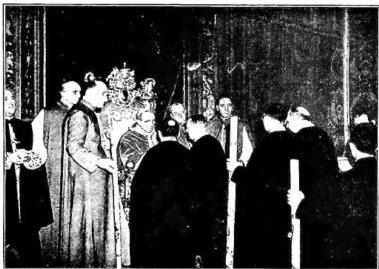
(fot. Felici)
PURIFICAZIONE — Presentation of the candles to Pius XII on the day of the P. (2 February 1952).
the whole complex of its impurities, and strips it radically through a long and most painful purgation: this is the passive p., called by s. Giovanni della Croce “dark night,” which “means the purgative contemplation that causes in the soul, passively, renunciation of itself and of all things” (ibid., prol. to the 1st stanza).
The p. p. is twofold, as the Mystical Doctor explains: “The first night or p. is the sensory one, by which the soul is purified according to the senses, adapting them to the spirit; and the other is the spiritual night or p., by which the soul is purified and stripped according to the spirit, adapting and disposing it for union with God” (ibid., bk. I, chap. 8).
I. P. P. OF THE SENSES. — This is proper to beginners, leading them into the state of the advanced. A twofold element must be distinguished, one negative and the other positive: a) the negative element of the p. p. of the senses is prolonged spiritual aridity, which makes discursive meditation impossible: « They no longer know where to turn the sense of the imagination and the reasoning faculty, because they can no longer take a step in meditation as they used to » (ibid., l. I, cap. 8). b) The positive element of this p. p. is a beginning of obscure mystical contemplation, which reveals itself through a lively desire for God (by which the aforementioned aridity is distinguished from a natural disposition to melancholy); yet « this contemplation is hidden and secret from the very person who possesses it » (loc. cit.). At this point in the interior life, the work of the spiritual director is of the greatest importance: he must reassure the soul, preventing it from turning back in order to resume discursive meditation, which has by now become useless and harmful (s. Giovanni della Croce, Viva fiamma d'amore, str. 3ª, V. 3º, §§ 4-13).
II. P. P. DELLO SPIRITO. - Propria dell'« anima che Dio destina ad una più alta perfezione » (Notte oscura, l. II, cap. 1), la p. dello spirito è separata dalla precedente da un periodo più o meno lungo, durante il quale l'anima gode i frutti della contemplazione oramai abituale (ibid.), ma nella quale si riscontrano ancora imperfezioni notevoli: presuntuosa manifestazione dei propri
doni, vanità ed arroganza, perdita del dovuto rispetto a Dio (ibid., l. II, cap. 2). Alloro subentra, tremenda per i tormenti che porta seco, la p. p. dello spirito « Dio spoglia le loro potenze, affetti e sensi, sì spirituali che sensibili, tanto esteriori che interiori, lasciando nell'oscurità l'intelletto, arida la volontà, vuota la memoria, e gli affetti dell'anima in una somma afflizione, amarezza ed angoscia, privandola del sentimento e gusto che prima sentiva dei beni spirituali » (ibid., cap. 3). Principio operante di detta p. è una contemplazione più penetrante, che manifestando all'anima il contrasto vivissimo che vi è tra la luce e perfezione divina e la sua impurità, le cagiona un dolore indicibile: « Invadendo l'anima questa pura luce per espellerne la impurità, l'anima si sente così impura e misera, che le pare che Dio le sia diventato avversario ed essa nemica di Dio » (ibid., cap. 3). Vero purgatorio, di cui neppure il padre spirituale può lenire il dolore (ibid., cap. 7), che si prolunga spesso per anni.
Prove connesse a quella fondamentale p. sono spesso orribili tentazioni, spirito di bestemmia, scrupoli, perplessità, talvolta, in anime più forti e predilette, pure assalti visibili, con percosse e suggerimenti d'ogni fatta, del diavolo. Tutto tende a far meglio sentire all'anima il proprio nulla onde sperare da Dio solo la Grazia liberatrice. Superando ogni ostacolo, finalmente « l'anima giunge all'unione spirituale del perfetto amore di Dio » (ibid., cap. 14). Allora, dice la ven. Maria dell'Incarnazione, « l'anima nella sua unità e nel suo centro resta, in un amor attuale, negli abbracci dello Spesso, il sovradarabile Verbo Incarnato » (Ecrits Spir., II, Relation de 1654, § LXXVI, V [13° stato di orazione, parte 1°]). V. MISTICA.