TIEPOLO, GIOVANNI BATTISTA

Image from page 76
Image from page 76

TIEPOLO, GIOVANNI BATTISTA. – Painter, born in Venice on 5 March 1696, died in Madrid on 27 March 1770. Son of Domenico, a “parcenevole di vascello” (i.e., co-owner of a merchant ship), and of Orsola; father of Gian Domenico and Lorenzo, likewise painters. Universally recognized as the greatest painter of the 18th century.

As a young man, he studied the rudiments of art under Gregorio Lazzarini. He then trained himself, following the examples of Piazzetta, Bencovich, and Ricci; later, freed from the tenebrous current, he drew especially on Paolo Veronese. A precocious talent, at twenty he exhibited a *Pharaoh Overwhelmed*, which met with great success at the feast of St. Roch. In 1716 he painted for the church of the Ospedale di Sacrificio d’Abramo, still extant. In 1717 he is listed in the books of the painters’ guild; on 21 November 1719 he married Cecilia Guardi, sister of the painters Antonio and Francesco, and had nine children by her. After his early easel paintings, Tiepolo established himself as a great fresco painter; and in more than half a century of prodigious activity he ennobled the art of fresco, which had been reduced to the role of “decorative art,” restoring it to the high artistic level of the golden age of Giorgione and Titian. Already in the ceiling of Palazzo Sandi in Venice, frescoed shortly before 1725, in which he depicted *The Force of Eloquence*, the creative impetus of the young artist is fully evident. A new dramatic inspiration, meticulous study of movement, a lively interplay of light and shadow, reflections, and foreshortenings: these are the elements that reveal his new pictorial language. In those years he frescoed *The Glory of St. Teresa* for the church of the Scalzi, with the help of the quadraturist Girolamo Menogozzi-Colonna (trained in the Bolognese-Bibienesque tradition), who would remain his faithful collaborator until Tiepolo’s departure for Madrid (1760).

In 1726 he was called to decorate the chapel of the Sacrament in Udine Cathedral, and in the documents he is already described as a “celebrated” painter. In Udine he also frescoed (1725–28, perhaps with some intervals) the Archbishop’s Palace, depicting in the staircase *The Fall of the Rebel Angels*, in the gallery various *Stories from the Old Testament*, and in the “red room” a *Judgment of Solomon*; and these frescoes mark a decisive step in the conquest of light, not only for Tiepolo himself but for all painting of the period. In the same period, Tiepolo supplied for the Dolfin Palace in Venice ten large canvases with subjects from Roman history, now divided between the Hermitage in Leningrad (1), the Kunsthistorisches Museum in Vienna (2), and a private collection in New York (3).

Article illustration
(Industrial Photographic Agency)
Tiepolo, Giovanni Battista – *Adoration of the Magi* – Munich, Alte Pinakothek.

---

In 1731 in Milan he frescoed five remarkable ceilings in Palazzo Archinto, all destroyed in the bombings of 1943. The artist worked with incredible speed; and in the same year he decorated the main hall of Palazzo Dugnani (then Casati) with frescoes. These paintings, luminous in color and full of light, earned the artist new commissions. From Bergamo he was invited to decorate the Colleoni Chapel, where in 1732 he painted four allegorical figures in the pendentives of the vault; in the following year he completed the chapel’s decoration, depicting three large scenes from the *Life of the Baptist* as well as a *St. Mark* and a *Martyrdom of St. Bartholomew*. During this first Lombard sojourn, which was nevertheless interrupted by trips to Venice, Tiepolo brought a new spirit to the painting of the region. After working in Venice on various easel paintings, he went to Vicenza and in 1734 frescoed the staircase and main hall of Villa Loschi at Biron. He then returned to Venice, painted the grand frieze of the *Bronze Serpent* for the church of SS. Cosma e Damiano (now in the Accademia), and began the altarpiece with the *Martyrdom of St. Agatha* (installed only in 1747) for the church of the Santo in Padua. During this period he entered into relations with Count Algarotti, to whom he remained closely attached in friendship. Tiepolo’s palette grew still brighter, taking on silvery resonances, abandoning entirely the wavy sense of movement, aiming for a more compact plastic achievement and a greater tension in the line. The King of Sweden, apprised of the new Venetian pictorial star, instructed Count de Tessin, his minister in Venice, to invite Tiepolo to Stockholm to paint the new Royal Palace, but the negotiations failed because the proposed fees were too modest for the artist.

In 1737 he was again in Milan, where he frescoed in the chapel of St. Victor in Sant’Ambrogio a *Beheading of St. Victor* and a *Shipwreck of St. Satyrus* (works now much deteriorated); and it was certainly at this time that he decorated the ceiling of the sacristy of the Masses in the same basilica with a *Glory of St. Bernard*, also destroyed in the bombings of 1943. Between 1735 and ’40 Tiepolo’s art moved toward a new “classicism,” striving to find a new canon of beauty. This is seen in the two immense canvases at Verolanuova with the *Sacrifice of Melchizedek* and the *Fall of Manna*; and above all in the three paintings formerly in the Villa Girola on Lake Como, one of which, with the *Triumph of Amphitrite*, is now in the Dresden Gallery. But in those years he also created works of profound humanity and an absolutely unusual realism for the time, such as the striking *Way to Calvary*, accompanied by a *Flagellation* and a *Crowning with Thorns* in San Alvise in Venice. In these canvases, almost anguished by the sacred themes, Tiepolo abandoned all search for formal beauty in favor of the dramatic sense of Christ’s time: and thus he drew inspiration from Titian and Rembrandt. In the same period, and certainly working on several works simultaneously, between May 1737 (when he undertook it) and October 1739 (when he finished it), he completed the fresco in the ceiling of the Jesuits in Venice, depicting *St. Dominic Instituting the Rosary*.

Invited again to Milan, in 1740 he painted for Palazzo Clerici the stupendous ceiling with *The Olympian Gods*, which marked a new stage in the conquest of “heavenly” painting.

Tiepolo worked intensively in the fifth decade of the century in his native Venice. For the Scuola del Carmine he executed between 1740 and ’43 the ceiling canvases, of which the central one, with the *Virgin of Carmel*, in its shimmering play of light, represents one of his most harmonious creations. For the church of the Scalzi he frescoed (1743–44) the immense ceiling with the famous *Transport of the Holy House of Loreto*, unfortunately destroyed by enemy bombing in 1915. He also painted much for Venetian palaces: he provided Palazzo Barbaro with the ceiling canvas of the *Apotheosis of Francesco Barbaro* (now in the Metropolitan Museum, New York) and four oval overdoors, now dispersed in various collections; he painted for Palazzo Cornaro a beautiful *Allegory of the Spouses* (now in the Contini collection in Florence); and more besides.

But his masterpiece of this period is the decoration of Palazzo Labia, in which, collaborating with Menogozzi-Colonna, he wonderfully frescoed *The Meeting of Antony and Cleopatra* and *The Banquet of Cleopatra*, with other minor scenes in the central hall: an unsurpassable example of joyous and sunlit pictorial illusionism. During this period, Tiepolo left Venice only in 1743, to fresco the Villa Cordellina at Montecchio Maggiore near Vicenza with scenes of *The Generosity of Scipio* and *The Family of Darius*; unfortunately these are now much deteriorated and left by the villa’s owners in complete neglect (the ceiling was transferred in 1919 to the Vicenza Museum because of the villa’s poor condition).

Article illustration
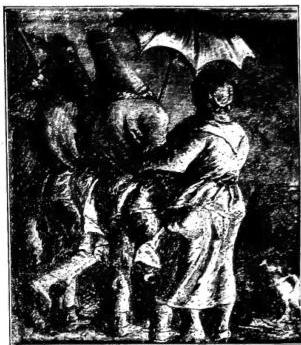
Tiepolo, Gian Domenico – *Clowns under an Umbrella* – Venice, Ca’ Rezzonico.

Repeatedly urged to decorate the Würzburg Residenz, TIEPOLO arrived with his sons Domenico (aged twenty-three) and Lorenzo (fourteen) on 12 December 1750 in the capital of Franconia, where he was splendidly received by Prince-Bishop Karl Philipp von Greiffenclau. During the three years of his German sojourn, honoured with every distinction, he executed in the Kaisersaal the most monumental fresco ensemble then existing—perhaps his absolute masterpiece—comprising on the ceiling Apollo conducting the bride to Barbarossa and on the walls The Marriage of Barbarossa and The Investiture of Bishop Arnold; and in the vast staircase vault an overwhelming Apotheosis of Olympus. He also painted the two large altarpieces for the Residenz chapel (1752) and an Epiphany (1753) for the church of Schwarzach (now in the Munich Pinakothek). Returning to Venice at the end of 1753, he resumed his feverish activity with substantial assistance from his sons; it was probably at this time, or shortly before, that he frescoed the Villa Soderini at Nervesa (destroyed in the war of 1917).

In June 1754 he began, and in August 1755 completed, the ceiling frescoes of the Chiesa della Pietà—one of his most golden, luminous and musical creations. In the autumn of 1755 or spring of 1756 he frescoed the Villa Contarini at Mira, including a Reception of Henry III now in the Musée Jacquemart-André, Paris. In 1757 he was in Vicenza, where—with Domenico’s help—he painted the delightful Villa Valmarana cycle (once wrongly attributed entirely to him and dated twenty years earlier) and the ceiling of the Villa Cordellina. Elsewhere in Veneto he decorated the Villa Pisani at Stra and the Villa Barbaro at Maser; the largest surviving group from these years is the cycle formerly belonging to Baron Sartorio, now in the Museo Civico, Trieste.

Tiepolo also left a small but exquisite corpus of etchings—ten Caprices, twenty-three Fantasy Figures, an Epiphany, a St Joseph and two or three disputed plates, besides a handful of book illustrations and vignettes—works remarkable for the freshness and luminosity of their line and the wit of their inventions.

It is impossible to list here every painted work by Tiepolo. The principal ones include: Hamburg, Kunsthalle: Agony in the Garden and Crowning with Thorns; Angers, Musée: modello for the Villa Pisani ceiling (1760); Arkhangelsk, USSR: Antony and Cleopatra Meeting and Cleopatra’s Banquet; Bergamo Cathedral: Martyrdom of St John the Bishop (1743); Berlin, Museum: Martyrdom of St Agatha; Burano, S Martino: Crucifixion; Castelgomberto, Conte da Schio collection: Ulysses Discovering Achilles (and two pendants) formerly in the Palazzo Sandi, Venice; Chicago, Art Institute: four canvases of Rinaldo and Armida; Dresden, Gemäldegalerie: Infant Mary Presented to the Eternal Father, 1759, formerly at Cividale; Bolzano, parish church: Baptism of the Emperor Constantine, 1759; Frankfurt, Städel Institute: The Crotta Family Saints, 1754; Leningrad, Hermitage: Maecenas Presenting the Arts to Augustus; London, National Gallery: St Maximus and St Oswald; St Augustine and Other Saints; The Marriage of Barbarossa; Count Seilern collection: four modelli for the altarpieces of Aranjuez; Lugano, Thyssen collection: Death of Hyacinthus; Madrid, Prado: Immaculate Conception; Melbourne, National Gallery of Australia: Cleopatra’s Banquet, formerly in the Hermitage; Milan, Brera: Madonna of Mount Carmel; Mario Crespi collection: The Family of Darius before Alexander, modello for the Villa Cordellina, 1743; Rasini collection: Repudiation of Hagar (1717 or 1719, the artist’s earliest known signed and dated work); Treccani collection: Preaching of the Baptist; Mirano, parish church: Miracle of St Anthony of Padua; Munich, Pinakothek: Rinaldo and Armida and Rinaldo Abandoning Armida; Montreal, Museum: Alexander and Campaspe in the Studio of Apelles; New York, Metropolitan Museum: St Tecla (modello for Este); Apotheosis of the Spanish Monarchy (modello for Madrid); Oranienbaum, USSR, Palace: Mars with the Graces, ceiling; Padua, Basilica del Santo: Martyrdom of St Agatha, 1737; Paris, Louvre: Last Supper; Apollo and Daphne; Musée Cognacq-Jay: Feast of Nabal and Abigail; Parma, Pinacoteca: St Fidelis of Sigmaringen; Philadelphia, Johnson Collection: Venus and Vulcan; Rovetta, parish church: All-Saints Altarpiece, 1734; Stuttgart, Staatsgalerie: Apollo, modello for Würzburg; Stockholm, Nationalmuseum: Scipio’s Magnanimity, modello for the Villa Cordellina, 1743; University Museum: Danaë; Turin, Pinacoteca: Triumph of Aurelian; Udine, Museo Civico: Consilium in Arena (in collaboration with Domenico), 1748–50; Venice, Accademia: four mythological canvases, c. 1720–22; Transport of the Holy House of Loreto, modello for the Scalzi, 1743; Invention of the True Cross, formerly in the church of the Cappuccine nuns; Querini-Stampalia Gallery: Portrait of the Procurator Querini; Gesuati church: Madonna and Three Saints; S Staë church: Martyrdom of St Bartholomew, c. 1721; Palazzo Ducale: Neptune Offering the Gifts of the Sea to Venice; Vicenza, Pinacoteca: Immaculate Conception, Allegory of Fame (from the Villa Cordellina), Time Revealing Truth; Vienna, Akademie: Phaethon and Apollo, modello for the Palazzo Clerici, Milan, 1731; Washington, National Gallery: Timoclea and the Commander (formerly in the Palazzo Barbaro, Venice), Apollo and Daphne; Apotheosis of Spain, 1762, modello for Madrid; Würzburg University: Family of Darius and Mucius Scaevola.

Article illustration

Tiepolo’s importance in eighteenth-century European art was immense. Not only in Italy did he have numerous pupils and followers, but also in southern Germany and Austria, and even in Spain—where Goya, who certainly knew his works and admired his Caprices and Fantasy Figures, stands as a witness. Neoclassicism briefly eclipsed his reputation, but it revived with the Romanticism of Delacroix and above all with the Impressionists, who saw in the luminosity and fluent improvisation of Tiepolo’s art a vital precedent. Berenson’s verdict (1894) remains telling: “Tiepolo does not seem the last of the great masters, but the first of the new; the works he left in Spain largely explain the Spanish pictorial renaissance under Goya, who in turn exercised a profound influence on many of the best modern French painters.”

Recent decades of art-historical scholarship have uncovered a new chapter in Tiepolo’s early career, clarified the chronology of his works, disentangled the contributions of his son Domenico, and brought to light the latter’s fascinating artistic personality.

BIBL.: P. Molmenti, *Acqueforti del T.*, Venice 1896; id., *T. e la Villa Valmarana*, 1898; id., *T.*, Milan 1909; E. Sack, *G. B. und Dom. T.*, Hamburg 1910; M. Goering, s.V. in Thieme-Becker, XXXIII (1939), pp. 145–61 (with earlier bibliography); H. W. Hegeman, *G. B. T.*, Berlin 1940; M. Siebertcheva, *I dipinti del T. di Palazzo Dolfin all’Emigge*, Petrograd 1941 (in Russian); G. Lorenzetti, *La pittura veneta del Settecento*, Novara 1942; A. Morassi, *Novità e precisazioni sul T.*, in *Le Arti*, 1942; G. Vigni, *Disegni del T.*, Padua 1942; A. Morassi, *T.*, Bergamo 1943 (2nd ed. 1950); Th. Hetzer, *Die Fresken Tiepolo in der Würzburger Residenz*, Frankfurt am Main 1943; A. Morassi, *T. e la Villa Valmarana*, Milan 1945; R. Pallucchini, *Gli affreschi di G. B. e G. Domenico T. alla Villa Valmarana*, Bergamo 1945; G. Lorenzetti, *Il Quaderno dei T. al Museo Correr di Venezia*, Venice 1946; I. Grabar, *I quadri del T. in Arcangeli e l’autoritratto del maestro*, in *L’Arte*, 2 (1947) (in Russian); G. Vigni, *T.*, Florence 1951; T. Pignatti, *Il T.*, Milan 1951.

GIAN DOMENICO. — Painter, born in Venice on 30 August 1727 and died there on 3 March 1804. He was trained in art by his father Giovanni Battista, with whom he collaborated most faithfully until the latter’s death.

Today, unlike in the past, Gian Domenico is recognized as having a well-defined individual personality, which at a certain point succeeded in producing a more popular kind of painting, suited to the changing tastes of the times and, one might say, less aristocratic than that of his father. He soon showed his sympathy for the illustrative or genre current of Venetian painting; yet in his collaboration with his father he had to subordinate himself to translating the latter’s cartoons or “modelletti” into fresco (and more rarely, onto canvas). Even during his period in Würzburg, at the age of twenty-one, he created works in which his sharp modern flair is already evident; such as those in the Villa Valmarena; and likewise during his Spanish period; and above all after his father’s death. Gifted with inexhaustible inventive spirit, his engravings and his hundreds of drawings—sometimes sarcastic or dramatic, or simply fanciful—would suffice to make him a figure of singular prominence. After his stays in Germany (1751–53) and Spain (1762–70), he settled in Venice; in 1783 he was summoned to Genoa to fresco the ceiling of the Ducal Palace; then he returned to his native city and remained there until his death.

Shortly after 1745 he frescoed in Brescia, in the church of SS. Faustino and Giovita and in the nearby rectory; in ’47 he provided for the church of S. Polo in Venice fourteen stations of the *Via Crucis*; in ’49 he painted in the Villa di Zianigo (where he would fresco again in 1771, 1791 and ’93); in Würzburg he supplied three overdoors for the Residenz; in 1757 he signed and dated the *carnivalesque scenes* in the forecourt of the Villa Valmarena in Vicenza, where he also decorated other rooms; in 1759 he frescoed in Udine the monochrome frieze in the church of the Purità; he is mentioned in the Fraglia pittorica in 1761 and in 1775; on 20 October 1776 in Venice he married Margherita Moscheni, by whom he had two sons; from 1780 to ’83 he served as President of the Accademia.

The study of Gian Domenico Tiepolo’s artistic development has been distorted by the mistaken reading of the date of the paintings in the Villa Valmarena, which were thought to be from 1737 rather than 1757. Yet even in the *Via Crucis* scenes the stylistic differences between his works and those of his father are identifiable.

Article illustration
(Industrial Photographic Agency)
Tiepolo. Lorenzo Baldissera — Lorenzo Tiepolo portrays his mother Cecilia Guardi, his brother the priest Giuseppe Maria, and his three sisters — London, Rosebery Collection.

T. Lorenzetti, *La pittura veneta*, 1898; id., *T. e la Villa Valmarena*, 1898; id., *T.* Milan 1909; E. Sack, *G. B. und Dom. T.*, Hamburg 1910; M. Goering, s. V. in Thieme-Becker, XXXIII (1939), pp. 145–61 (with previous bibliography); H. W. Hegeman, *G. B. T.*, Berlin 1940; M. Siebertcheva, *I dipinti del T. di Palazzo Dolfin all’Emiagge*, Petrograd 1941 (in Russian); G. Lorenzetti, *La pittura veneta del Settecento*, Novara 1942; A. Morassi, *Novità e precisazioni sul T.*, in *Le Arti*, 1942; G. Vigni, *Disegni del T.*, Padua 1942; A. Morassi, *T.*, Bergamo 1943 (2nd ed. 1950); Th. Hetzer, *Die Fresken Tiepolo in der Würzburger Residenz*, Frankfurt am Main 1943; A. Morassi, *T. e la Villa Valmarena*, Milan 1945; R. Pallucchini, *Gli affreschi di G. B. e G. Dom. T. alla Villa Valmarena*, Bergamo 1945; G. Lorenzetti, *Il Quaderno dei T. al Museo Correr di Venezia*, Venice 1946; I. Grabar, *I quadri del T. in Arcangeli e l’autoritratto del maestro*, in *L’Arte*, 2 (1947) (in Russian); G. Vigni, *T.*, Florence 1951; T. Pignatti, *Il T.*, Milan 1951.

---

GIAN DOMENICO. — Painter, born in Venice on 30 August 1727 and died there on 3 March 1804. He was trained in art by his father Giovanni Battista, with whom he collaborated most faithfully until the latter’s death.

Today, unlike in the past, Gian Domenico is recognized as having a well-defined individual personality, which at a certain point succeeded in producing a more popular kind of painting, suited to the changing tastes of the times and, one might say, less aristocratic than that of his father. He soon showed his sympathy for the illustrative or genre current of Venetian painting; yet in his collaboration with his father he had to subordinate himself to translating the latter’s cartoons or “modelletti” into fresco (and more rarely, onto canvas). Even during his period in Würzburg, at the age of twenty-one, he created works in which his sharp modern flair is already evident; such as those in the Villa Valmarena; and likewise during his Spanish period; and above all after his father’s death. Gifted with inexhaustible inventive spirit, his engravings and his hundreds of drawings—sometimes sarcastic or dramatic, or simply fanciful—would suffice to make him a figure of singular prominence. After his stays in Germany (1751–53) and Spain (1762–70), he settled in Venice; in 1783 he was summoned to Genoa to fresco the ceiling of the Ducal Palace; then he returned to his native city and remained there until his death.

Shortly after 1745 he frescoed in Brescia, in the church of SS. Faustino and Giovita and in the nearby rectory; in ’47 he provided for the church of S. Polo in Venice fourteen stations of the *Via Crucis*; in ’49 he painted in the Villa di Zianigo (where he would fresco again in 1771, 1791 and ’93); in Würzburg he supplied three overdoors for the Residenz; in 1757 he signed and dated the *carnivalesque scenes* in the forecourt of the Villa Valmarena in Vicenza, where he also decorated other rooms; in 1759 he frescoed in Udine the monochrome frieze in the church of the Purità; he is mentioned in the Fraglia pittorica in 1761 and in 1775; on 20 October 1776 in Venice he married Margherita Moscheni, by whom he had two sons; from 1780 to ’83 he served as President of the Accademia.

The study of Gian Domenico Tiepolo’s artistic development has been distorted by the mistaken reading of the date of the paintings in the Villa Valmarena, which were thought to be from 1737 rather than 1757. Yet even in the *Via Crucis* scenes the stylistic differences between his works and those of his father are identifiable.

Cathedral: Madonna and St Philip Neri, Madonna and St Jerome Emiliani, 1778; Paris, Louvre, Bossetto for ceiling; Rome, Albertini collection: Nativity of the Virgin, Presentation in the Temple; Carandini-Albertini collection: The Arrival of Abraham and Lot, The Separation of Abraham and Lot (c. 1752–53); Schleissheim, Gallery: Christ in the House of Simon, Last Supper, 1752; Stockholm, Museum: Adoration of the Shepherds, 1754, Presentation in the Temple; Venice, Accademia: Abraham and the Angels, St Francis of Paola, Miracle of the Possessed Man, 1748; Ca’ Rezzonico: frescoes detached from the Villa Tiepolo; Verona, Civic Museum: The Olivetan Saints (from Murano).

BIBL.: In addition to the major works by Molmenti and Sack (see above), there are also brief discussions of Domenico in smaller monographs on the elder Tiepolo. In particular: O. V. Kutschera-Woborsky, *Die Fresken der Purità-Kapelle in Udine und die Kunst D. Tiepolos*, in *Jahrbuch der Preussischen Kunstsammlungen*, 1931; M. Goering, in Thieme-Becker, XXXIII (1939), pp. 159–61; A. Morassi, *Tiepolo e la Villa Valmarana*, Milan 1945; id., *Dom. Tiepolo*, in *Emporium*, 1941; id., *Novità e precisazioni sul Tiepolo*, in *Le Arti*, 1942; M. Pittaluga, *Acqueforti veneziane del Settecento*, Florence 1953.

---

LORENZO BALDISSERA. — Painter, born 18 August 1736 in Venice, died shortly before 8 August 1776 in Madrid; son of Giovanni Battista.

He followed his father to Würzburg and Spain. He is mentioned in 1761 in the register of the Fraglia pittorica of Venice. In 1768 he painted a ceiling in the Royal Palace of Madrid, then numerous portraits of the Royal Family. From 1774 he was embroiled in protracted disputes over payments for pastel works executed for the Royal Family.

Few are the works by L. known to us: a signed drawing in the Rasini collection in Milan; a portrait of Carlo Goldoni used for an engraving, at the Albertina in Vienna; engravings of his father’s works, signed. Likely still unrecorded works include: a pastel portrait, said to depict his wife but more probably his mother, at Ca’ Rezzonico; a drawing of three heads at the Museo alla Spina in Pavia; the painting of the T. family in the Rosbery collection in London; and a preparatory drawing for the figure of the painter in the aforementioned work, in a private collection in Milan. Other attributions made previously carry little weight, and thus the painterly figure of L., which must nevertheless be acknowledged on the basis of the engravings and these few drawings and paintings, of a certain prominence, remains to be clarified. — See plates IX–X.

BIBL.: Sack, op. cit.; Molmenti, op. cit.; S.-Cantón, L. T. pastellista, in Arch. Español, 1 (1925), pp. 229–30; A. L. Mayer, Dipinti di L. T., in Boll. d’arte, nuova serie, 4 (1924–25), pp. 413–22; G. Fiocco, L. T., ibid., 5 (1924–25), pp. 17–28; L. Mayer, Ancora L. T., ibid., 5 (1924–25), pp. 27–41; Lorenzo Zazzaroni, Venezia 1936; M. Goering, s.V. in Thieme-Becker, XXXIII, pp. 161–62; T. Pignatti, in Le Arti, 1951, no. 4; M. Pittaluga, Acquafortisti veneziani del Settecento, Firenze 1953.