
NEOCLASSICISM. — In the broad sense, this may signify any deliberate or programmatic return to expressive forms of classical taste; hence it has been possible to speak of neoclassical moments and tendencies in Hellenistic art, Roman art, Byzantine art, and so forth. In the narrower sense, the term n. denotes the emergence and spread in the visual arts of a particular taste characteristic of the second half of the 18th century and the early years of the 19th, whereby architecture, sculpture, painting, and every other artistic manifestation of a decorative nature reflect an interest in, study of, and consequently deliberate imitation of the forms of ancient classical art, investigated with an archaeological mentality, spirit, and culture; and this principally in accordance with the theories of G. G. Winckelmann and other learned Italian and foreign scholars and aesthetes.
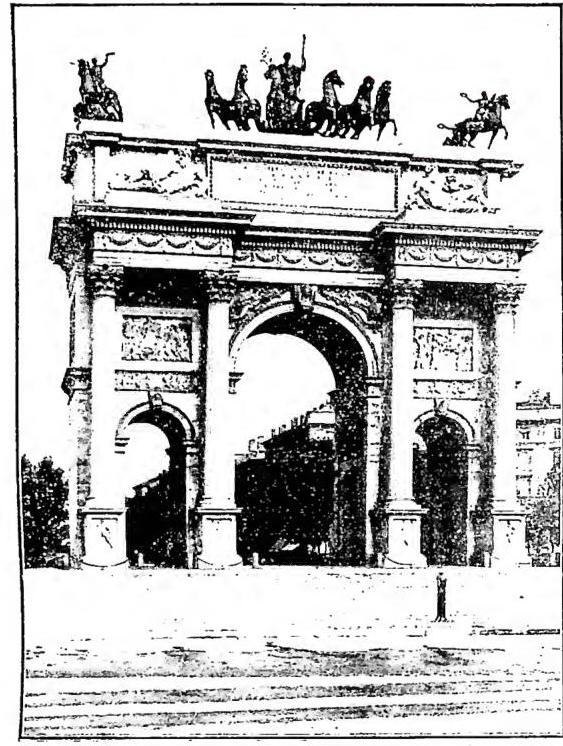
(Alinari photograph)
NEOCLASSICISMO - Arch of Peace by L. Cagnola, with additions by Peverelli and Moglia, inaugurated in 1838 - Milan.
of the Baroque age, which is characteristic of many circles of European culture and art from the first half of the eighteenth century onward. In chronological order, it follows the classicist approximations, almost always resolved through a return to sixteenth-century forms, which spread together with the first affirmations of rationalism in the field of architecture and of veristic naturalism in sculpture and painting, and it precedes, likewise chronologically, those forms that were explicitly purist (v. PURISMO), characteristic of the first decades of the nineteenth century. Among the leading Neoclassical architects in Italy were Michelangelo Simonetti, Pietro Camperese the Elder, Raffaello Stern, authors of the architectural complex of the Vatican Museums, A. Niccolini and P. Bianchi, active in Naples, Pollak, L. Cagnola and L. Canonica, active in Milan, Buonsignore, active in Turin, A. Selva, in Venice, and P. Nobili, in Trieste. In France, in Paris, following the path already indicated by N. Servandoni and G. Soufflot, the following worked in a Neoclassical style: B. Vignon, author of the Madeleine; Brouignart, who built the Stock Exchange; and Chalgrin, the foremost of them, who erected the Arc de l'Etoile. Other French Neoclassical architects were C. N. Ledoux, A. Peyre, C. Percier and P. F. Fontaine. Among the Germans, K. G. Langhaus, author of the Brandenburg Gate in Berlin, K. F. Schinckel, L. von Klenze and F. Weinbrenner deserve mention. The leading Neoclassical sculptors were A. Canova (v.) and A. Thorwaldsen (v.). Among painters, the one who embodied the aspirations of Neoclassicism better than anyone else was the Frenchman J. L. David, followed in Italy also by A. Appiani, V. Camuccini, F. Giani and other lesser figures. - Vedi tav. CXIII.