
CANOVA, ANTONIO. – Sculptor, born at Possagno on 1 November 1757, died at Venice on 13 October 1822. At the beginning of his artistic career he long admired, in Venice, in the rooms of the museum of the Farsetti palace, the plaster collection of ancient statuary; this may be said to have been his first school, in addition to that of the sculptor G. Torretti.
His first patron was the Venetian senator G. Falier, who entrusted him with the commission for two statues: Euridice and Orpheus (1773–76, Asolo, villa Falier); but his emergence into a new form of sculpture, in opposition to the late Baroque, already visible in the group Daedalus and Icarus (1779, Venice, Correr Museum), matured during his stay in Rome with the Monument to Clement XIV, executed when he was twenty-five (1784–87, Rome, church of the SS. Apostoli). Here the Berninian scheme of the Monument to Urban VIII is revived, but the three figures of the tomb: the Pontiff, Temperance, and Meekness possess an Attic simplicity and fully express a religious composure. Shortly afterward, Prince Rezzonico and the two cardinal brothers commissioned C. to create the Monument to Clement XIII. For five years C. worked on the grandiose tomb, which was unveiled in St Peter’s Basilica in the year 1792, on Holy Thursday. Great admiration was aroused by the realism of the two lions guarding the sarcophagus, the classicism of the Genius of Death, the idealism of the allegorical figure raising the Cross, and the expressive power of the aged Pontiff absorbed in prayer. From then until his death, C.’s fame had no rival in Europe. To satisfy his age’s passion for classical mythology, C. revived in his creations: Cupid and Psyche (1794, Paris, Louvre), Hercules Casting Lichas into the Sea (1795–1815, Rome, National Gallery of Modern Art), Perseus (1799–1802, Vatican, Pio-Clementino Museum), the Italic Venus (1805–1812, Florence, Pitti Gallery), Venus Victorious in the guise of Paolina Borghese (1806–1808, Rome, Borghese Gallery), Paris (1812–13, Munich, Old Pinakothek), and the Graces (1813–16, Leningrad, Hermitage), of which group Foscolo, in his well-known poem, desired to be the ideal inspirer.
Also worthy of mention are the numerous stelae: that for Admiral Emo (1792–95, Venice, Arsenal Museum), that for Antonio Zustinian (1797, Padua, Civic Museum), that for Giovanni Volpato (1806–1807, Rome, portico of the SS. Apostoli), and that for Domenico Manzoni (1817–18, Forlì, church of the Most Holy Trinity). The scheme of the slightly tapering stele, surmounted by various crowning elements, is often repeated; in bas-relief, the bust of the deceased,
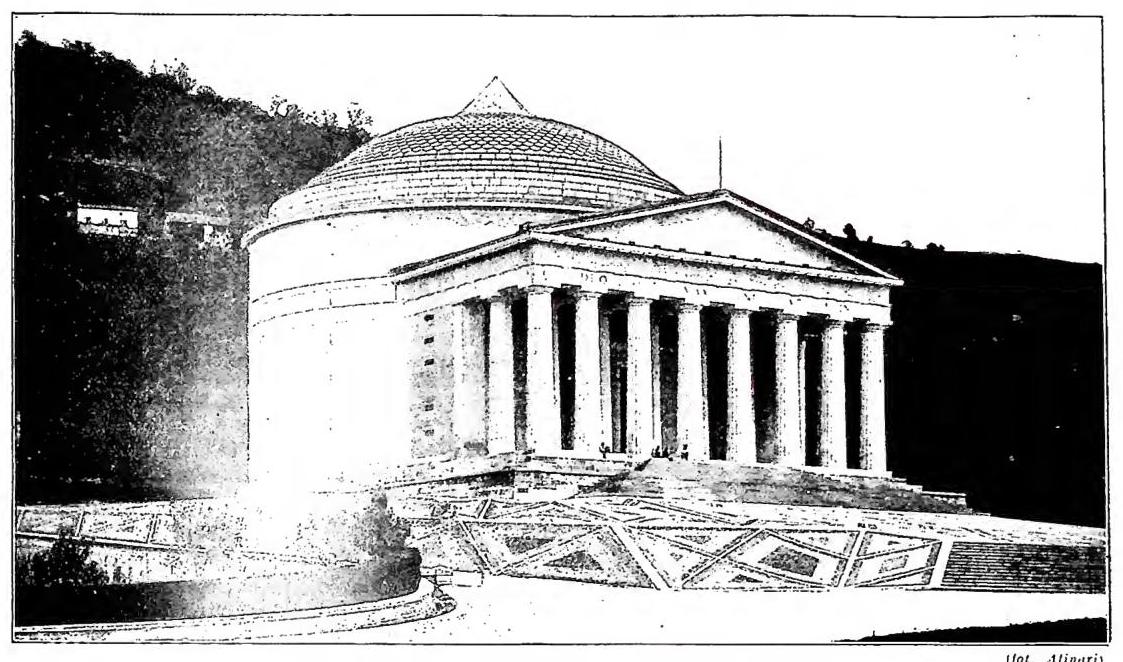
(photo Alinari) CANOVA, ANTONIO – Self-portrait in marble. Possagno. Canovian Temple.
At the repeated insistence of the French ambassador and Cardinal Consalvi, he went to Paris for the first time for the portrait of Bonaparte (1802), a second time (1810), during the exile of Pius VII, for the portrait of the Empress Maria Luigia—in the Diario dictated to Abbot Sartori, his maternal half-brother, one may see his religious consistency and his love for all things Italian—and finally in August 1815 for the negotiations concerning the restitution of the works of art seized from the Papal States. C. overcame the difficulties and resistance; the correspondence with Cardinal Consalvi is interesting in this regard. Within twenty days the restitution took place of the listed statues, paintings, codices, manuscripts, medals, and prints. C.’s name was entered in the Golden Book of the Capitoline, and Pius VII conferred on him the title of Marquis of Ischia and an annual income, which C. devoted to pensions for young artists and to the benefit of the academies. On a design by Pietro Bossi and following suggestions from Antonio Selva, in his final years C. undertook to erect a great temple at Possagno: he himself laid the foundation stone on 11 July 1819, dressed in the habit of the supreme Order of the Knights of Christ. For his church he had painted the great altarpiece The Deposition of Christ from the Cross, and managed to complete several metopes with episodes from the Old and New Testaments and to model the great Pietà in plaster. To religious art he had given one of his masterpieces, the Penitent Magdalene (1796, Genoa, Palazzo Bianco). He died in Venice in 1822; the funeral rites were celebrated by the cardinal patriarch in the Basilica of S. Marco, and the funeral oration was delivered by Leopoldo Cicognara at the Academy of Fine Arts.
His art, which some like to describe as parallel to Foscolo’s poetry, represents the last great voice of Italian art to have moved Europe; in its individuality of forms and spiritual conception it expresses the monumental value of sculpture. Rigid classicism found its representative in Thorwaldsen; C.’s was ultimately a romantic attitude toward classical antiquity, which explains one of the reasons—not the least—for his fascination and genuine greatness. - Vedi Tav. XLV.