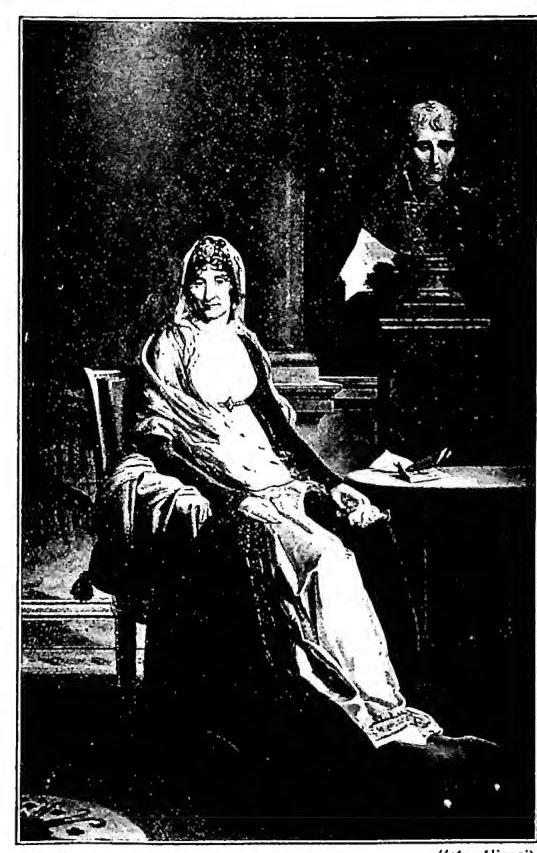
BONAPARTE. — Italian family, descended, according to some, from the Lombard Cadolingi, mentioned in the 11th and 12th centuries; according to others, from a notary B. of Sarzana. In the 16th century, a member of this family moved to Corsica. In Ajaccio, from Carlo (1746–85) Buonaparte (this was the original spelling, changed by Napoleone in 1796 to that of B.) and Maria Letizia Ramolino (1750–1836), Napoleone (1769–1821) was born; he had four brothers: Giuseppe (1768–1844), king of Naples and later of Spain; Luciano (1775–1840), who settled in Rome in 1804 and in 1814 obtained from Pio VII the title of prince of Canino; Luigi (1778–1846), king of Holland and father of Napoleone III (1808–73); Girolamo (1784–1860), king of Westphalia; and three sisters: Maria Anna Elisa (1777–1820), grand duchess of Tuscany and wife of Felice Baciocchi; Maria Paolina (1780–1825), who first married General Leclerc and, after being widowed, remarried Prince Camillo Borghese, and was given the title of duchess of Guastalla; Maria Annunziata Carolina (1782–1839), wife of Gioacchino Murat and queen of Naples. After the fall of Napoleone, Pio VII welcomed several members of the B. family warmly in Rome; this hospitality was viewed with suspicion by the other European powers.
Among the Napoleonids, the following had particularly close contacts with the Church and Italy:
I. CHARLES-LUCIEN B
Prince of Canino, born on 24 May 1803 in Paris, died there on 29 July 1857. Son of Luciano B. and Alessandrina Lorenza Bleschamp, he was taken a few months after his birth to Rome, where his father, having fallen out with his imperial brother, had moved. From an early age he showed a pronounced inclination for the study of botany and zoology. After his marriage to Zenaide B., he travelled to the United States of America, and his frequent scientific expeditions provided him with the material for a work on American ornithology, published in 1832, which earned him a reputation as a scientist. Having published an Iconografia della fauna italica, he played a leading role in the meetings of Italian scientists (the circular for the first Congress, at Pisa, in 1839, bore his signature above those of the other promoters) and took part in all the congresses, up to the eighth, held at Genoa in 1846. After Pio IX’s accession to the tiara, the Prince of Canino was among the most fervent revolutionaries and, if nothing else, morally responsible for the atmosphere of cynical violence that led to the assassination of Pellegrino Rossi. When the republic was proclaimed, he was elected a deputy. After the Pope’s return from Gaeta, he left Rome.Silvio Furlani
II. LUCIANO, LUIGI, GIUSEPPE, NAPOLEONE B
Cardinal, son of the learned and troubled Carlo Luciano, prince of Canino, and of Zenaide, the only daughter of Giuseppe Bonaparte; born in Rome on 15 November 1828 and died there in 1895. His features were remarkably similar to those of Napoleone I, but his character was gentle and charitable. In 1848 he accompanied his father, in the uniform of a volunteer, to the Piedmontese camp; but the unexpected death of his intimate friend Gustavo Spada, who fell on 27 June 1849 on the Gianicolo while fighting against the French, led him to renounce the title of prince of Canino and the palace in piazza Venezia in favour of his brother Luigi Napoleone, in order to devote himself to exemplary religious practices and a highly secluded life. In 1853 he received Holy Orders. Against his will, he became a Secret Chamberlain of Pius IX, but firmly refused the office of grand almoner offered to him by his cousin and godfather Napoleone III; nevertheless, in his honour, the Pope appointed him in 1868 cardinal priest of S. Pudenziana, where he was buried.He was deeply attached to Pius IX. He lavished all his possessions on his relatives and the poor, and was a constant friend of Gioacchino Belli, who, in a significant letter, excused himself from accepting the invitation extended to him by the cardinal to translate the Gospel of St Matthew into Romanesco.
Paolo Dalla Torre
III. NAPOLEON JOSEPH-CHARLES-PAUL B
Born on 9 September 1822 in Trieste, died on 17 March 1891 in Rome. He was the third-born son of Girolamo B., king of Westphalia, and Caterina of Württemberg. Since his father obtained permission in 1823 to reside in Rome, he moved there, but after the disturbances of ’31 he went to Florence, and then to Switzerland. His tutor was Enrico Mayer, with whom he remained lifelong friends. In 1837, after the death of his mother and through the intervention of his uncle Guglielmo, sovereign of Württemberg, he was admitted to attend the military school of Ludwigsburg. Having resigned from the Württemberg army, which he had entered as a staff officer, he was elected in 1848, after the February Revolution, as a deputy to the French Parliament. A republican, he expressed his disapproval of his cousin’s coup d’état of 2 December 1851 and, although designated heir to the throne by the senatus consultum of 7 November 1852, he often professed opinions contrary to those of the emperor. He took part in the Crimean War and in 1859 married the ven. Maria Clotilde, eldest daughter of Vittorio Emanuele II. Senator since 1852. A sectarian anticlerical, on 1 March 1861 he delivered a very violent speech against the temporal power of the popes, asserting that there were only «two possible solutions: the unity of Italy with Rome as capital or the intervention of the reac-