
BELLI, GIUSEPPE GIOACCHINO. - B. in Roma on 7 Sept. 1791, d. in Roma on 21 Dec. 1863. General Valentini, his paternal uncle, was shot in 1798; as a child B. followed his mother in flight towards Napoli. After the fall of the Roman Republic, his father obtained a post at Civitasvecchia. In 1803 B. was orphaned and entered the schools of the Collegio romano. He was then employed in the bookkeeping office of Prince Rospigliosi, and subsequently in that of ecclesiastical estates; later in the state domain, aided by subsidies from Card. Odescalchi. In 1810 he left the state domain with a small allowance, and for three years held the office of secretary in the household of Prince Stanislao Poniatowski. Lodovico Micara, later a cardinal, secured him a room in the Capuchin convent, where he learned English and French and deepened his knowledge of the physical and mathematical sciences.
(phot. Archives Photographiques)
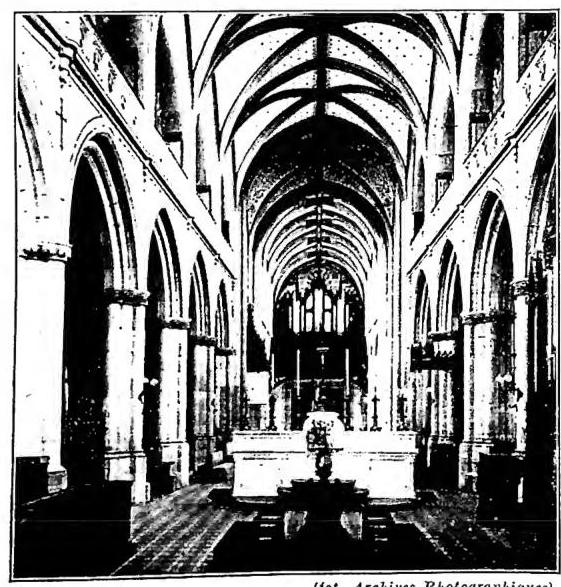
BELLEY - Interior of the cathedral of S. Giovanni, viewed from the choir (late 13th, early 14th century).
BELLI GIUS. GIOACCHINO - BELLI VALERIO
Ida G. G. Belli, Centocentum sonetti..., edited by E. Vergara Caffarelli and G. R. Ansaldi, Roma 1911
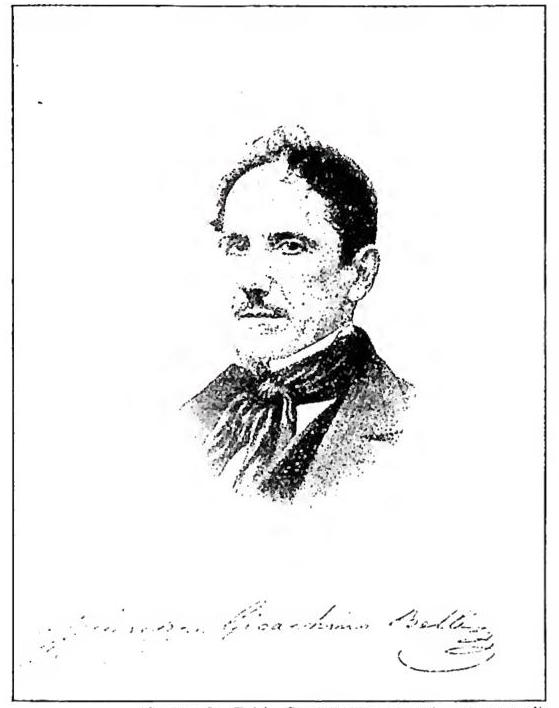
BELLI. GIUSEPPE GIOACCHINO - Photograph with autograph signature. Rome, V. Cianfarani collection.
In 1837 his wife died; he then became more unmanageable and misanthropic than ever: he left the Palazzo Poli, dismissed the servants, and retired to live with some relatives at Via Monte della Farina, no. 11. In 1840 he asked the Pope for a post, obtaining that of assistant in the secretariat of the public debt directorate, and in 1842 that of head of correspondence. In 1848 he deplored the killing of Pellegrino Rossi; the following year, frightened by the revolution, he hurled a sonnet against Mazzini. In 1852 he composed twelve chapters and ten sermons against modern civilization and dedicated them to the editors of Civiltà cattolica. He translated the hymns of the Roman Breviary and composed two short poems in ottava rima on the Passion of Christ. He was a theatrical censor and treasurer of the Conference of S. Vincenzo de' Paoli.
The universal significance of B.’s poetry derives from the classicism with which the author structures the vast fabric of his incisive observations, entering those settings in which the contrast emerges between the sumptuous manner of a genteel tradition and the unprepared, artless attitude of the common people, who attempt to interpret that other noble life, unfamiliar to them, without reverence and without mystery. This new epic asserts itself through its delineation of hundreds of characters and scenes: there are the women of the markets, the craftsmen within the confines of the old city, alternating with ecclesiastics and sovereigns in the biting and bold accents of the vernacular; there is the eternal contrast of great and small passions brought onto the plane of art; a mixture of religiosity and superstition, liturgy and marketplace, reserve and obscenity, sustained by the force of the dialogues, by the spontaneous flow of the hendecasyllables, by the epigrammatic final thrust of the sonnet.
Morandi’s edition of the Sonetti romaneschi (Città di Castello 1886-89) and the unpublished works edited by E. Vergara Caffarelli and G. R. Ansaldi: Centocenti sonetti roma-
neschi, ritrovati e annotati da Pio Spezi (Rome 1944), offer us a very extensive poetic output of more than 32,000 verses; it remains necessary to clarify the meaning to be attributed to the satires, so violent and more often irreverent, against the Pope and the men of the Curia. B. was neither an opponent of temporal power, nor a supporter of Italian unity, nor the fashionable liberal and anticlerical; nor did he experience, as Domenico Gnoli imagined, spiritual crises. His life was that of an academic, faithful to the ideals of classicism, a passionate and patient scholar, a good citizen, a “profound and sincere Catholic,” as the “Osservatore Romano” wrote at his death. The case of B.—a Roman in a toga who experienced the whole pleasure of speaking in the manner of the people—(“a Papa Grigorio je volevo bene perché me dava er gusto de potenne di male”), with all reservations and reproaches concerning his irreligious and immoral “inventions,” must be placed along the line of a genuine literary, rather than moral, conversion, owing to the artist’s concession to his exceptional Romantic and dialectal inspiration. The sonnets are a fact of poetry and not a political fact (S. Negro), a singularly characteristic literary phenomenon, originating in Porta’s poems and in the dialectal vitality of the Roman populace. This explains why B. kept the sonnets to himself, did not publish them, indeed considered destroying them, and at his death entrusted them to a bishop: Mons. Tizzani, chief chaplain of the papal army.