
CIVITAVECCHIA. — The Roman Centumcellae, where Trajan, around A.D. 106, created an artificial harbor, alternately garrisoned by detachments of the Misenate and Ravennate fleets, as the funerary inscriptions testify (CIL, XI, 3520 ff.). At the beginning of the fifth century, Rutilius Namatianus describes the city and its harbor (Itinerarium de reditu suo, I, nos. 237–60). Pope Cornelius (251–53) was exiled in C.
In the fourth century A.D. it was an episcopal see: Epictetus I is attested in 314, Epictetus II in the mid-fourth century, followed by Pascasinus in 487, Molensis in 495–99, and Carosus in 531. In 554 the city was disputed between the Goths and the Byzantines, who, at the time of Gregory the Great (590–604), had the comes Theophanius at the head of the city (Gregorii I Dialog., IV, 27). The bishop of C., Laurentius, is mentioned in a letter of Pelagius I (556–61); Bishop Dominicus subscribed the acts of the Roman Synods of 505 and 601. In 740, Gregory III (731–41) enclosed the city with walls (Lib. Pont., I, p. 421). The city was captured and burned by the Saracens in 813, and most of the inhabitants fled into the woods on the nearby mountains. Paschal I (817–24) enriched the church of St. Peter with gifts (Lib. Pont., II, p. 59). In 821, the bishop of C., Peter, was Paschal I’s legate to the emperor Louis and took part in the Council of Eugenius II in 826. That same year Bishop Leo succeeded him; in 836 there is evidence of a Bishop Peter. At the time of Leo IV (847–55), the inhabitants of C. were still wandering in the Tolfa Mountains (Lib. Pont., II, p. 131).
The Pope then founded a new city about 12 km from the ancient one, in the locality now called Farnesiana. It was solemnly dedicated in 854. Its remains were studied by Lauer; Marucchi pub-
lished a tetrastichic metrical monumental inscription, preceded by the monogram of Pope Leo IV, later held in the Civic Museum. Leo IV also built there the churches of St. Peter and St. Leo, to which he presented gifts (Lib. Pont., II, pp. 132–33). In 1871, the alignment of the streets of Leopoli, its towers and enclosing walls, and the remains of buildings could still be recognized on the ground (A. Guglielmotti, Storia della marina pontificia, I, Rome 1871, p. 67). In 856–61, Dominicus was bishop of C.
During the Saracen destruction, the monastery of St. Mary at the Mignone, owned by the abbey of Farfa, was also ruined (Regest. Farf., no. 49); it was later rebuilt by Abbot Ratfredus between 930 and 936.
After Pope John VIII’s victory over the Saracens near Cape Circeo in 877, the inhabitants began returning to the shore, and among the ruins of the ancient city there was rebuilt, in 889, the settlement that was called Civitas Vetus, Vecla, Veggia, Vecchia, C., where the population was definitively reestablished on the 15th of that year. It was, however, rather a fortified castrum near the harbor. Between 940 and 950, its bishop was Valentinus; in 963, Adalbert, son of King Berengar, landed there. Disputes then arose over possession of C. between the monastery of Farfa and the Roman monastery of SS. Cosmas and Damian (P. Fedele, Le carte del monastero dei SS. Cosma e Damiano, in Archivio della Società romana di storia patria, 21 [1898], p. 459 ff.; 22 [1899], p. 25 ff.; 383 ff.); they were settled in favor of Farfa at the Lateran in 1072 under Alexander II. Meanwhile, Bishop Azzone of C. had taken part in the Roman Synods of 1037 and 1050. An inscription of 1093 mentions a Richard, bishop of Tuscania, Centocele, and Bieda (S. Campanari, Tuscania e i suoi monumenti, II, Rome 1856, p. 25). A fierce struggle then arose over possession of C. between Guido, bishop of Tuscania, and Alberico, bishop of Sutri. Innocent II (1130–43) granted C. as a benefice to Petrus Latronis. In 1167, C. was attacked by Frederick’s army under the command of the chancellor Rinaldo, archbishop of Cologne, and Petrus Latronis assumed its defense. In 1192, Celestine III united C., Tuscania, and Bieda with the see of Viterbo. On 9 December 1224, the people of C. offered Honorius III full jurisdiction over the city. In 1265, Clement IV granted the castrum to Giovanni di Vico, prefect of Rome. But in 1291, Nicholas IV placed C. under the direct authority of the Apostolic Chamber. Eugenius IV resided in the fortress in 1434 and issued, in favor of the city, two constitutions dated 1432–41, granting exemptions from taxes and promoting agriculture. Nicholas V (1447–55) had the fortress restored and in 1451 declared C. a free commune with its own statutes (C. Calisse, Statuti della città di C., in Studi e documenti di storia e diritto, 6 [1885], pp. 109–37).
During the pontificate of Pius II (1458–64), in May 1462, the Paduan Giovanni de Castro discovered a rich alum mine at Tolfa (Pastor, II, pp. 224–25); by 1463, 8,000 workers were already employed there. It is estimated that the discovery secured for the papal treasury an annual revenue of 100,000 ducats (G. Zippel, L'allume di Tolfa e il suo commercio, in Archivio della Soc. rom. di st. patria, 30 (1907), pp. 5 ff., 389 ff.).
Pius II had further restoration work carried out on the fortress between 1461 and 1463; additional work was also undertaken at the harbor under Sixtus IV (1481). In 1508, Julius II laid the foundation stone for the new fortress, designed by Bramante, subsequently continued by G. Leno and A. da Sangallo, and completed by Michelangelo. Sixtus V (1585–90) had the aqueduct built by G. Fontana; Clement VIII (1592–1605) restored the harbor and the outer breakwater, works commemorated on the medal of 1604; Paul V (1605–21) had warehouses built; Urban VIII (1623–44), after further work on the harbor, walls, and aqueduct, established the port’s exemptions in 1630. Innocent XII (1691–1700) repaired the aqueduct and restored the office of governor of the city, together with a municipal administration; Benedict XIV (1740–58) had further work carried out at the harbor.
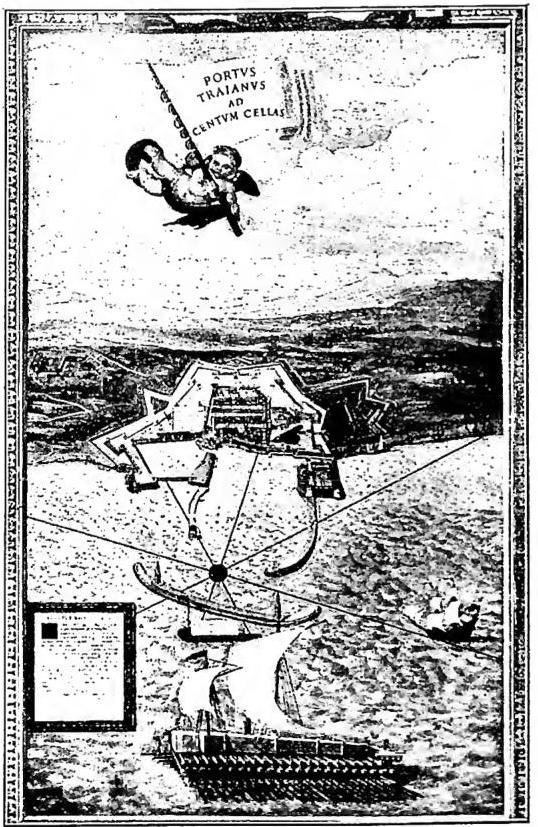
(phot. Anderson)
CIVITAVECCHIA - Porto di C. Affresco di Ignazio Danti (1580-83). Vaticano, galleria delle Carte geografiche.
Nel 1814 viene restaurato il governo pontificio; Leone XII il 20 dic. 1825 ricostituisce la diocesi, riunendola con Porto e S. Rufina; il 28 genn. 1828 viene fondato il seminario. Gregorio XVI (1831-46) ingrandì le mura della città; nel 1849 avviene lo sbarco delle truppe francesi. Nel 1850 è riunita mediante « la via di ferro » a Roma; il 23 luglio 1854 il papa Pio IX distacca la diocesi di C. da Porto e S. Rufina e la unisce a Corneto Tarquinia. Il 16 sett. 1870 viene occupata la città dall'esercito italiano e C. è annessa al regno d'Italia. I martiri Veriano, Marcelliano e Secondiano secondo la leggenda sarebbero di Tuscania (BHL, 7550; Martyr. Hieronymianum, p. 430); un altro testo li fu martiri di C. (Acta SS. Augusti, II, Parigi 1867, pp. 401-407). Patrona della città è s. Firmina.
Oltre al gruppo di iscrizioni cristiane riportate nel CIL, XI, 3567-71, della quale una del 516 ed una del 557, altre si rinvennero nel 1919 nella contrada « Polveriera » appartenenti ad un'area cimiteriale, all'aperto (R. Mengarelli, Iscrizioni etrusche e latine rinvenute nel territorio di C., in Notizie degli scavi, 1919, pp. 216-231; le iscrizioni cristiane sono ai nn. 263, 264, 267, 269, 273). Un'iscrizione giudaica fu rinvenuta nel sepolcreto romano lungo la via Aurelia in contrada « Pozzolano » (ibid., p. 225, n. 281). Di C. sono il p. A. Guglielmotti (1812-93) e C. Calisse (1859-1945).
Per i dati della diocesi: V. TARQUINIA.