Machine translation of the 1948–1954 Italian original. The original text is authoritative.
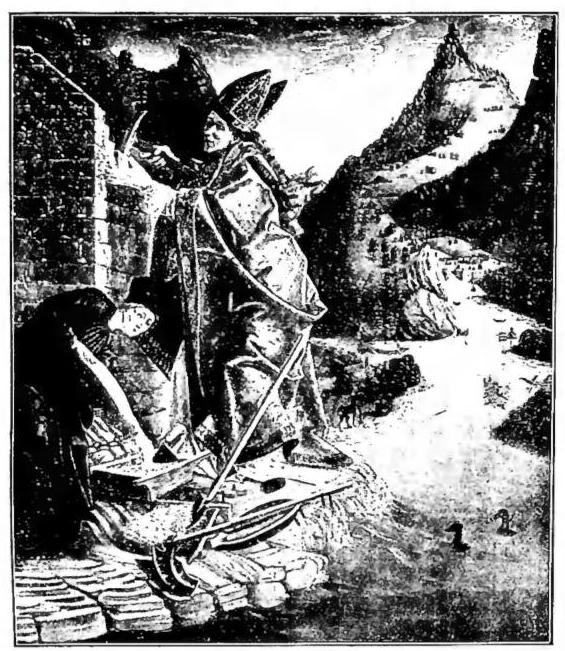
VOLCANO. - Behind the figural type conforming to the conventional Hellenistic Hephaistos, traces of an archaic Roman divinity can be discerned in the Roman V. VOLFANGO, santo - S. V. Chapel, according to legend, by forcing the devil to help him. Detail of a wing of the altar of s. V., painted and carved by Michael Pacher (1471-81) - St. Wolfgang. (courtesy of Dr. B. Degenhart)In fact, his cult in Rome is extremely ancient: his festival, Volcanalia, appears in the oldest calendar (Aug. 23); he had his own specific priest (flamen Volcanalis) since the time of the oldest Roman priestly organization; his open sacred enclosure, the Volcanal, was considered to have been founded by Romulus. His relations with fire seem very ancient; animals, particularly fish, were sacrificed to him, thrown alive into the fire. In myths of a clearly Italic character, he appears as a divine progenitor present in the hearth (Servius Tullius) or in any case in fire (Caeculus, founder of Praeneste); he also appears as the father of Cacus, known from Roman poetry as a fire-vomiting monster, but more anciently as the male counterpart of the goddess Caca, whose relations with fire are documented in cult. In the collective lectisternium of 217 B.C., V. Vesta. Other elements of his cult emphasize a connection with the sun: thus the open-air place of worship where sacred objects struck by lightning were exposed to the sun's rays. In the Volcanalia festival, which was so popular that it survived well into the Christian era, there was the custom—as documented by a Christian author himself, Paulinus of Nola—of spreading out garments in honor of the Sun. Another sanctuary of V., mentioned from 214 B.C. onward, was located in the Circus Flaminius, outside the pomerium, just as the Volcanal itself was with respect to the Palatine pomerium. Linked to V. is the cult of the goddess Maia (eponymous of the month maius, May?), to whom the flamen Volcanalis presented a sacrifice on May 1st. The name of V. Zeus, velchanos.
BIBL.: W. Warde Fowler, Roman festivals, London 1899, p. 209 ff.; G. Wissowa, Religion und Kultus der Römer, 2nd ed., Munich 1912, p. 229 ff.; id., in W. Roscher, Ausführliches Lexikon für klassische Mythologie, VI, col. 356 ff.; J. Carcopino, Virgile et les origines d'Ostie, Paris 1919, p. 87 ff.; F. Altheim, Griechische Götter im alten Rom, Giessen 1930, p. 172 ff.; M. Guarducci, in Scritti in onore di B. Nogara, Città del Vaticano 1937, p. 183 ff. Angelo Brelich
Cite this article
“VOLCANO.” Enciclopedia Cattolica, vol. XII (1954), p. 989. Azione Romana digital edition, https://azioneromana.com/article/volcano.