
TARSIA. — A craft practice consisting in joining on a surface fragments or thin sheets of differently colored woods in order to obtain effects similar to those of woodcut or painting, also through the use of black mastic in the joints; individual elements are put into place on the basis of a design featuring ornamental motifs or figures.
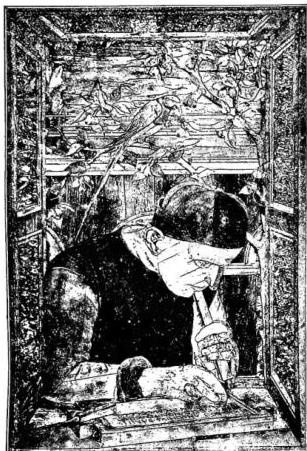
(courtesy of Dr. B. Degenhart)
TARSIA – Intarsia artist. Attributed to Antonio Barile (1502). Vienna, Österreichischer Museum.
of the Holy Sepulchre). Among the most distinguished masters were the brothers Giuliano and Benedetto da Maiano. The former collaborated with Francesco di Giovanni, known as il Francione, in the Hall of Lilies in the Palazzo Vecchio, depicting, among other things, the figures and works of Dante and Petrarch; he executed the exceedingly beautiful choir stalls in the cathedral of Pisa and joined Domenico del Tasso in exquisitely adorning the choir of the cathedral of Perugia.
Later, Tuscany saw the flourishing of the inventions of Giuliano da Sangallo, son of the intarsia artist Francesco di Bartolo Giamberti, of the Pistoian Ventura Vitoni, and of Baccio d'Agnolo, together with his sons Giuliano, Filippo, and Domenico. Another notable master of central Italy was Domenico d'Antonio Indivino da Sanseverino, who decorated the choir stalls of the upper basilica of S. Francesco in Assisi. In the Palazzo Ducale of Urbino, the Florentine Baccio Pontelli probably executed, around 1480, under the direction of Francesco di Giorgio Martini, admirable works for the doors of several rooms and for the celebrated studiolo of Duke Federico da Montefeltro, where still lifes, geometric and vegetal motifs, ingenious perspectives, and allegorical figures—including the three theological Virtues—stand out, apparently based on designs by Sandro Botticelli. In northern Italy, the Modenese Bartolomeo dei Polli excelled, working in the choir of the Certosa of Pavia from designs by the painter Ambrogio Borgognone, and above all the brothers Lorenzo and Cristoforo Canozi da Lendinara, who introduced the use of artificially colored woods, thereby multiplying the chromatic effects of intarsia, and left works of solemn Piero della Francesca-like character in the cathedral of Modena (panels with figures of the four Evangelists) and in the Basilica del Santo in Padua (1462–69). Their innovation was cultivated in the 16th century with seductive ornamental fertility by fra' Giovanni da Verona and fra' Damiano da Bergamo, both trained in Venice in the school of fra' Sebastiano da Rovigno. To the former belong the magnificent intarsias in the choir of the monastery of Monteoliveto (1505) and in the church of S. Maria in Organo at Verona; to the latter, those of the doors of S. Pietro in Perugia (1535) and of the choir stalls of S. Domenico in Bologna (1541–49).
Among the decorative resources of these masters, who raised pictorial virtuosity to its highest degree, noteworthy are views of buildings and streets with panoramic aims, in which an attempt is made to obey the laws of aerial as well as linear perspective. Also remarkable for their figurative complexity are the intarsias executed in the choir of S. Maria Maggiore in Bergamo (c. 1530), from cartoons by the painter Lorenzo Lotto, by Gian Francesco Capodiferro of Lovere, a pupil of fra' Damiano da Bergamo. With the advent of Mannerism, wooden intarsia was replaced in furniture for private use by inlays of hard stones, while sacred furnishings became weighed down with massive projections, hardly compatible with the linear polychromy of the Renaissance.
Only during the Rococo period did intarsia flourish again, chiefly in France, owing to the great cabinetmakers Andrea Carlo Boulle, Carlo Cressent, Riesener, and others, who knew how to use the most precious woods, together with metals and tortoiseshell flakes, for surface inlays rich in chromatic refinement and fanciful arabesques. Venetian cabinetmakers in Italy were influenced by them. Toward the end of that century and during the first decades of the nineteenth century, after the meticulous virtuosity of the Piedmontese Pietro Piffetti, the Lombards Giuseppe and Carlo Francesco Maggiolini, of European renown, impressed an original mark with their restrained ornamentation for furniture decorated with landscape and floral motifs. In the last century, the sporadic intarsia artists limited themselves to reproducing the figurative repertory of past ages, and a certain revival of taste was recorded in the final decades together with the progress of wood engraving, as demonstrated by the panels with Neo-Renaissance motifs prepared by Edoardo Del Neri for the Casa Madre dei Mutilati in Rome. – Vedi tav. CXXVIII.