
TARRAGONA, ARCHDIOCESE of. – Metropolitan see and capital city of the province of the same name in Spain. It has an area of 2,394 sq. km. and a population of 215,000 inhabitants, all Catholics, distributed among 151 parishes, served by 220 diocesan priests and 44 religious priests; it has 2 seminaries, 12 men’s and 65 women’s religious communities (Ann. Pont. 1953, p. 418).
Its suffragan dioceses are Barcelona, Gerona, Lérida, Solsona, Tortosa, Urgel, and Vich. The patroness of the archdiocese is the Blessed Virgin under the invocation of her Nativity. Feast: 18 September. An Iberian center called Cullipolis, it was inhabited in the sixth century B.C. by the Ilergetes. In the battle of Cissa, Scipio defeated the Carthaginian Hannibal; from then on the city was called Tarraco by the Romans and in 16 B.C. Augustus raised it to the status of a colony (Inlia Victrix Triumphalis) and made it the capital of Hispania Tarraconensis. From then on, as the seat of the imperial legate, the city flourished increasingly as an agricultural and commercial center. Its wine was renowned (Martial, 13, 118). Its Roman ruins are imposing: the amphitheater, partly excavated in the rock; the Palace of Augustus, or Roman praetorium; the Roman theater; the Roman aqueduct, etc. It was devastated by the Franks in 264, then destroyed by the Goths in 460, occupied by the Moors in 714, subsequently conquered by Louis of Aquitaine and Ramon Berengario, but again retaken and plundered by the Moors; it was finally occupied by Alfonso the Battler in 1220. It rose in revolt in
The see of T. was represented in 314 at the Council of Arles by the presbyter Probatius and the deacon Castorius; then by Imerius in the time of Damasus and Siricius; Ascanio in 465; Giovanni, who convened the first provincial Synod at T. on 6 November 516 and another at Gerona in 517; Sergio, who was present at the Council of Barcelona in 535 and at that of Lérida in 546; then Tranquillino, about 560; Artemio, who sent Stefano to the Third Council of Toledo and attended the provincial Synods of Saragossa in 599 and of Barcelona; Eusebio (610–32), who was present at the Council of Egara; Audace (633–38), who attended the Fourth Council of Toledo, while Protasio (637–46) was present at the Sixth and Seventh Councils and also sent his delegates to Toledo for the Thirteenth, Fourteenth, and Fifteenth Councils; Vero attended the Sixteenth and Seventeenth. The Muslim invasion then took place under his successor Giorgio. Louis the Pious managed to occupy the city briefly; part of the territory passed under the diocese of Barcelona, while the metropolitan rank passed to Narbonne, until 759. Berengario di Rosanes, bishop of Vich, secured the reconquest of T. in 1116 through the action of Ramon Berengario III the Great, and Pope Urban II conferred on him the pallium and appointed him archbishop of T.; the same honor was conferred upon his successor, St. Oldegario, bishop of Barcelona. He took part in the Councils of the Lateran (1123) and Clermont (1130) and died on 6 March 1137. He was succeeded by Gregorio, formerly abbot of Cuscane; later came the archbishops Aspargo Barca, Pedro Zagarriga, Augustin (1576–86), A. Perez (1634–37), and F. de Armanya y Font (1785–1803).
The Cathedral was built between 1171 and 1331 on the hill where the temple of Jupiter Capitolinus originally stood and where a mosque was later erected. It constitutes one of the finest examples of Gothic art; its sturdy Romanesque apse resembles a fortress. Then, at the beginning of the thirteenth century, under the direction of Brother Bernardo (d. 1256), construction continued in the Gothic style; later Flamboyant Gothic was introduced, followed by the Plateresque and Churrigueresque styles, as in the side chapels added between the sixteenth and eighteenth centuries. It measures 104 m. in length; the naves are 30 m. wide, with a transept measuring 45 by 15 m., surmounted by an octagonal dome 28 m. high. The Romanesque bell tower at its base was continued in the fourteenth century and, although unfinished, reaches a height of 65.40 m. The Gothic façade is approached by a broad flight of steps. The portal, begun in 1278 by Master Bartolomeo, known as the Norman, depicts the Virgin among the Apostles; other statues were added later by Giacomo Castalis (1475); the finely worked doors date from 1510. The two arms of the transept are illuminated by two rose windows with artistic stained glass dating from 1574, much restored.
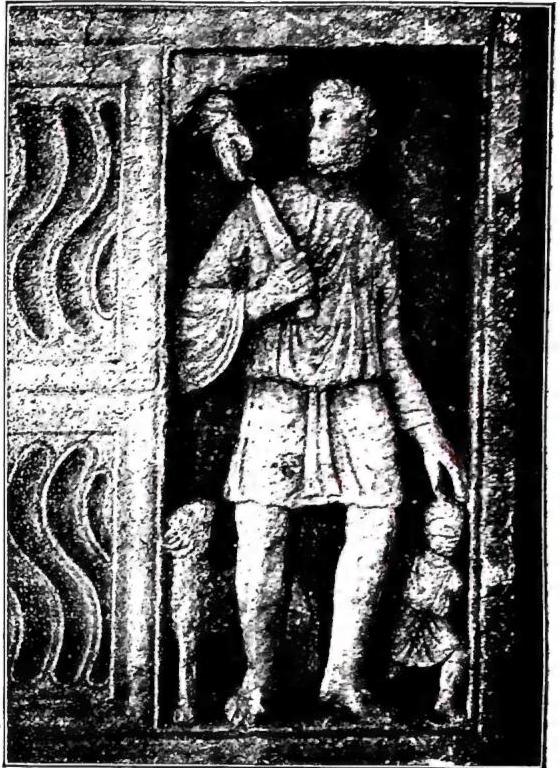
TARRAGONA, ARCHDIOCESE of. – The Sacrifice of Isaac. Detail of the sarcophagus of Eleuterio (fifth century), from the early Christian necropolis of S. Fruttuoso – Tarragona, Museum of Early Christian Art.
In the left nave, the chapel of St. Francis contains the tombs of the archbishops Teres (d. 1603) and Lopez Pelaez (d. 1918); the chapel of Monserrato, in the Flamboyant Gothic style, was erected by Cardinal Pedro De Cardona, who is buried there (d. 1530); it also contains the tomb of Archbishop Costa y Borras (d. 1864). In the chapel of St. Thomas, likewise in the same style, is the tomb of Archbishop Felix y Solans (d. 1870); the artistic retable on the altar is the work of M. Ortoneda and comes from Solivella.
The cloister is entered through a Romanesque portal, as are the ambulatory passages with their light ogival vaults and decorated, carved capitals; some represent the “procesión de las ratas” (the rats burying the cats). On the southern side are fragments of the temple of Jupiter Capitolinus and an Arab arch bearing an inscription dated to the year 349 of the Hegira (that is, A.D. 960), belonging to the door of the mihrab of the ancient mosque. Farther on is the chapel called the Corpus Christi, formerly belonging to the Chapter and now a section of the Diocesan Museum containing retables from the fourteenth and fifteenth centuries, paintings, liturgical goldsmithery, etc.; on the northern side of the cloister is the chapel of St. Mary Magdalene; farther on are remains of the Roman orx, the chapels of N. Señora del Claustro, with a much-venerated statue of the Blessed Virgin from the fourteenth century, of St. Tecla (1535), and of N. Señora de las Nives.
The ancient convent of S. Francesco was partly converted into government offices and partly into a school; the Jesuit College was used as a barracks, as were the convents of the Mercedarians and the Carmelites, which were likewise put to military use. Near the Diocesan Museum are the Diocesan Archives and the Chapter Hall, with a fifteenth-century tapestry called «de la Buena Vida», Renaissance retables, sacred furnishings, missals and antiphonaries, and 52 tapestries from the fifteenth to the seventeenth centuries. On the ruins
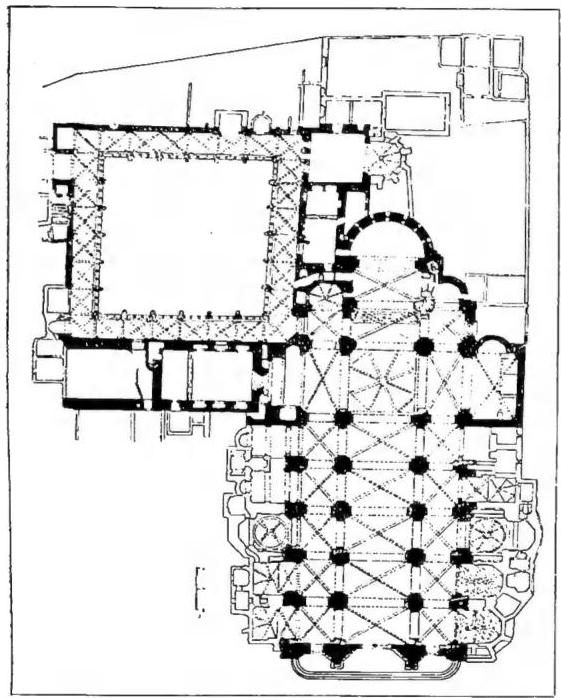
(from Ars Hispaniae, V. Madrid 1918, fig. 165)
Near the sea, in the Roman amphitheatre, «el Milagro» was established by the Knights Templar; it then passed to the Trinitarians and was subsequently converted into a penitentiary. In the fishermen’s quarter, the church of S. Pietro was erected in 1878. Near T. is the «hospital de l’Infante» for pilgrims, built in the ogival style in 1341.
The Provincial Archaeological Museum contains the most interesting collection of Roman and medieval antiquities in Spain after that of Madrid, including surviving fragments from the monastery of Poblet, while the Provincial Library contains volumes, manuscripts and incunabula from the monasteries of Poblet, S. Creus, Scala Dei and Escornabbón. The Real Sociedad Arqueológica Tarraconense, founded in 1845, has its headquarters there; since 1901 it has published its Archaeological Bulletin.
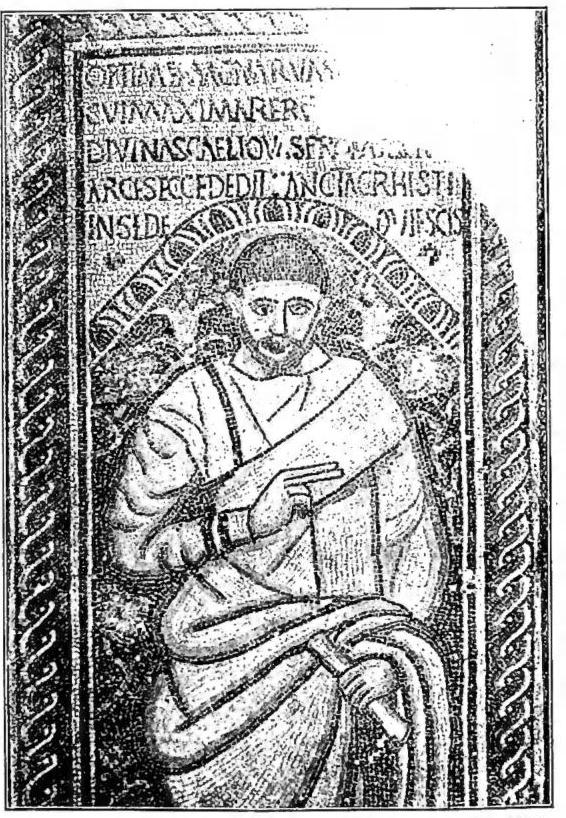
A large Christian cemetery situated south of the city was discovered in 1923; it had been partly plundered by seekers of marble and sarcophagi between the twelfth and thirteenth centuries. From the systematic exploration carried out by the Rev. J. Serra Vilaró from 1926 onward, it appears that eighteen different forms of burial were used in this cemetery; some of the deceased were placed in a pit in the ground inside a wooden coffin, which was then covered with fragments of amphorae and earth. In other cases, the pit in the ground was lined with tiles or slabs, or with stones and mud, or stones and lime; sometimes the covering was made of tiles arranged with two slopes (a cappuccina); very frequently, burial took place inside whole amphorae from which the narrow terminal part had been removed, or in pieces of amphora joined with lime; some pit graves were lined inside with white or red plaster and covered either with slabs or tiles arranged with a double slope, or with horizontal stone or marble slabs. There are many stone or marble sarcophagi; some are carved with pagan subjects, others simply have a strigilated front; some sarcophagi were made by hollowing out blocks taken from earlier buildings; a few lead sarcophagi were also found. All the sarcophagi were buried underground; some graves had a small mound projecting above ground, consisting of a stone packing 2 m. × 1 m. with sloping side walls to prevent water infiltration. The surface of this layer was smoothed and decorated in white or red; in some graves the mound reached dimensions of 3.50 m. × 3 m., with a high step 0.35 m. high. Near these mounds, bones of domestic animals, oysters and remains of other foods were collected, as well as fragments of glass and earthenware vessels. One grave also has a table in the form of a klinē, as in certain tombs at Rome and on the Isola Sacra. In some tombs, a marble inscription was fixed into the mound; in the richer ones there were mosaic decorations and epitaphs. One displays a toga-clad figure, another the Good Shepherd, and another a floral and geometric design. The corpse was often laid above a layer of quicklime; traces of clothing and gold threads, needles, and bone and metal buttons have been found. Two larger chambers were constructed with large quadrangular stone blocks, with a cross-vault and three arcosolia inside. A great deal of funerary equipment was discovered, such as earthenware vessels, lamps, and even an articulated ivory doll.
The basilica discovered in this cemetery had three naves and a semicircular apse; graves were arranged beneath its floor. Fragments of Christian inscriptions were identified among the material used in its construction; one of the side walls was built above a row of sarcophagi. The evidence provided by the exploration indicates that this building was the basilica erected after the devastation of 409 over the tombs of the martyrs of T. in 259, namely the bishop s. Fruttuoso (v.) and his deacons Augurio and Eulogio. The cemetery area subsequently developed around their tombs.
The epigraphic syllogae have transmitted the funerary poems of the bishops Giovanni and Sergio of the sixth century (G. B. De Rossi, Inscriptiones christianae, II, Roma 1888, p. 294). The epitaph of an Euticius, presbyter of the «civitas Albitana» near T., is also known. The inscription of a Marturia, with 4 and 2, contains the date of the year 393 and the acclamation «vivas cum beatos»; that of a Pientia, dated to the year 415, bears an incised cross; that of a «vir honoratus Aventinus» gives the dates of the years 421 and 461, while two others give respectively the dates of the years 471 and 503. Among the formulas are remembered: «in sanctorum sede quiescis; sancta Christi in sede quiescis», and «sperana resurrectionem a Domino».
Among the ancient monasteries, mention should be made of that of S. Creus, founded by Ramon Berengario IV for the Cistercians and abandoned in 1885; its monumental entrance leads to a courtyard with the fountain called that of S. Bernardo; on the right are the Abbatial Palace and a small cloister from 1625. The church, divided by pillars into three naves, was begun in 1174 in the Romanesque style and completed in the Gothic style in 1211. Many kings of the Catalan dynasty were buried there, including Pietro II (1285), Giacomo II (1377) and his wife Bianca d’Anjou, and the Italian admiral Ruggero di Lauria (1304), etc. South of the church is the large cloister (1304–41) in the ogival style, where many Catalan nobles were buried; the chapter house has three naves and contains the tombs of abbots; above it is the novices’ dormitory; alongside are the storerooms and the ancient cloister (1153)
in the Romanesque-ogival style, together with other monastic buildings. The knightly Order of Montesa was founded at S. Creus in 1316.
Il monastero di S. Maria di Poblet fu istituito nel 1153 dal conte di Barcellona Ramon Berengario IV che lo donò ai Cistercensi; il suo nome però è dato da un eremita che visse nel luogo ca. il 1120. Il monastero divenne uno dei più sontuosi e ricchi della Spagna per le dotazioni ricevute dai re di Aragona che vi eressero un loro palazzo e vi ebbero sepoltura. Nel 1835 il monastero venne depredato e incendiato, ma venne restaurato e restituito ai Cistercensi nel 1940. Essi occupano ora la parte detta de « las Casas nuevas ». Oltrepassato il « Parco dei Monaci » si giunge ad un cortile dove a destra è la cappella gotica di S. Jorge (1442), poi, attraverso la porta reale, si penetra in un altro cortile con gli avanzi della foresteria, l'ospedale, il palazzo e la chiesa rovinata di S. Catalina. Si giunge poi alla « Puerta dorada » (1480-99): ivi frammenti di affreschi riferentesi alla storia dell'abbazia. La chiesa ha facciata barocca con statue della Vergine, s. Benedetto, s. Bernardo, tra colonne di diaspro e agli angoli torri esagonali. L'interno è a tre navate costruito da Alfonso II d'Aragona nel sec. XII; l'altar maggiore, donato da Carlo V, in alabastro è opera di Daminano Forment (1529). Vi sono mausolei dei re Alfonso II, Giovanni I e II, Giacomo I il Conquistatore, Pietro il Cerimonioso e Ferdinando d'Antequera. Dietro l'abside è il chiostro romanico; inoltre il chiostro di S. Esteban (sec. XIII) immette a una serie di aule a volta.
La biblioteca di Pietro d'Aragona fu in parte trasferita a T. Nella sala capitolare sono le tombe degli abati. Il palazzo, iniziato nel 1397 da re Martino, è rimasto incompiuto.
Vilanova de Esconalbon è un antico monastero degli Agostiniani fondato nel 1162 e costruito sulle rovine di una fortezza romana sulla Mola, a 700 m. di altezza; rovinato nel 1835 fu riscattato nel 1911. Un portale romanico immetto in una chiesa romanica ogivale (1165-1240) con annesso chiostro romanico ed edifici monastici, che contengono anche una collezione artistica e una ricca biblioteca.
Le rovine della celebre certosa Scala Dei sorgono presso Villelas, sulle pendici della sierra de Nonstrant; Scala Dei fu la casa madre di quasi tutte le certose della Spagna e del Portogallo; fu fondata da Alfonso I nel 1163 e Pietro II vi istituì il priorato; vi si ammirano gli avanzi di due chiostri e di celle dei monaci; un triplice portale, l'eremitaggio detto di S. Antonio, la Correria, la Grange dei Bon Repos, la cappella de la Piedad. La Biblioteca superstite è nel Seminario di T. - Vedi tav. CXXVII.
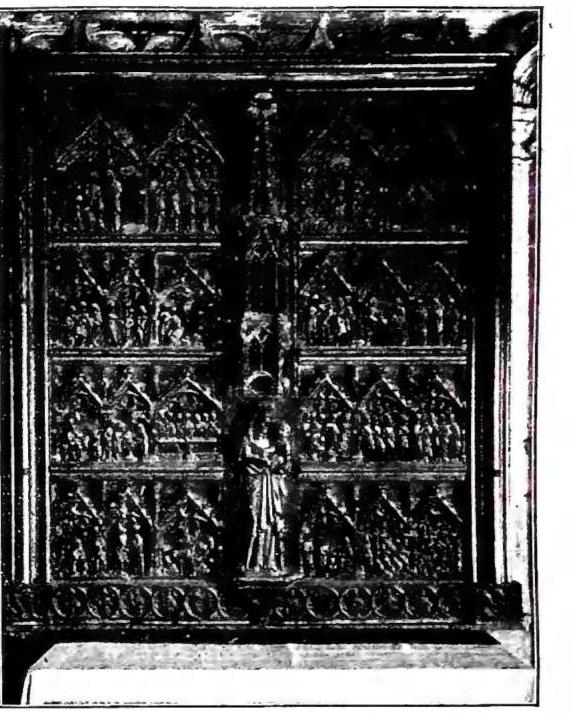
(fot. Max)