SIVIGLIA, ARCIDIOCESI DI

Image from page 476
Image from page 476

SEVILLE, ARCHDIOCESE OF. – Archdiocese and capital of the homonymous province in Andalusia (Spain). The archdiocese comprises, within its territory of 27,716 sq. km., the civil provinces of Seville and Huelva, as well as part of those of Cádiz, Córdoba, and Málaga. It has a population of 1,752,000 inhabitants, of whom 1,751,840 are Catholics, distributed across 320 parishes, served by 451 diocesan priests and 325 religious; it has two seminaries, 65 male religious communities and 216 female (*Ann. Pont.* 1953, pp. 403-404).

It is the ancient *Hispalis* in the Baetican province. In Seville, during the entire Visigothic period, St. Felix the Deacon was venerated, mentioned on May 2 in the Marble Calendar of Carmona from the 6th century and in that of Córdoba from 961, as well as the holy martyrs Justa and Rufina, who, provoked by pagans during the festival of the Adoniae (July 17-19), shattered the statue of the Phoenician goddess Salambbo in Seville and were martyred (F. Cumont, *Les Syriens en Espagne et les Adonites à Seville*, in *Syria*, 8 (1927), pp. 330-41). The *Passio* (BHL 459) places their martyrdom on July 19, as does the Hieronymian Martyrology, which, however, names only Justa; the Mozarabic calendars instead place it on July 17. Their relics are mentioned in inscriptions, one of which dates to 662 (J. Vives, *Inscripciones cristianas de la España romana y visigoda*, Barcelona 1942, nos. 333 and 306).

The first known bishop is Marcellus (3rd century), attested by the Emilian Catalogue (ms. R. II, 18 of the Escorial); present at the National Council of Iliberis in the year 300 was Sabinus (PL 84, 301); he later had himself represented at the Council of Arles in 314. In 441, Bishop Sabinus II was expelled from his see by a faction supported by King Rechila, and in his place a certain Epiphanius was elected (Hydatius, *Chron.*, ad ann. 441); Sabinus II was not able to return to his see until 461 (Hydatius, loc. cit., in *España Sagrada*, IV, Madrid 1756, p. 426); Sallustius is named in a document of November 30, 520 (Jaffé-Wattenbach, no. 786) as vicar of Pope Hormisdas; Zeno, said to have been Sallustius’ predecessor at the end of the 5th century and vicar of Pope Simplicius (ibid., no. 590), was not bishop of Seville but of Mérida in Lusitania (cf. J. Vives, *Inscripciones*, cit., no. 363, commentary, at the end). The see was metropolitan when, in 589, the prelate St. Leander celebrated the first provincial council and was designated in a public document as metropolitan of the Italic province (PL 84, 358), a title later given to all his successors beginning with his brother St. Isidore (d. 636), who celebrated the second provincial council in 610 and probably also a third, of which only one canon survives in the Pseudo-Isidorian collection (*Decretales Pseudoisidorianae*, ed. P. Hirschius, Leipzig 1863, p. 396). During the rule of these two saintly brothers, the see of Seville (569-636) was spiritually the true capital of Spain; to St. Leander is owed the conversion of the Visigothic people, solemnly proclaimed at the Third Council of Toledo in 589 (St. Isidore, *De viris ill.*, 57); St. Isidore (q.v.) completed his work, gave the Visigothic Church precious disciplinary laws at the Fourth Council of Toledo, organized canon law in the *Collectio Hispana*, infused great vitality into the episcopal schools, and produced a literary output that made him the teacher, not only of Spain but of all medieval Europe. The disciples formed in his school extended his influence to the most important Churches of the peninsula, such as Toledo and Zaragoza. Thanks to these two prelates of Seville, the Church of Spain remained united to Rome and received the papal directives untainted.

St. Isidore was also a teacher of monks, and his Rule long contended with that of St. Benedict for dominance in the peninsula’s monasteries, until in the 11th century the Rule of the abbot of Monte Cassino triumphed definitively following the Gregorian reform.

The successors of Leander and Isidore up to the Arab invasion (711) are known especially from the Emilian Catalogue and the subscriptions to the Councils of Toledo. Bishop Braccarius in the second half of the 7th century was not the author of the *De ecclesiasticis dogmatibus* as has been claimed (J. Madox, in *Razón y Fe*, 122 (1941), pp. 237-39; *Epistolario de Álvaro de Córdoba*, ed. Madox, Madrid 1947, p. 168, no. 15). Oppas, the last bishop of this period, betrayed the cause of King Don Rodrigo, contributing to the ruin of the Visigothic monarchy and the triumph of the invading Arabs. Seville was subdued by Mūsā b. Nuṣayr in 712, and, after a quickly suppressed Christian uprising, endured Arab domination for five centuries under a regime of tolerance, with all the difficulties that characterize the history of Mozarabic Christians, though preserving its ancient organization intact. Within the city, the metropolitan churches of St. Vincent and of Rubina (according to the testimony of Ibn al-Qūṭiyya: *Iftitāḥ*, 11) and that of the holy martyrs Justa and Rufina were preserved; these could be repaired but not enlarged, and worship had to be confined within, without any external manifestation. Probably in 825, the two brothers Adolphus and John, natives of Seville, were martyred in Córdoba (Usuard’s Martyrology under September 27), and in 856 their sister Aurea, a nun in the monastery of Cutechara after her brothers’ deaths (cf. St. Eulogius of Córdoba, *Memoriale Sanctorum*, III, 17), fell victim to the persecution of ʿAbd al-Raḥmān II and his son Muḥammad (853-59), which was a consequence of a militant proselytism led by St. Eulogius, who was himself martyred in 859. And since Christians voluntarily offered themselves for martyrdom, the Council of Córdoba in 852, presided over by Reccafredus, metropolitan of Seville, and provoked by ʿAbd al-Raḥmān himself, forbade such behavior (cf. St. Eulogius, op. cit., II, 16), though without great success: Álvaro of Córdoba places this bishop among the persecutors of Christians (cf. *Vita Eulogii*, no. 7). Another prelate of Seville, named John, apostatized at the end of the 11th century under torture and justified his conduct by declaring that what matters for a Christian is not the lips but the conscience; that against his will he had denied with his tongue, and since he was faithful to Christ in his heart, one should not look to what the lips manifested to men (cf. Hugh of St. Victor, *Ad archiep. Hispalensem.*, in *España Sagrada*, IX, 3rd ed., Madrid 1860, pp. 434-38). Of the other prelates of Seville from the Mozarabic period, it suffices to mention Nonnitus, successor of Oppas Teudula, at the beginning of the 9th century, who wrote against Adoptionism, and another John known from the epistolary of Álvaro of Córdoba (*Epp.*, III and VI; ed. cit.). The last known was Clement (c. 1144), who had to flee his see immediately upon election, with the arrival of the Almohads, fanatical persecutors of Christians, until 1248 when King Ferdinand III the Saint of Castile reconquered Seville, the most important city of Muslim Spain. The first archbishop of the new series was the infante Don Philip, son of the king.

Article illustration

One of the most notable figures of this period in the ecclesiastical history of Seville was Rodrigo de Santaella, a trusted man of the prelates of Seville from 1491 to 1509, recognized as the founder of both the current Seminary (1505) and the civil University (1508), both erected with bulls of Julius II. After the city was reconquered by King St. Ferdinand, the formation of the clergy was carried out in the Studium Generale, founded near the Cathedral by Alfonso the Wise; but this institution disappeared in the 15th century, and then the two prelates Diego Hurtado de Mendoza and his brother Diego de Deza devoted themselves entirely

The choir; the "Mayor" has the grand altarpiece, a work by the Fleming Dancart from 1482; behind the chapel is the "High Sacristy" with a venerated image of the Madonna. In the chapter hall (16th century) is the image of the Immaculate Conception, a work by Murillo. On either side of the choir are four chapels: in that of St Peter is the tomb of Archbishop Diego Deza and nine paintings by Zurbarán. The "Royal Chapel" is in Renaissance style (1551–75); on the altar is the Virgen de los Reyes, carried by King Ferdinand in all his campaigns; in front is the bronze and silver sarcophagus containing the body of St Ferdinand, transferred here in 1579. On the altar of the crypt below stands the small ivory statuette of the Virgen de las Batallas (14th century).

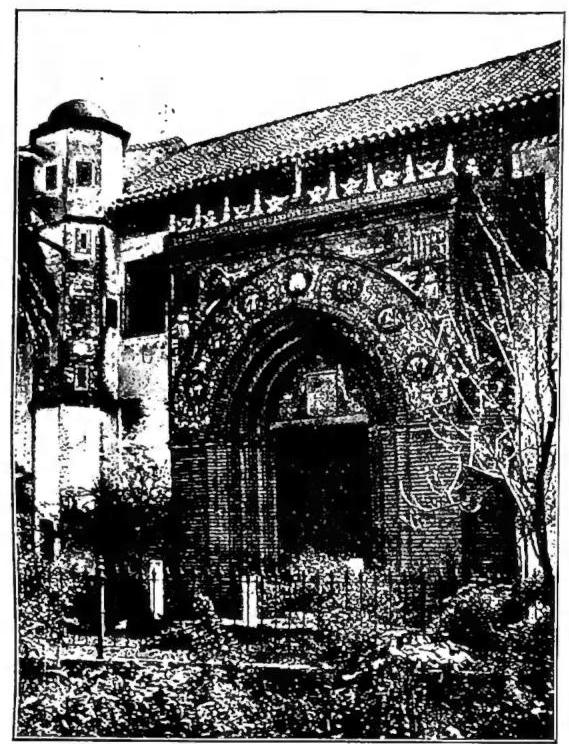
Other notable churches include: the church of El Salvador, built over an ancient mosque, with artistic altarpieces, a Christ by M. Montañés, an Ecce Homo attributed to Murillo, and the venerated image of the Virgen de las Aguas from the 13th century. The church of St Martin, with Gothic vaulting from the 14th–15th centuries, was restored in 1896 and 1926. The parish church of St Giles has an apse from the 13th century; the rest dates to the 14th but was rebuilt in the 17th; it was burned in 1936 and restored. The interior preserves remnants of a mosque, with 14th-century panels and mihrab in the apse; in a new chapel is the Virgen de la Macarena (Our Lady of Hope), the most popular in the city. On the night of Holy Thursday two pasos, escorted by praetorians, leave the parish of St Giles and return on the morning of Good Friday. The church of St Marina has a 14th-century sculpted portal and a bell tower with an Arab base; it was devastated in 1936 and is under restoration; its interior is a former mosque, and within it is the chapel of the Santo Cristo. The church of St Catherine, also built in the 14th century on an ancient mosque (of which the restored tower remains), received its 14th-century portal in 1929, transferred from the church of St Lucy. The 14th-century church of St Isidore, recently restored, has a three-aisled interior; in the sacristy is a chapel erected on the site where St Isidore died (AD 636). The convent of St Paul, founded in 1475, preserves a Gothic portal, and in its annexed church, with ribbed vaulting, are statues of St John the Baptist and St John the Evangelist by M. Montañés (1638) and Gothic tombs. The 14th-century church of St Roman also preserves sculptures by Montañés, as in the chapel annexed to the convent of St Agnes. The university church was built by the Jesuit Bartolomé Bustamante (1565–79). The church of Santa María la Blanca is a former synagogue of 1391, transformed with Visigothic capitals, as is that of St Bartholomew. The "Palacio Arzobispal" (17th century), with a Baroque façade, houses a collection of paintings including that of the Virgin presenting the chasuble to St Ildefonsus, by Velázquez. The asylum for Venerable Priests contains a chapel with frescoes by Valdés Leal on the dome and ancient stained glass depicting scenes from the lives of the saints.

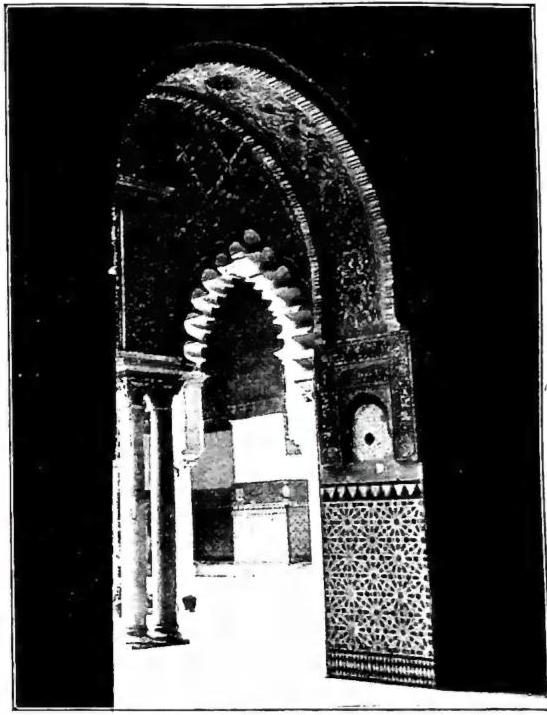
The "Alcázar" or "Alcazaba," built by the Arab conqueror Mūsā in 712, extended as far as the Torre del Oro and the banks of the Guadalquivir; it served both as a fortress and a royal residence. In the 11th century the kings of the Banū ʿĀbbād dynasty (1023–91) adorned the palace with columns and materials from the city and the palace of Medina-Az-Zahra. Sultan Abū Yaʿqūb Yūsuf (1171–76) built the Torre del Oro. After Ferdinand III captured Seville in 1248, he constructed the vaulted gallery of the Baños de María de Padilla; the palace was enlarged by King Peter I the Cruel in 1364–66. Later, in the 15th century, further works were carried out under the Catholic Monarchs Ferdinand and Isabella, and again in 1526 for the marriage of Charles V. In the hall called of Charles V are tapestries depicting the conquest of Tunis, commissioned by Charles V in 1551 from Pannemaker based on cartoons by Juan de Verea.

The Provincial Archaeological Museum was installed in 1945 in the former Fine Arts building of the Ibero-American Exposition of 1929; it comprises Roman, Paleo-Christian, Visigothic, Hispano-Arab, Moorish, medieval and Renaissance archaeological collections.

The Provincial Museum is instead housed in the former Mercedarian convent (17th century) and accommodates the Academy of Fine Arts, the painting and sculpture museum. The former church has been converted into the "Salón Murillo," where 54

Article illustration
(from K. Hielscher, *La Spagna smemorata*, Berlin 1922, pl. 11)

Seville, archdiocese of — Convent of St Paul, founded in 1475.
They supported the establishment of the Seminary; indeed the second archbishop founded in 1515 the celebrated ecclesiastical college of St Thomas; a third was established by Don Alonso Manrique.