
TIVOLI, DIOCESI di. — City and diocese in the province of Rome.
The diocese has an area of 620 sq. km., with a population of 70,000 inhabitants, all Catholics, in 45 parishes served by 68 diocesan priests and 20 religious priests; it has one seminary, 5 male and 34 female religious communities (Ann. Pont. 1953, p. 424).
Tibur, a very ancient city of Latium, rises on both banks of the Aniene, at the foot of Monte Ripoli. At first a settlement inhabited by people of Mediterranean stock (Siculi, Sicani, Aborigines), it was later, according to tradition, occupied by a colony of Greeks from Arcadia. Its principal cult was that of «Hercules Victor», venerated in a magnificent temple; Vesta too was especially worshipped there. It formed part of the Latin League and fought strenuously against Rome until, subjugated in 337 B.C., it became a Roman municipium, enrolled in the Camilia tribe. The Romans had many villas in the surrounding area; Augustus enjoyed staying there, and it was the preferred residence of Maecenas and Horace; the most splendid was that of the emperor Hadrian. P. Sulpicius Quirinius, governor of Syria at the time of the census in Palestine when Jesus Christ was born, although a native of Lanuvium, had his tomb near T., not far from Ponte Lucano. The Plautii Silvani, originally from T., possessed extensive estates there, as well as the well-known tomb near Ponte Lucano. In a third-century inscription listing the members of a funerary collegium of Tenuiores at Tibur (CIL, XIV, 3649), Christian names appear, such as Laurentius, Exuperantius, and others. Between the third and fourth centuries T. is said to have had a bishop named Quirinus; the first certain bishop is Paulus. A burial ground, perhaps Christian, with loculi and arcosolia, was discovered near the Acquoria bridge in 1928; not far away, a ring with a carnelian engraved with the well-known acrostic ΙΧΘΥΣ had previously come to light. Traces of Christianity have been thought to be recognizable in certain formae of the imperial necropolis on the right bank of the Aniene. The slow development of Christianity in T., hindered by the persistent cult of Hercules, which yielded considerable profit, became more pronounced in the fifth century. In the year 467 a Tiburtine, Simplicius, son of Castinus, was elected bishop of Rome. Under his impulse, the Tiburtine bishop Candidus (465–504) founded the church of St. Peter (today La Carità), built the churches of St. Euphemia and St. Eugenia, and the small basilica of St. Symphorosa (v.) at the site of the martyr’s burial, at the ninth milestone of the Via Tiburtina. In homage to Simplicius, the wealthy Goth Valila founded in 471, on one of his properties near T., the church of S. Maria in Cornuta, endowing it with the «massa Cornutensis»
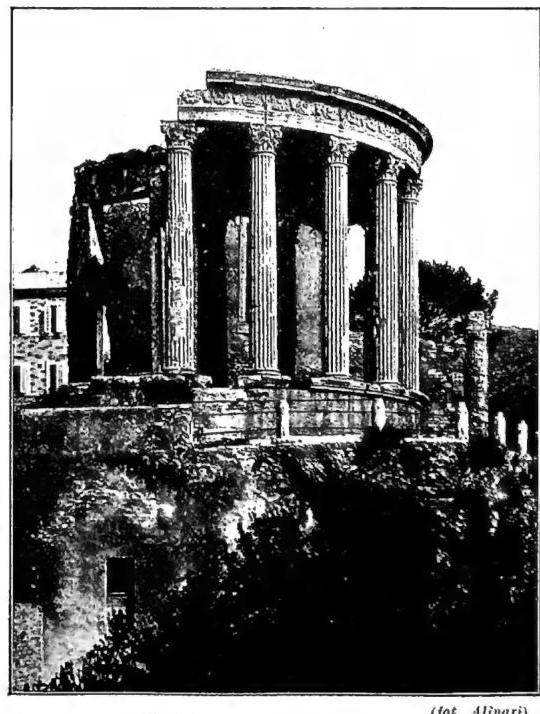
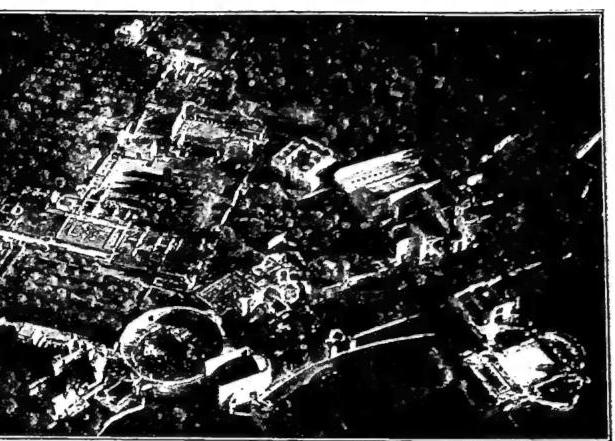
and rich sacred furnishings described in a notarial document known as the Carta Cornutiana. At that time, the territory of the Tiburtine diocese, corresponding to that of the ancient Roman municipium, included the upper Aniene Valley, together with the Sublacense region. During the Gothic War, in 544, since T. had sided with the Eastern Emperor, it was garrisoned by a contingent of Isaurians; because of a disagreement between the Greeks and the Tiburtines, Totila’s Goths were treacherously admitted; the destroyed fortifications were subsequently repaired by Totila himself. In the course of the sixth century the Basilica Laurentius must have been erected in the city’s old Forum, on the ruins of part of the complex of the temple of Hercules Victor, the first phase of today’s cathedral of S. Lorenzo. It had a baptistery supplied with water from the Aniene, and the episcopal residence; it was the center of Tiburtine life in the Middle Ages. Evidence of the persistent mingling of Christianity and paganism is provided by a funerary inscription from the year 613 (CIL, XIV, 3896) in the oratory of S. Alessandro, attached to the Cathedral, in which the widow Leta, invoking respect for her own tomb and that of her children, calls down the wrath of Pluto upon those who violate it and wishes them the same fate as Ananias and Sapphira. Honorius I (625–38) dedicated a church on the Via Valeria, near T., to the memory of St. Severinus, an ascetic monk and precursor of St. Benedict. Also in the seventh century, the remains of the temple of the goddess Bona, on Monte Affiano, were converted into a temple dedicated to the archangel St. Michael. A second Tiburtine pope was John IX (v.). In 945 there is the first mention of a Benedictine church and abbey dedicated to the martyr Vincent, venerated at the eighteenth milestone of the Via Tiburtina. In the locality of Collegrasso, in the territory of Montecelio, the remains of a small basilica and a trichora erected over a tomb situated in an imperial-era hypogeum were discovered. The primitive construction, made of tufa blocks and bricks, of the martyr’s memorial dates from the fifth or sixth century; a complete restoration was carried out in the tenth century by the Benedictines, with new pictorial decoration consisting of a series of images within medallions. Of the small basilica, whose aisles were divided by marble columns, the tiny presbytery, the small abbatial seat, and the remains of the schola cantorum are still visible; adjoining it was an open-air cemetery with inscriptions from the fourth or fifth century, and inscriptions from the earlier pagan burial ground were also found there. The complex, abandoned by the monks and partly destroyed through the removal of its materials, suffered its final damage in the fighting at Casal Battista between the Colonna and the Orsini in 1498. In the tenth century, several ruined pagan temples became Christian churches; in Castrovetere, the arx of Roman Tibur, in whose center the church of S. Paolo had already been erected, the two small temples—one known as the circular temple of Vesta, the other rectangular and identified as the temple of the Sibyl—became respectively the churches of S. Maria and S. Gior-
(phot. Gab. fot. nez.)
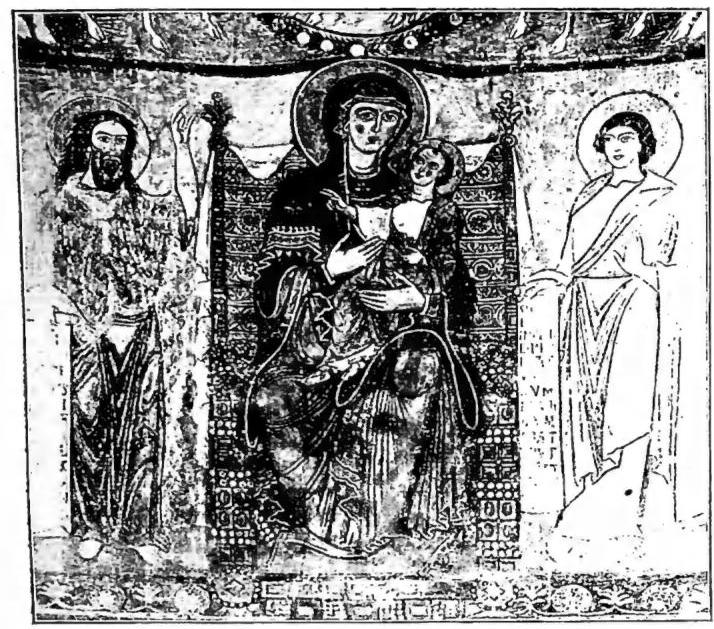
TIVOLI, DIOCESI di — Madonna and Child, whose halo bears the word BEX. At the sides are St. John the Evangelist and St. John the Baptist. Fresco of the Roman school of the twelfth century, in the apse of the church of S. Silvestro — Tivoli.
…gio. The temple of Diana, near the ancient Baths, was converted into the church of S. Andrea; a nymphaeum of a Roman villa, near Porta Scura, was dedicated to S. Maria della Torre. In the year 1001, Otto III, favoring the Romans in their continual disputes with T., besieged the city, which, having surrendered, was placed under the imperial standard. The determined Ghibelline predominance in T. over the Guelph element then began; the former was supported by the imperial Benedictines of Farfa, established near the church of S. Maria Maggiore, the latter by the Benedictines of Subiaco, more devoted to the Pontiff, whose monastery stood near the church of S. Clemente, among the ruins of the Roman amphitheatre. Toward the end of the 12th century or in the early years of the 13th, the celebrated triptych with the image of the Saviour, preserved in the Cathedral and an illustrious relic and palladium of the city, was executed, perhaps by a monk from Farfa. In 1085, Henry IV and the antipope Clement III, during the siege laid to Rome, stayed in T. until the arrival of the liberator of Gregory VII, Robert Guiscard. T., a strongly fortified key to Abruzzo, a safe port for Rome’s enemies and its rival, was hated by the Romans, who longed for its destruction; but, unlike Tusculum (destroyed in 1191), it was saved by the valour of its sons: in 1142 the besieging Romans were put to flight and then defeated again at Quintiliolo in the following year. The inspiration for the resistance came from an illustrious bishop of T., Cardinal Guidone (1125–54), who consecrated in 1138 the church of SS. Andrea and Saba, now demolished (inscription in the Villa Gregoriana), and the church of S. Valerio. In 1146, Eugenius III, fleeing from Rome, which had rebelled with Arnaldo da Brescia, transferred his court to T.; returning from France, he came back there in 1153 and died there. In 1155 T. witnessed Pope Adrian IV and Frederick Barbarossa, encamped at Ponte Lucano because of a new uprising by the Romans, solemnly celebrate in the open air the feast of St. Peter. On that occasion the Tiburtines offered the keys of the city to the powerful sovereign, but the Emperor wished T. to remain faithful to the Pontiff, subject to the imperial rights. The bell tower of the Cathedral, the rebuilding of the churches of S. Pietro (la Carità) and S. Giovanni Evangelista (formerly S. Cristoforo), and the compilation of the illuminated codex containing the register of the Tiburtine Church all date from the 12th century. Between the end of the 12th century and the early years of the 13th, the wooden group of the Deposition, preserved in S. Lorenzo, and the frescoes in the church of S. Silvestro depicting episodes from the Saint’s life were executed; the influence of northern art is evident in the latter. In 1216–1217, under Bishop Giovanni Antonio Colonna, St. Dominic founded in T. one of the first hospices of his Order; in 1252 Alexander IV granted the Minors the church of S. Maria Maggiore, formerly belonging to the Benedictines, also dedicating it to St. Francis; it was then renovated in the Romanesque-Gothic style. Part of the adjoining convent was adapted as the seat of the city government. In 1224 Cardinal Ugolino, Bishop of Ostia, later Gregory IX, consecrated the underground chapel of the Duomo, where the image of the Saviour remained preserved for a long time. The Romans again besieged T. in 1253, until, through the intervention of Innocent IV, a treaty was signed in 1259 by which T., while retaining its autonomy, undertook to pay the Romans an annual tribute of 1,000 lire and to accept a count sent from Rome to administer justice; the Commune was governed by a military commander, while the bishops also exercised political power. In 1285 Honorius IV granted the church of S. Biagio to the Dominicans. At the end of the 13th century, the Franciscan Iacopo Torriti painted the icon of the Madonna preserved in S. Francesco. The first mention of the evocative ceremony of the Inchinata dates from 1305 (v. sotto). In the same period a local artist executed the greatly venerated image of the Virgin in the church of Quintiliolo. During the popes’ residence in Avignon, Cola di Rienzo, marching against the Colonna of Palestrina, harangued the Tiburtines from the top of the Palloni loggia, near the Duomo, urging them to follow him in the enterprise. Between 1370 and 1381 T. was ravaged by hostilities against Count Corrado of Anticoli, who refused to pay them tribute; these ended with the victory of the Tiburtines. During the disastrous Western Schism, in 1378, Urban VI, gravely ill, found refuge in T.; shortly afterwards the supporters of the antipope Clement VII, encamped at Ponte Lucano, were put to flight by the Tiburtines, united with the Bretons of the condottiero Giovanni Acuto. In the 15th century T. took an active part in the age-old dispute between the Orsini and the Colonna and, because of its position, in the struggle between the Angevins and the Aragonese for possession of the Kingdom of Naples. In 1461 Pius II stayed with his court in the convent of the Minors at S. Francesco; there he dictated the pages of his Commentari, in which he describes T., its environs, and Hadrian’s Villa, and he also decided upon the construction of the Rocca Pia, entrusting its execution to the pupils of Filarete, Varrone and Niccolò fiorentini. Sixtus IV stayed for some time in that fortress and there promulgated the constitution Quemadmodum operosa of 29 August 1475, confirming the celebration of the Jubilee every 25 years, as had already been decreed by Paul II. The bishop of T. was Angelo Lupi (1471–85), whose tomb is in the Cathedral; he saw to the establishment of the hospital confraternity near the church of S. Giovanni Ev. In 1522 Adrian VI, during new disputes between the Tiburtines and the Romans, declared T. to belong to the Holy See and made it the seat of a governorship. During his stay in the Rocca Pia, in 1539 Paul III approved the Rule of the nascent Society of Jesus, presented to him by St. Ignatius of Loyola. One of the first colleges founded by the Jesuits was that of T., near the church of S. Salvatore, already existing not far from the present Palazzo del Comune (1549). At the Conclave of Julius III (1549), Cardinal Ippolito d’Este jun. was appointed Governor of T.; owing to his aristocratic lavishness and refined artistic taste, the old Government Palace near the church of S. Francesco and the adjoining Valle Gaudiosa were transformed by Pirro Ligorio into the magnificent Villa d’Este. In the full…
During the war between Paolo IV and Filippo II, the duke of Alba occupied T. in 1556 and spent the winter there with his troops, fortifying it; after the conclusion of peace, in the following year, Paolo IV spent the month of October there. In 1571, Msgr. Bandini Piccolomini, archbishop of Siena, founded in T. the Accademia degli Agevoli, dissolved at the end of the 17th century. Through the munificence of Cardinal Matteo Contarelli, a church was erected in 1587 in honor of St. Sinforosa; later called del Gesù, it was officiated by the Jesuits and was almost entirely destroyed by air raids during the Second World War. In 1638 Urban VIII reduced the territory of the diocese by uniting various castles of the upper Aniene Subiaco (v.) created abazia nullum. From 1657 to 1662 the bishop of T. was Cardinal Giulio Roma, a Milanese; among his other benefactions were the complete reconstruction of the cathedral of S. Lorenzo and the erection of the Seminary. T. acquired a second academy in 1716 with the foundation of the Colonia arcadica sibillina, affiliated with the Arcadia of Rome, whose first custodian was Canon Giovanni Carlo Crocchiante, historian of the churches of Tivoli; it ceased its activity in 1850. In 1771 S. Clemente M. Hofbauer spent six months as a hermit at Quintiliolo, near T., before entering the Congregation of the Redemptorists. In 1826 an extraordinary flood of the Aniene caused serious damage to the settlement of T., with many victims; Gregory XVI entrusted the architect Clemente Folchi with diverting the river, whose overflowing waters, channelled into two tunnels excavated in the depths of Monte Catillo, plunge down the opposite slope, forming the great waterfall. The admirable works, inaugurated on 7 October 1835, were completed with the construction of the Gregorian Bridge and the creation of the evocative Villa Gregoriana.
INCLINATA OF T. – This is the name given to the feast celebrated in T. for the Assumption. It no longer holds the importance it once did. After heralds on horseback and the pages of the districts had proclaimed the festival, on the evening of 14 August a grand procession was organized; it was led by seven servants of the Confraternity of the Savior, carrying large candelabras, followed by the guilds of the various arts, each with its own "talamo" (a small triumphal machine adorned with flowers and bearing the statue of the patron saint), the confraternities, and the magistracy carrying the icon of Christ, the trumpeters, the patricians, the militias, and the people.
The procession, by torchlight, reached the bridge of Cornuta (now replaced by the Ponte Gregoriano), and after invoking peace from the Lord, the image of the blessing Christ was turned toward the waters; they prayed that He might protect the city from the river's fury, and a lit candle was thrown into the whirlpools. On the return, the procession stopped at the hospital, where a bouquet of flowers was offered to the prior. The hospital chaplain incensed the image of the Savior, repeated the invocation for peace, and, having dipped a bundle of aromatic herbs into rose water, washed its feet three times. The procession then proceeded to Piazza di S. Maria Maggiore, where the "Inchinata" took place. The Virgin moved to meet her Son; three times the two simulacra bowed
beneath verdant triumphal arches, then, followed by the talami of the arts, they entered the church, where they remained all night, one facing the other: the people believed they exchanged soft words of filial and maternal love. The next day, 15 August, the image of the Savior was returned to the Cathedral. – See plate XVII.